

A working paper on tax planning and DeFi credit risk argues that borrowers who pledge appreciated crypto and borrow dollar-pegged stablecoins may be pushing part of that risk onto lending pools shared by other users.

The paper was written by Lisa De Simone of the University of Texas at Austin, Peiyi Jin of the National University of Singapore, and Daniel Rabetti of the National University of Singapore. It focuses on Venus, a DeFi lending protocol on BNB Smart Chain.
Borrowing can defer a taxable sale
The paper opens with a simple example. If an investor bought Ether for $1,000 and the position later rose to $4,000, taking out $1,000 by selling one-quarter of the holdings would generate cash, but it would also realize a $750 capital gain under U.S. tax rules for investment digital assets.
DeFi offers another route. The holder can deposit all of the Ether into a lending protocol as collateral and borrow $1,000 worth of a dollar-pegged stablecoin. The loan itself is not taxable income, and the Ether can still capture any future upside. The borrower gets spendable funds without selling the original asset.
That structure can lower or defer taxes, but it also creates fragility. In the example, the initial collateral ratio is 25% because the collateral is worth $4,000 against $1,000 of debt. If Ether falls to $2,000, the loan-to-value ratio doubles to 50%, and the ratio can climb further as interest accrues.
Once the ratio breaches a protocol limit, the code can trigger liquidation. External traders may repay part of the debt and take some Ether at a discount. The borrower has delayed a taxable sale, but the lending pool is left exposed to collateral volatility, debt growth, and the borrower’s willingness to manage the position before liquidation.
The paper’s broader point is that a personal tax choice can become part of a shared credit market funded by other users, even though lenders mostly see only wallet addresses.
Dataset spans 13 million transactions on Venus
The sample runs from Nov. 12, 2020 to July 31, 2022 and covers 15 major tokens on Venus. The researchers examined about 13 million transactions and built 1.36 million borrower-day observations, meaning one record per active wallet per day.
Roughly 3% of traders met the study’s definition of default.
That definition is not the same as a missed mortgage payment. In this paper, default means a loan’s loan-to-value ratio stayed above Venus’s 60% threshold for at least seven days while the borrower neither added deposits nor took new loans. On that basis, cumulative default debt exposure totaled $133.34 million.
The authors note that a single troubled loan can appear in the data across multiple observation dates, so that figure represents cumulative daily risk exposure rather than principal actually lost in a one-time event.
“Buy, borrow, die” moves from private banking to public wallets
The paper places the strategy in a familiar wealth-management frame: buy, let the asset appreciate, borrow against it for spending needs, and avoid selling. In its traditional form, this is often described as “buy, borrow, die.”
Repeated borrowing can defer capital gains tax for years. Under U.S. estate rules cited in the article, heirs may receive a reset in tax basis when they inherit assets, wiping out much of the accumulated tax burden from the original holder’s gains.
Historically, this was largely a tool for wealthy clients. Private banks could review a client’s broader financial condition, set tailored lending limits, negotiate terms, and work through risk before collateral had to be sold.
DeFi turns that process into code. The software does not evaluate a user’s full financial profile. It reads the wallet’s assets and applies the same collateral rules to everyone.
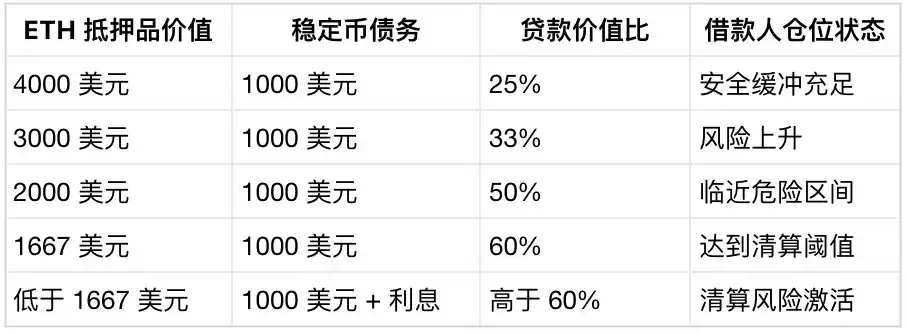
The barrier to entry is much lower, but the system rests on overcollateralization. Under the Venus parameters described in the paper, eligible collateral worth $10,000 can support up to $6,000 of debt. A borrower who takes the full amount has very little room for a price decline; a borrower who draws only $2,000 has a much larger cushion. Both accounts are monitored continuously against oracle-fed market prices.
If collateral falls through the threshold, liquidators can repay part of the debt, seize collateral at a discount, repair the account, and collect a reward. The mechanism is designed to protect the pool before collateral value drops below debt. But fast selloffs, weak market liquidity, and blockchain congestion can all reduce liquidation effectiveness.
Tax motivation adds another layer. To cut risk, a borrower may need to trade, repay debt, or sell part of an appreciated position. Borrowers who are using loans to postpone a taxable sale may be more likely to delay those moves. The paper says that tendency can be stronger when unrealized gains are larger or when a position is close to qualifying for the lower long-term U.S. capital gains tax treatment.
Stablecoins make the trade more attractive. Dollar-pegged tokens turn a volatile collateral asset into usable dollar purchasing power. Traders can keep assets such as ETH posted as collateral and borrow USDT or USDC for other uses.
The paper says large holders are using crypto collateral to borrow stablecoins, keeping liquidity while preserving exposure to the underlying asset. At origination, the protocol sees a normal collateral ratio. It cannot see whether the borrower entered ETH at a very low cost basis, would realize a large gain by selling, or could obtain a meaningful tax benefit by holding a few months longer. Those details can shape what the borrower does when the loan turns dangerous.
IRS reporting expectations created a natural experiment
To separate tax-driven behavior from broader crypto market moves, the researchers use the Infrastructure Investment and Jobs Act, effective Nov. 15, 2021, as an external shock.
Section 80603 expanded information-reporting obligations for digital asset brokers. Traders therefore began to expect that more of their on-chain activity could eventually be reported to the Internal Revenue Service, or IRS.
The paper’s identification strategy relies on that shift in expectations rather than on the later operational rollout of tax forms. Custodial brokers began reporting gross proceeds from certain sales and exchanges on Form 1099-DA starting Jan. 1, 2025, and later IRS rules require cost-basis reporting for some transactions from Jan. 1, 2026. The paper notes that these rules apply to institutions that actually custody user assets, while non-custodial DeFi services are not currently covered.
What matters for the study is the market reaction when the law passed in November 2021, well before the reporting system took full effect. The authors compare data before and after the law to capture how users responded to the expectation that future trades might become visible to regulators.
Blockchains do not reveal nationality or tax residency, so the researchers infer which wallets are likely tied to U.S. users using behavioral characteristics: trading concentrated during U.S. working hours, unusual behavior on U.S.-specific holidays, and holdings of U.S.-regulated dollar stablecoins.
The paper says each proxy can misclassify wallets, so the authors report multiple measurement approaches and also apply stricter screens that combine several conditions.
The logic is straightforward. The same financial system experienced a policy shock. Both groups faced the same token prices and the same Venus rules, but the wallets inferred to be U.S.-linked were more likely to care about the reporting change. That allows the study to isolate tax-related behavior from market noise.
Estimated trading probability fell 24.5% for inferred U.S. borrowers
In the paper’s main model, borrowers inferred to be linked to the U.S. became 24.5% less likely to trade assets after the law than international users. Borrowers carrying stablecoin debt showed an additional 23% decline in trading activity.
That fits the paper’s mechanism. Stablecoin borrowing gives users cash while the appreciated collateral remains posted inside the protocol.
The paper uses “liquidity” in a narrow wallet-level sense: the daily probability that a borrower makes any asset trade. It is not referring to exchange depth, bid-ask spreads, or the market impact cost of large orders. The measure is about portfolio trading activity and whether appreciated assets become effectively locked in place.

The study says these patterns are stronger when unrealized gains are larger and loan-to-value ratios are higher. It also reports seasonal behavior: trading activity falls in December, especially in the final week, when investors are more inclined to defer gains into the next tax year, then rises once holdings pass the one-year mark needed for lower U.S. long-term capital gains tax treatment. The authors read those patterns as support for a tax-based explanation rather than a random effect around the law’s passage.
The researchers estimate that U.S. borrowers in the sample deferred an average of $3,357.42 in capital gains tax per year, equal to about 17% of portfolio size over the same period. The estimate assumes the wallets belong to U.S. taxpayers, reconstructs holdings from on-chain data, and applies the relevant tax rates. The paper presents it as an order-of-magnitude measure for the sample, not a precise universal figure.
Lower trading activity is tied to weaker loan performance
The final part of the paper studies how weaker trading activity affects loan quality. Borrowers who trade less may keep risky positions open for longer, miss opportunities to repay, and fail to add collateral before thresholds are breached. A tax preference formed outside Venus can end up as unpaid debt inside Venus.
The authors acknowledge a reverse-causality problem: default itself could cause users to abandon a wallet and stop trading. To address that, they use an instrumental-variable approach and isolate the decline in trading activity linked to the policy shock rather than to the protocol’s own internal distress.
The model estimates show that each 1% increase in tax-driven illiquidity is associated with an 11.2% increase in the number of defaulting accounts and a 39.6% increase in defaulted loan balances. A one-standard-deviation increase in illiquidity corresponds to roughly $350 more default debt for an individual borrower, or 2.7 times the model baseline.
The paper cautions that these percentages apply only to the subset of tax-sensitive borrowers affected by this policy event. They are not a universal multiplier for all DeFi loans.
Code can read prices, not borrower motives
The paper says this exposes a blind spot in automated lending. Smart contracts can read collateral prices, debt balances, accrued interest, and liquidation thresholds. They do not observe a borrower’s cost basis or tax motive.
Two wallets may post the same ETH collateral and borrow under identical terms, making them look equally risky inside Venus. In practice, one borrower may be willing to sell and reduce risk, while another may do almost anything to avoid selling. That creates a borrower-selection problem.
Overcollateralization can absorb ordinary price moves. It does not fully solve for borrowers who are especially unwilling to dispose of appreciated assets, keep debt outstanding as their cushion shrinks, and reduce trading at the same time. The risk becomes concentrated in a group whose motives the protocol cannot see.
If liquidation works as intended, outside participants repay debt and dispose of collateral, and lenders may avoid losses. If liquidation fails, losses can be absorbed through the protocol’s own loss-allocation process by reserves, token holders, and liquidity providers. In that sense, a personal tax preference can become a shared financial consequence for the whole pool.
The authors also set out clear limits
The paper does not present tax as the only source of risk. The study covers one protocol during the 2020-2022 bull-bear cycle. U.S. identity is inferred from behavior. Default is defined using a specific long-duration high-LTV threshold rather than a broader measure.
The study also confirms that large collateral price swings and flaws in liquidation design can contribute to loan problems on Venus. Results could differ on protocols with deeper liquidity or different collateral parameters, and markets with more sophisticated liquidation bots could behave differently from Venus during the sample period.
Even so, the paper offers a view that is hard to obtain in traditional lending datasets: a wallet-level record of collateral, debt, user activity, liquidation, and account abandonment through the full life cycle of a loan.
Its closing point is that DeFi has moved a strategy once associated with private banking onto public blockchains and opened it to ordinary users. Replacing human underwriters with code does not erase human motives. Tax considerations, attachment to appreciated assets, and reluctance to sell can still pass through the protocol and shape who ultimately bears the lending risk.