


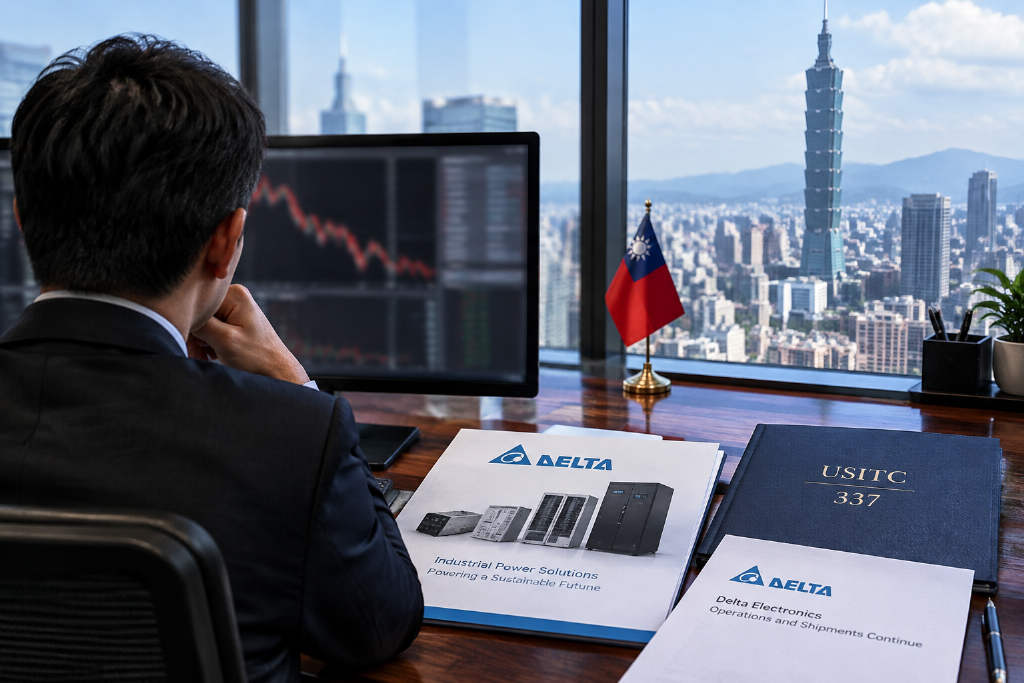
Delta Electronics reported higher revenue for September and for the first nine months of 2026, while its shares fell after the U.S. International Trade Commission, or USITC, opened a Section 337 patent investigation. The company later said the probe had not materially affected operations, and the stock trimmed part of its intraday decline.
September revenue and nine-month sales both rose
Delta said September consolidated revenue came in at NT$65.4 billion, up 14.6% from NT$57.061 billion a year earlier. The figure was also 1.3% higher than NT$64.586 billion in August.
For January through September 2026, consolidated revenue reached NT$539.668 billion, compared with NT$393.272 billion in the same period last year, marking growth of 37.2%.
The report said the numbers reflected continued demand from global cloud service providers for high-end AI server power supplies and thermal modules. Shipment momentum in power products tied to advanced AI servers remained the main support for the company’s operating growth.
USITC probe focuses on vertical power delivery technology
The USITC recently launched a Section 337 investigation at the request of U.S. company Vicor, covering specific Vertical Power Delivery, or VPD, systems and related components. The report said the patented technology is mainly used to address high-density power consumption and heat dissipation issues in high-compute chips.
If the investigation ultimately finds infringement, one potential outcome would be a Limited Exclusion Order, or LEO, that could restrict certain products from entering the U.S. market. That possibility has drawn attention to Delta’s overseas shipment compliance and to the legal process that may follow.
Company statement helped narrow the share decline
Delta shares opened at NT$1,940 and at one point fell to NT$1,855 during the session after news of the patent dispute. The company then issued a material disclosure through Taiwan’s public information platform, saying current production and shipment scheduling had not been affected by the investigation and that it would respond through legal procedures to protect its rights.
After that statement, part of the market uncertainty eased and buying emerged at lower levels. The stock closed at NT$1,900, down NT$65, with the loss narrowing to 3.31%.