
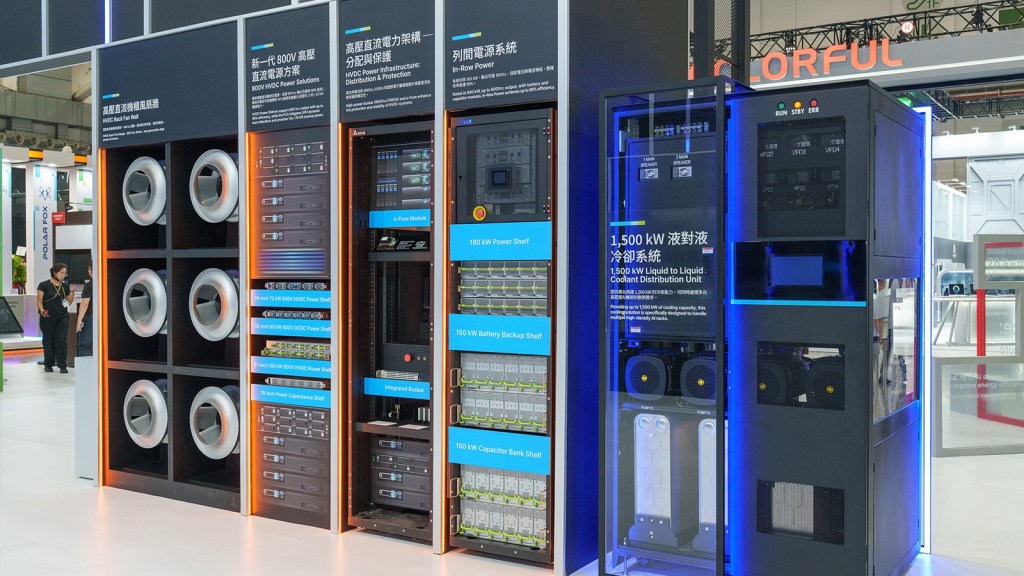
Nvidia’s 800V high-voltage direct current power architecture has come under renewed scrutiny after market research firm SemiAnalysis warned that broad deployment could move from an earlier 2027 expectation to 2028 or later, raising questions about the AI data-center power supply chain.
Supply-chain sources, however, said the issue is tied to validation rather than a technical bottleneck. Delta Electronics is expected to start low-volume production near the end of the first quarter of 2027, then gradually increase shipments from the second quarter of 2027.
Delay linked to validation and added testing
Digitimes, citing supply-chain sources, reported that early system verification uncovered a potential short-circuit risk. That finding led U.S. customers to ask for additional testing. The resulting redesign and certification process forced Delta Electronics (2308), Simplo Technology (6121), and upstream material suppliers to adjust shipment schedules in parallel.
The same sources said key components including power cabinets, backup battery units, or BBU, and battery packs have already been resubmitted for validation, and that progress has been smooth. In that account, the current delay reflects a phased shipment adjustment rather than weaker demand or a technical setback.
800V HVDC and 50V serve different functions
Another market concern centers on Nvidia’s Rubin platform, which still uses a 50V power architecture. Some have questioned whether 800V HVDC remains necessary. Supply-chain sources said that interpretation confuses two different layers of the power system.
They said 50V is used for power distribution inside the rack, while 800V HVDC is designed to transmit high-voltage power from the data-center level to the rack. As rack-level power consumption for Rubin Ultra and later platforms is expected to rise to 600 kW to 1 MW, traditional AC systems and lower-voltage architectures would face limits tied to excessive current, transmission loss and heat dissipation. On that basis, the need for 800V HVDC remains intact.
±400V and 800V expected to coexist during transition
During the initial rollout, ±400V HVDC and 800V HVDC are expected to coexist. The report said the ±400V setup is viewed as a transitional option, bridging the gap before the 800V ecosystem is fully mature. As later platforms advance and product validation is completed, 800V penetration is expected to expand.
Supply-chain sources said the long-term technology direction has not changed and that the current schedule adjustment reflects the actual pace of validation work, not a retreat from the technology itself.
Delta shipment ramp seen in Q2 2027
On production timing, Delta is expected to enter low-volume production near the end of the first quarter of 2027. From the second quarter, shipments are set to scale gradually in line with customer deployment schedules.
The original ABMedia report said that in 2027, continued capital spending by large cloud service providers and broader upgrades to AI data-center power infrastructure are expected to support a new round of growth for Taiwanese power-supply makers and related component suppliers.