

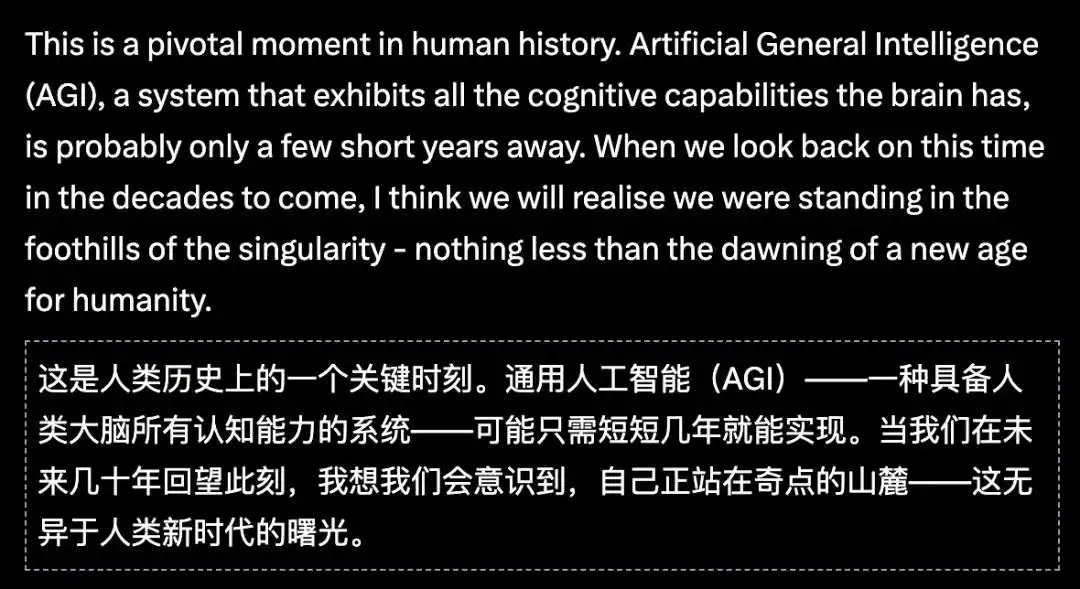
Demis Hassabis, the Nobel laureate and DeepMind chief, says artificial general intelligence, or AGI, may be only a few years away and describes the current moment as a turning point in human history.
In his essay, A Framework for Frontier AI and the Dawning of a New Age, Hassabis argues that AGI, if built and deployed responsibly, could become one of the most beneficial and transformative technologies humanity has ever created. He writes that its impact could be on the order of 10 times the Industrial Revolution and could unfold 10 times faster.
Hassabis says such systems could help accelerate drug discovery, support the development of new clean energy sources and open the door to advanced materials. He also raises the possibility that society could eventually reach a stage where resources are no longer the main constraint on human progress.
Hassabis frames AGI as the dawn of a new era
Hassabis writes that this is a critical point in human history. Looking back decades from now, he says, people may conclude they were standing at the foot of the singularity and witnessing the dawn of a new age.
He says he has spent his life working toward AGI because he has long believed that, handled responsibly, it would rank above ordinary technological breakthroughs in both benefit and reach. In the essay, he places AGI in a category beyond the internet or mobile internet, comparing it instead to moments like the discovery of electricity or the mastery of fire.
He also uses a striking line to describe the technology: humanity has effectively found a way to make sand think.
Real-world gains are emerging, but so are frontier risks
According to Hassabis, AI is already producing tangible real-world benefits. Still, he says the field must move carefully through this phase if it wants to realize the technology’s full promise.
He points to cybersecurity challenges that frontier models are already creating. As capabilities continue to improve, he says, other threats could come into view quickly, including nuclear and biological risks. Farther out, he says stronger safeguards will be needed to maintain control over increasingly agentic systems that may be capable of recursive self-improvement, while also dealing with unknown issues that may only become clear over time.
Hassabis says he remains confident that human ingenuity can solve hard problems and that technical AI risks can be addressed collectively. But he adds that this will require enough time and room to get the next stage right, something he says neither the field nor society at large has managed to secure so far.
Competition is speeding progress and compressing the safety window
Hassabis says the world is now caught in an intense and layered commercial and geopolitical race. That competition has helped drive rapid advances and faster delivery of potential benefits, but he argues that frontier AI is progressing faster than humanity’s understanding of the technology itself.
He says no one can say with certainty what comes next, and even experts disagree sharply. In a setting where uncertainty is high and the stakes are enormous, he argues for what he calls cautious optimism. That approach, in his view, calls for public policy that supports innovation while also rewarding responsibility and safety, encourages international cooperation on key safety questions and pushes stakeholders to think more carefully about how AI should be deployed for the public good.
A proposed Standards Body for frontier AI
The center of Hassabis’ policy proposal is a new Standards Body that would test frontier AI models and evaluate their risks in a dynamic, flexible and rigorous way. He says the United States is well positioned to take the first step and establish such a framework.
He suggests a model similar to a federally supervised public-private partnership or an industry self-regulatory organization, explicitly drawing a comparison to the Financial Industry Regulatory Authority, or FINRA. Its board, he says, should include leading independent technical experts as well as representatives from the open-source community.
He adds that the organization would need meaningful funding, likely coming largely from industry, so it could attract world-class technical talent and secure the compute required for testing at scale.
Frontier classification, a 30-day review window and post-release cooperation
Under Hassabis’ proposal, the Standards Body would set benchmark tests and define thresholds. Models that meet those thresholds would be classified as frontier-class, and the organizations developing them would be treated as Frontier Labs. Those benchmarks, he says, would need regular updates to keep pace with advances in model capability.
Organizations recognized as Frontier Labs would be encouraged to follow a set of best practices. Hassabis lists examples including publishing model cards with technical detail, maintaining strong internal cybersecurity, conducting background checks for people in critical roles and committing sufficient resources to safety and security research.
At the beginning, he says Frontier Labs would voluntarily submit models to the Standards Body for review up to 30 days before release. Once the evaluation process has shown itself to be effective and robust, he says the arrangement could be formalized quickly.
At that point, frontier models would need to pass evaluation before they could be deployed in the U.S. market. Labs would also be expected to work with the Standards Body after release to address any major vulnerabilities that emerge.
Testing should cover cybersecurity, bio risk and agentic behavior
Hassabis says model evaluation should include rigorous scientific testing for capabilities in cybersecurity, biological threats and other high-risk domains.
For agentic AI in particular, he argues for dedicated tests that can identify whether a model is trying to bypass guardrails, whether it is showing early signs of deception and whether key best practices are actually in place.
He gives examples such as adding digital watermarks to AI-generated images and producing human-readable output tokens that could help people understand the model’s reasoning process.
Those evaluations, he says, should be updated on a regular basis, perhaps quarterly at the outset. Benchmarks that become outdated or saturated, meaning models have effectively maxed them out, should be retired and replaced.
Held-out tests, third-party audits and tighter controls if needed
Hassabis says the early versions of these evaluations could be developed in consultation with Frontier Labs. Over time, though, the Standards Body should build its own technical capability and create held-out tests independently so models do not simply overfit to known benchmarks.
He also says the organization could work with government to foster an ecosystem of third-party audit bodies that would help conduct assessments and contribute to the development of new benchmarks and testing methods.
In his view, the appeal of the framework is that it stays grounded in technical reality while still supporting innovation and rewarding responsible conduct. He says it is meant to keep up with the field’s pace and adapt as the most serious risks become clearer.
Hassabis also leaves room for much stronger intervention. If conditions demand it, he says, the framework could tighten step by step and, in extreme circumstances, coordinate a shared slowdown in development across frontier labs.
Applies to frontier-class models, with exemptions for non-frontier systems
Hassabis says recognition as a Frontier Lab would carry significant prestige, and the system should be open to any organization whose model meets the benchmark standard.
He argues that the framework should apply to all frontier-class models, whether they come from domestic or foreign groups and whether they are open-source or closed-source. Non-frontier models, including those from startups or academia, would be exempt from the process.
Because the technology will affect the whole planet, he says the ideal outcome would be a framework that helps the international community reach agreement on how to control the most serious risks while making sure everyone can access and benefit from AI’s opportunities.
Technical answers will not settle the economic and philosophical questions
Hassabis says AGI has the potential to become the ultimate tool for scientific and medical progress while driving major gains in productivity and economic growth.
Even so, he says those outcomes depend on getting the technical foundations right first through a globally shared framework, strict scientific methods and cooperation among top minds.
And even if the technical problems are solved, he writes, harder economic and philosophical questions will remain. He asks what kind of new economic model could support shared prosperity in a post-scarcity world, what values people would want to live by, where meaning and purpose would come from and how the human condition itself might change.
Those questions, he says, cannot and should not be left to technologists alone. Society as a whole will need to take part in defining that next chapter.
Hassabis closes by saying that AI inspires both excitement and uncertainty, and both responses are justified. The future, he writes, is not yet written. Humanity should use the remaining window before AGI arrives to shape the technology into a force that benefits everyone. The essay was cited alongside a reference link to Hassabis’ post on X, and the MarsBit piece says the article came from the WeChat public account New Intelligence, authored by David and Solomon.