
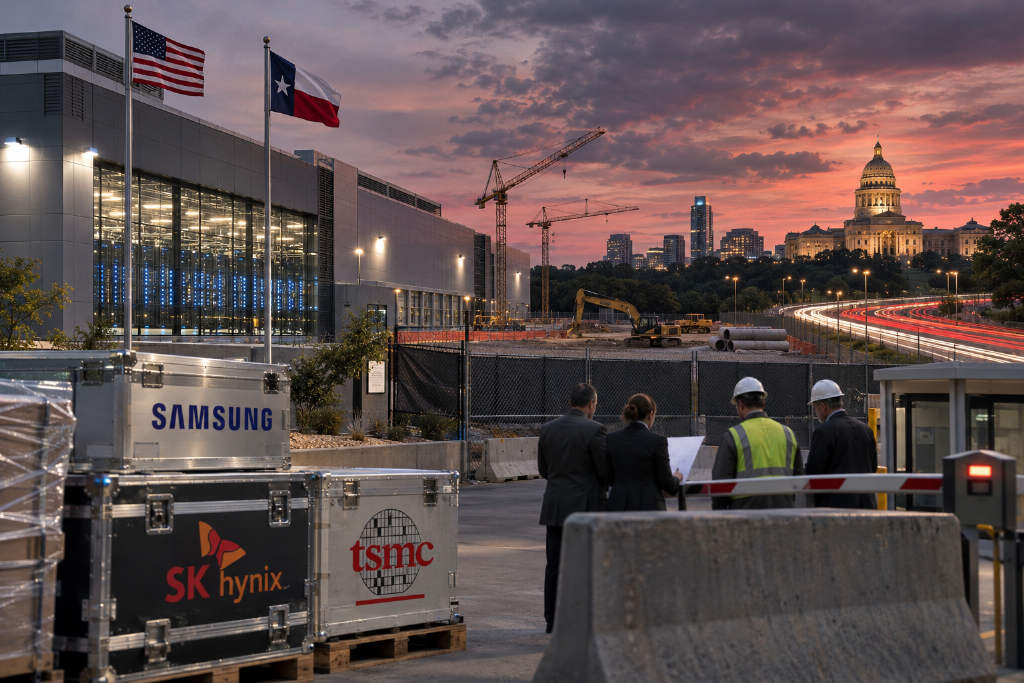
U.S. midterm election results have added a fresh policy risk to the AI infrastructure buildout. Democrats won the House and Senate and also captured governor’s offices in key states including Texas, Ohio, and Georgia. Several of those winning candidates had made a halt to data center development a central campaign pledge, shifting the issue from campaign rhetoric toward a policy threat that developers may now have to price in.
Bloomberg said the result could leave roughly half of planned new AI data center capacity in the U.S. facing tougher local review and resistance. In the market’s view, that has become one of the biggest wild cards hanging over the AI infrastructure boom.
Texas becomes the focal point after the governor’s race
Bloomberg reported that Democrat Gina Hinojosa won the Texas governor’s race on Tuesday, making her the state’s first Democratic governor in more than 30 years. During the campaign, she repeatedly called for an immediate halt to data center development and argued that developers were driving up electricity prices and consuming water resources.
Developers were already operating in an uncertain environment. Republican Governor Greg Abbott had previously paused some data center approvals. Hinojosa described Abbott’s position as 「election-year theater」 and pledged to keep approvals frozen until lawmakers pass legislation that puts Texans first. For developers planning large AI campuses in Texas, that is being treated as the worst-case scenario.
SemiAnalysis said before the election that Texas accounts for nearly 30% of new U.S. data center capacity expected to come online by 2028, the highest share of any state. The firm said that if Texas is delayed by a few months, national figures could change. It also said Hinojosa’s stance points more clearly to a long halt, as she has argued the pause should remain in place until legislation protects community input, shields household power bills, and removes tax incentives for data centers. How long such a pause might last remains unclear.
Ohio and Georgia add to the pressure on planned capacity
Bloomberg said that when Texas is considered together with other Democratic gubernatorial wins, roughly half of planned new AI data center capacity in the U.S. could face stricter local scrutiny. The campaign positions taken by these candidates also point to rising voter backlash against AI infrastructure projects.
In Ohio, Democrat Amy Acton defeated billionaire Vivek Ramaswamy and flipped the governor’s office from Republican control. Acton backed what she called an immediate conditional pause, under which developers would need to meet a list of requirements before receiving construction permits. She also pledged to push back against what she described as unconstrained data center development.
In Georgia, Keisha Lance Bottoms became the state’s first Black female governor, ending more than two decades of Republican rule. Georgia is the third-largest data center state in the U.S. and has historically encouraged development, but local opposition has been rising. During the campaign, Bottoms supported a pause on new construction. Jefferies said her victory could lead to a temporary statewide halt.
In Pennsylvania, Democratic Governor Josh Shapiro won re-election, and expectations are for broad policy continuity. He had earlier promoted investment in the state, then later turned more critical of speculative projects and proposals that faced local opposition.
New York Governor Kathy Hochul had already put in place a similar pause in July this year. Libby Cantrill, head of public policy at PIMCO, warned that gubernatorial election outcomes would have a major effect on the direction of data center projects.
Markets react first as futures and chip-linked names weaken
Markets began to digest the regulatory risk soon after the election result was known. In early Wednesday trading, S&P 500 futures fell as much as 1.2%, while Nasdaq 100 futures dropped as much as 2.2%.
Key suppliers tied to the U.S. AI buildout also came under pressure. South Korea’s Samsung Electronics and SK Hynix each fell by about 4% at their intraday lows. TSMC, the chip manufacturing partner for Nvidia, also traded weaker.
The selloff outweighed an earlier positive catalyst. AI chipmaker AMD and server supplier Super Micro Computer had previously posted strong earnings, helping lift AI infrastructure-related stocks. Bloomberg said that with Democrats controlling both chambers of Congress, Silicon Valley interest groups that were relatively less affected during the first two years of President Donald Trump’s term may now face tougher scrutiny.
Analysts split on whether the hit means delays or just higher costs
Views differ on how severe the impact may be.
Gordon Johnson of GLJ Research estimated that about 13 GW of data center capacity in Texas is directly exposed to the risk, enough to supply the instantaneous electricity demand of about 10 million homes. In his view, projects that already have power, permits, and steel will still move forward. Projects with power but without state environmental permits could be delayed by 12 to 18 months. Projects with neither may shift to Louisiana or Oklahoma, or may not be built at all.
Jefferies uses a scale of 1 to 5 to rate the political risk facing new data center projects in each state, with higher scores indicating a less friendly environment. The bank had expected a Hinojosa win to bring an immediate statewide halt and had raised Texas from level 3 to level 4. Even so, Jefferies analyst Jonathan Petersen said that regardless of the election outcome, the 2027 legislative session could tighten rules on grid cost allocation, water use, and tax incentives for data centers. In his view, those measures are more likely to raise development costs and barriers than to materially reduce the number of projects in Texas.
PIMCO took a similar line. The firm said that even if a statewide halt does not ultimately happen, AI infrastructure projects are still likely to face more resistance, including longer permitting timelines and greater concessions from developers.



