
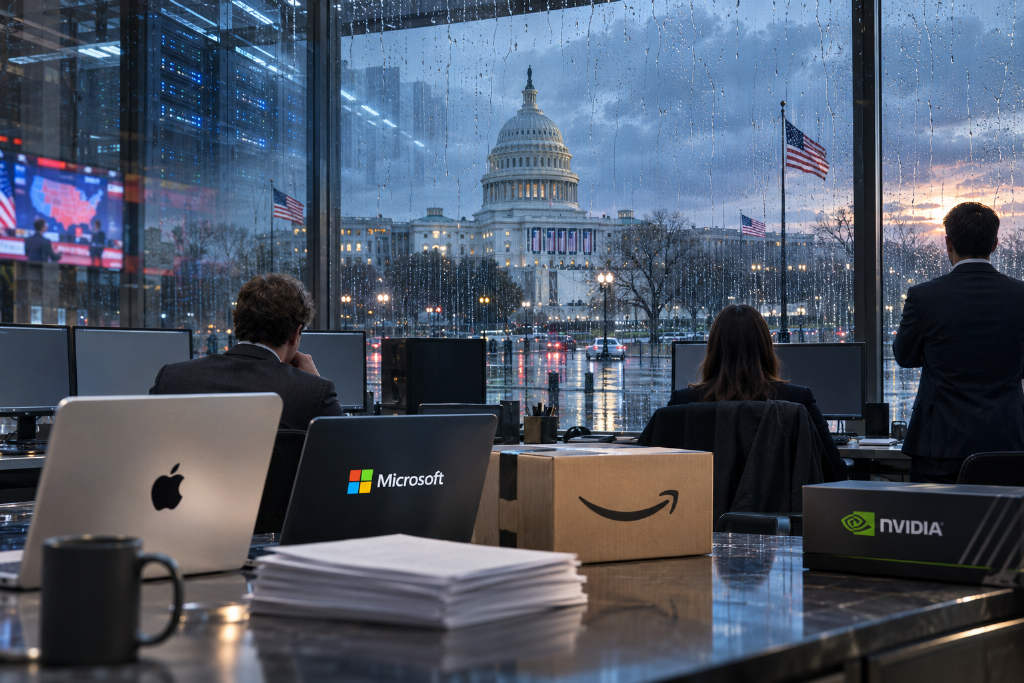
U.S. stocks opened sharply higher after the Associated Press called both the Senate and the House for Democrats, but the post-election rally quickly showed a split under the surface. The Dow Jones Industrial Average jumped more than 1,100 points within the first 30 minutes of trading, and Amazon, Microsoft and Apple each rose more than 6% at one point. Nvidia and data center names did not keep pace, leaving investors focused on what comes next: nonfarm payrolls, Nvidia earnings and policy risk around AI infrastructure.
AP called both chambers for Democrats, with 62 races still being counted
According to the Associated Press, as cited by Forbes, Democrats secured the Senate late on Nov. 3 Eastern Time and the House early on Nov. 4. That settled control of Congress. The new Congress will take office in January 2027.
The report said 62 congressional races were still being counted, including two Senate contests in Mississippi and Alaska and 11 House seats in California. Those races may change the final seat count, but not which party controls either chamber.
Futures sank first, then reversed as Wall Street shifted its reading of the result
The market reaction was volatile from the start. During vote counting, Nasdaq 100 futures fell as much as 2.4%, while Taiwan stocks saw an intraday swing of 1,885 points. Once the outcome became clearer, sentiment turned. By early Nov. 5 in Taiwan time, the Nasdaq 100 index was up about 1.3%.
The report cited Jake Dollarhide of Longbow Asset Management, who said a Democratic-led Congress would "put pressure on the tech industry, and could bring regulatory pressure to all things AI." After the result was confirmed, attention shifted to the idea of divided government.
Andrew Slimmon of Morgan Stanley Investment Management said, "The market likes gridlock better than one party having too much power." Michael Arone of State Street Global Advisors said "the biggest risk is not the blue wave itself, but investors overreacting to it."
Big Tech led the rebound, while Nvidia and CoreWeave lagged
The same headline produced very different stock moves. The report said large-cap tech names that had been hit hard over the past month led the rebound. By early Nov. 5 in Taiwan time, Amazon was up about 8.1% and Microsoft about 7.9%, with both recovering their post-earnings losses.
AI chip and data center stocks were weaker. Nvidia was down about 0.7% at the same time, and CoreWeave fell more than 6% after the open. The article tied that underperformance to concern that oversight of AI data centers could tighten after the election.
It also noted that Texas' new governor had proposed pausing new data center projects in the state, while Texas and Georgia together account for about one-third of AI data center spending. Safe-haven flows were visible as well. Gold jumped on election night and was up about 3.3% by early Nov. 5 in Taiwan time.
The Nasdaq 100 had already entered correction before the election
The article argues that the election was not the root cause of the sell-off in tech. On Oct. 6, the Nasdaq 100 stood at a record 31,224. By Nov. 2, it had fallen 10.4%, enough to enter correction territory. The move took 19 trading sessions.
The decline was broken into three waves: rate worries in mid-October, earnings pressure in late October and financing stress in early November. In that framing, the election was the final trigger, not the starting point.
Alphabet: cloud revenue up 103%, stock still dropped 12.6%
The report said the market is changing how it scores AI spending. Google Cloud revenue rose 103% year over year, but Alphabet posted $51.4 billion in capital expenditure for the quarter, pushing free cash flow into negative territory. The stock then fell 12.6%. The article summed up the shift this way: investors are no longer asking how much companies spend, but what they get back.
Intel: nearly a 30% intraday plunge
Intel was presented as one of the first casualties of rising memory costs tied to AI data centers. The stock fell nearly 30% intraday, according to the report. Intel said PC shipments would decline about 12% this year, with one reason being higher memory costs driven by AI data centers. Apple also warned that memory costs would keep rising.
AMD: record third-quarter revenue, but selling pressure returned
AMD offered another example of how little room the market is giving companies. The report said AMD posted record third-quarter revenue of $13.4 billion, with data center revenue up 97% year over year. The stock rose more than 8% in after-hours trading, but the gain faded in the regular session on Nov. 4. By early Nov. 5 in Taiwan time, AMD was down about 3.6%.
The article's conclusion was simple: even within the same AI narrative, investor patience is getting shorter.
Three near-term catalysts: payrolls, Nvidia earnings and data center policy
The report listed three events to watch over the next two weeks:
- Nov. 6 evening in Taiwan time: U.S. October nonfarm payrolls, with expectations for 55,000 new jobs, a figure that could shape rate expectations.
- Nov. 18 morning in Taiwan time: Nvidia earnings, described as a broad test of AI demand.
- Ongoing: policy developments affecting data centers, including AI oversight agendas at the state level and in the new Congress.
It then laid out three scenarios:
- Nvidia delivers strong guidance, and the post-election rebound spreads into semiconductors.
- Earnings meet expectations but guidance is cautious, extending the correction.
- Signals of tighter data center regulation intensify, keeping pressure on the AI infrastructure supply chain.
The article said these were scenario outlines only and did not constitute investment advice.
The report also detailed Mitrade products and promotions
Beyond the market analysis, the original article described trading functions available on Mitrade. It said Nvidia, Amazon, Microsoft, Alphabet, AMD, Intel and gold can all be traded in one account through contracts for difference, or CFDs. It also listed two-way trading, extended-hours U.S. stock trading, TradingView charts and free indicators, stop-loss orders, trailing stops, timed position closing and negative balance protection.
The article warned that leverage risk rises when volatility expands and said traders should set risk controls before entering positions.
It also listed two promotional offers for BlockTempo readers:
| Offer | Requirement | Maximum reward |
|---|---|---|
| New user task | Complete registration, fill in information, finish identity verification and make a first deposit within the campaign period | 100 USD trading bonus + 100 USD gold free contract |
| Tiered deposit | Reach the required cumulative deposit level within 7 days of registration, with the top tier at 10,000 USD | 1,200 USD trading bonus voucher |
| Total | — | 1,300 USD trading bonus + 100 USD gold free contract |
The report added that rewards are issued as trading bonus vouchers and can be withdrawn to the account wallet only after users complete the required trading tasks within the validity period. It also said users must enroll in the campaign manually in the app and return to the event page to claim rewards after meeting the conditions. Final terms are based on the in-app campaign description.
The election took the headline, but earnings and policy still set the direction
The article ended by saying the first-day rally after the election reflected relief from fading uncertainty, not a clean resolution of the issues facing tech stocks. Companies still need to show returns on AI spending. Suppliers still need to show orders. And the shift in Congress has reminded the market that the cost of AI appears not only in earnings reports, but also in policy.
It identified Nvidia's earnings on Nov. 17 Eastern Time as the next major test and said volatility is likely to remain a constant before then.



