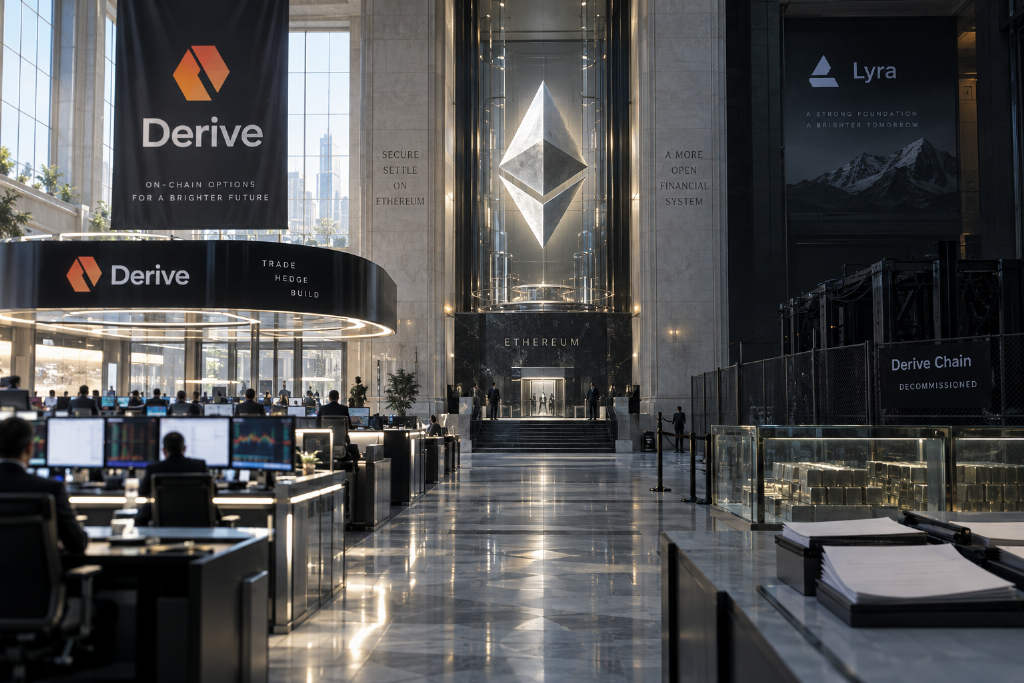
While market attention has centered on ZEC, Robinhood Chain, NEAR and Ethereum, a smaller DeFi name has been having its own breakout. That project is Derive, and its token is DRV.

DRV has climbed steadily since March. The token is up about 9x this year and more than 220% over the past month, repeatedly setting new highs. Last week, it briefly moved above $0.56. It has since pulled back to around $0.47, though its fully diluted valuation still stands above $700 million.
The bigger story is not only the token move. Derive has been operating in crypto derivatives for years. The protocol used to be known as Lyra, and it is now the largest on-chain options venue by trading volume. Several developments landed at the same time: a full rebuild of the underlying architecture with the launch of V3, a plan to direct a larger share of protocol fees to DRV buybacks, and fresh attention from Citrini Research toward on-chain financial infrastructure.
DefiLlama data cited in the report show Derive recorded about $4.279 billion in options notional volume over the past 30 days as of an Oct. 12 check, or roughly 86.8% of the tracked market total. Measured by options premium volume, its share was closer to 93%. A later reference to DefiLlama’s rolling 30-day page put Derive’s options notional volume at $4.236 billion and options premium volume at $80.56 million, equal to about 86.8% and about 93% of total on-chain options protocol activity, respectively.
That points to a market structure in which on-chain options remain much smaller than perpetual futures, yet one protocol already accounts for most of the flow. Derive is now changing course again on infrastructure: instead of continuing to maintain its own dedicated chain, it is moving rule verification and collateral custody to Ethereum.
From Lyra to Derive
Derive did not appear overnight. Its history goes back to 2021, when the project launched as Lyra and focused on on-chain options trading.
In its early phase, Lyra used an automated market maker to provide liquidity and used Synthetix for risk hedging. That same year, the project raised $3.3 million in a round co-led by Framework Ventures and ParaFi Capital.
Throughout 2022, Lyra kept refining its AMM model. It then began to change direction. From late 2023 to early 2024, Lyra V2 gradually shifted from an AMM-led structure to an order book model: orders were matched off-chain, while margin management and settlement ran on a dedicated Ethereum layer 2 built on the OP Stack. That network was first called Lyra Chain and later became Derive Chain after the rebrand. In August 2024, Lyra officially changed its name to Derive.
An order book gives professional market makers a way to submit direct quotes, and it gives traders more flexible order types. Combined with portfolio margin, users can manage multiple options and perpetual positions in the same account.
V3 replaces Derive Chain
On Oct. 7, 2026, Derive announced the launch of V3. The upgrade replaced Derive Chain.
Under V2, the system was built around Derive Chain, an Ethereum layer 2. Brokers, custodians and vault developers needed more than a trading API when integrating with the platform. They also had to work with smart contract wallets, cross-chain tooling and related infrastructure. At the same time, the Derive team had to maintain the trading system, the rollup and the connected services, then coordinate changes across those pieces. According to the team, one goal of V3 is to reduce that integration burden and make new products easier to build and connect.
The new architecture has three parts.
- Orders are still matched off-chain. Derive says the system retains sub-millisecond matching capability. That refers to matching speed, not Ethereum final settlement speed.
- Protocol computation runs off-chain and then submits proofs. Margin, pricing and settlement logic run inside a zkVM. The system generates zero-knowledge proofs for batched state updates and sends them to Ethereum contracts for verification.
- Collateral is held in Ethereum smart contracts. Those contracts verify the proofs and process withdrawals. State update data is published to Celestia for data availability and third-party state reconstruction.
The point of the design is to keep complex computation off-chain while letting Ethereum verify whether the computation followed protocol rules.
Derive also described a defined exit mechanism. If the protocol does not process withdrawal requests within the required time window, another operator can continue settlement under the exit rules.
On trading features, eligible traders can combine ETH and BTC positions in one account and lower margin requirements when risks offset each other. Borrowable assets have also expanded beyond USDC to ETH, WBTC and HYPE.
V3 also organizes markets by risk group. Each group has its own tradable products, acceptable collateral and lending rules. Strategy managers can create vaults through the interface without writing code. External users deposit assets and receive vault shares, while managers use the account’s capital to run strategies, with gains and losses reflected in share value.
Derive said it plans to add more markets and vaults and complete integrations with more partners in the coming weeks. The direction is clear: make its trading and risk management stack easier for other applications to use, rather than relying only on traffic to the main website.
How far ahead is Derive?
The protocol’s scale is backed by data.
According to Derive’s own figures, year-to-date options notional volume had reached about $15.87 billion as of Oct. 12, 2026. That was about 2.9 times the project’s reported 2025 full-year figure of $5.43 billion.
DefiLlama’s Oct. 12 rolling 30-day page, as cited in the report, showed Derive at $4.236 billion in options notional volume over the prior 30 days, good for about 86.8% of total on-chain options protocol volume. Options premium volume was $80.56 million, about 93% of the total.

The distinction matters. Notional volume measures the size of the underlying exposure represented by options trades. Premium volume measures the actual amount paid for options, which is closer to the absolute capital flowing into the options market.
The source also breaks down the growth. Based on Alea Research’s third-quarter statistics, Derive posted $7.45 billion in options notional volume in Q3, up 89.6% quarter over quarter. Over the same period, the number of trades rose 6.2%, while average notional size per trade increased from about $47,000 to $84,000.
Its lead in on-chain options still looks small next to the broader crypto options market. Coinglass data showed that, as of Oct. 12, disclosed Bitcoin options open interest across Deribit, CME, OKX, Binance and Bybit totaled $37.9 billion in notional terms. Deribit alone accounted for $31.5 billion. By comparison, Derive’s platform-wide options open interest across all covered underlying assets was about $3.46 billion in aggregate notional value.
Those datasets do not cover the same underlying assets, so they cannot be used to calculate a direct market share. The size gap still says a lot: even after taking a dominant position in on-chain options, Derive has a long way to go if it wants to capture a broader slice of crypto options demand.
Revenue adds another layer. DefiLlama data in the report showed Derive generated about $680,800 in protocol fees over the past 30 days, while platform-defined revenue came to about $547,200 over the same period. Those figures cover the whole protocol, including options and perpetuals.
So the current picture is mixed. Derive has built a clear lead in on-chain options volume, but the revenue base remains limited. The next step is not simply holding on to the top spot. It is proving that volume leadership can become lasting protocol revenue, and that revenue growth can support the token’s valuation.
For an options venue, low fees are not automatically a negative. Professional market makers and institutions are often sensitive to trading costs, and lower fee levels may help attract liquidity. That is also why V3’s push into vaults, brokers and third-party integrations matters. Derive is trying to place its trading and risk engine inside other applications and gain more sources of order flow, instead of depending only on direct user acquisition through its own front end.
The DRV narrative: research attention, buybacks and valuation
Two other developments drew attention around the V3 launch.
The first was Citrini Research. On Oct. 8, the firm published Breaking The Wall, a report discussing the relationship between AI agents, traditional finance and blockchains. Citrini Research had already drawn broad attention across global financial markets in early 2026 after publishing a scenario-based report on AI’s future impact.
The core idea in the new report is that as real-world assets move on-chain and AI agents become able to execute financial operations automatically, programmable blockchain-based financial infrastructure that runs around the clock could see new demand.
That line of thinking overlaps with Derive’s product direction. If more kinds of assets trade on-chain, there may also be more demand for hedging and derivatives around them. Derive already has one example: in July, the platform announced XAUT options, extending its product set into tokenized gold. V3 is also designed to support more markets and more external integrations.
Citrini Research also disclosed a crypto token basket in which DRV, Lighter (LIT) and Ether.fi (ETHFI) each received a 10% weight, making them the three largest allocations in that crypto portfolio.
The second development was more direct for the token. On Sept. 24, the Derive community published a proposal to raise the share of eligible protocol fees used for DRV buybacks from 35% to 50%. On Oct. 6, the project said the new ratio would take effect on Oct. 14.
That creates a clearer link between protocol activity and token purchase demand.
What the market still needs to see
At this stage, Derive’s valuation case has two parts.
One comes from the business that already exists: its lead in on-chain options, meaningful trading volume, actual fee generation and infrastructure that has been running for years.
The other comes from growth expectations that remain unproven: whether V3 can attract more professional firms, whether vaults can bring in new order flow, whether the on-chain options market itself can expand further, and whether any of that eventually turns into larger protocol revenue.
Those two pieces are not the same. After DRV’s sharp rise, the key question is no longer only whether Derive can remain the top on-chain options protocol. It is whether revenue can grow fast enough to justify the valuation the market is assigning to it.
That makes Derive representative of a wider pattern in on-chain derivatives. In perpetuals, platforms such as Hyperliquid have already shown the scale an on-chain derivatives exchange can reach. Options remain a smaller and more specialized market. Derive has built an advantage in that niche, but the stronger that lead becomes, the clearer the next question is: is it simply staying ahead in a relatively narrow market, or can its new infrastructure help expand the on-chain options market itself?