

Deutsche Bank said in a foreign-exchange report dated Sept. 3 that the United States is mobilizing capital for the AI race at an unprecedented scale and tying that effort more closely to the dollar’s position in global finance. In the bank’s framing, the strategy has three parts: use open capital markets to fund AI infrastructure, use blockchain rails to broaden access to dollar-denominated assets, and let AI leadership feed back into the dollar’s standing. The same model, the report said, also changes the dollar’s risk profile, making it behave more like a higher-risk asset than a traditional safe-haven anchor.
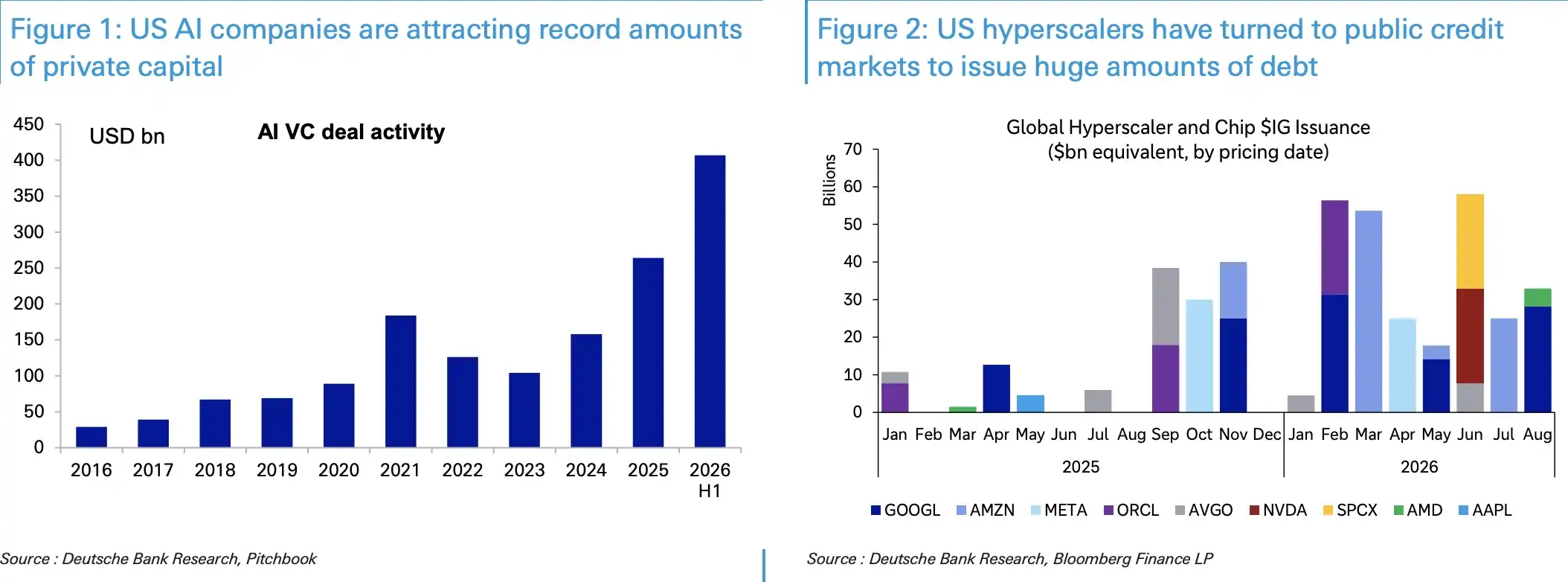
AI financing has expanded across multiple markets
According to the report, cited by Chasing Wind Trading Desk, US companies are expected to spend about $800 billion on AI capital expenditures this year. AI venture funding has raised more than $400 billion, and the two largest AI labs alone have raised nearly $217 billion combined, with valuations approaching $1 trillion each.
In credit markets, hyperscale technology companies including Google, Meta, Amazon, and Oracle have raised roughly 10 times their 2020-2024 average annual volume in the investment-grade market this year.
Deutsche Bank said this wave of financing is already feeding into structural dollar risk. As US funding sources shift from official long-term capital to private short-term technology capital, the correlation between the dollar and equities is rising, while the currency’s traditional hedging role is weakening. If AI business models fail to deliver, or if the US loses ground in the AI race, the dollar could face meaningful downside pressure.
Private equity, debt, and equities are all being tapped
The report breaks the US funding push into three channels: private equity, public debt, and stock markets.
In private markets, AI venture fundraising has exceeded $400 billion this year. More than 90% of the largest deals are concentrated in the United States, and the annualized growth rate is three times last year’s level.
In debt markets, major technology companies have moved into bond financing on a much larger scale. Deutsche Bank said Google, Meta, Oracle, and Amazon have raised about 10 times their 2020-2024 average annual amount through the investment-grade credit market.
In public equities, Google completed its first share sale since its 2004 IPO in June 2026, raising $85 billion. SpaceX completed what the report described as the largest new share listing in history at a valuation approaching $2 trillion.
This financing expansion comes as US twin deficits remain wide. Deutsche Bank said the fiscal deficit is above 6% of GDP, while the current-account deficit is close to 4% of GDP. With domestic fiscal savings insufficient, the added demand from AI capital expenditure has to be filled by foreign capital.
Deutsche Bank data showed that in the second quarter of 2026, the US drew more than $400 billion in foreign equity capital in a single quarter, far above any previous quarter and well beyond debt inflows, which had long been the main source of capital-account financing.
The report added that foreign official demand for long-term US Treasury holdings is falling as geopolitical fractures deepen, while the appeal of technology assets is helping fill that gap through private channels such as retail investors. SpaceX reportedly reserved about 30% of its IPO allocation for retail investors, more than three times the usual IPO level, reflecting a shift in how US companies think about their funding mix.
Tokenization is being positioned as a new distribution layer for dollar assets
Alongside large-scale fundraising, Deutsche Bank said the US is deploying blockchain infrastructure to attract global capital and push asset tokenization from concept into live market use.
Asset tokenization refers to converting ownership of financial assets such as stocks, bonds, and real estate into digital tokens recorded on a blockchain. DTCC, which currently holds about $115 trillion in US assets, completed its first tokenized transactions in July 2026. A total of 40 financial institutions took part, including tokenization tests involving the SPDR S&P 500 ETF Trust (SPY) and a JPMorgan test that used tokenized assets to meet Chicago Mercantile Exchange margin requirements. DTCC plans to formally launch its tokenization service in October 2026.
On the regulatory side, the report said the US Securities and Exchange Commission sent DTCC a no-action letter in December 2025, confirming that the same security can trade on both traditional and onchain rails while keeping the same investor protections and ownership rights. A follow-up decision in January 2026 said the issuance format or custody format of a security does not change how federal securities law applies.
At the exchange level, the New York Stock Exchange is working with Securitize on a digital platform aimed at 24/7 trading, instant settlement, fractional stock trading, and stablecoin settlement. Nasdaq has announced an "equity token design," with full tokenization capability planned for 2027, and has also said it will introduce 23/5 trading by the end of 2025.
Deutsche Bank said tokenization has strategic value for the dollar on two fronts. First, tokenized assets can improve collateral liquidity and capital efficiency, making US assets more attractive to global investors. Second, if US stocks and bonds move to 24/7 instant settlement, the entry barrier for global retail investors would fall sharply, broadening demand for dollar assets.
The report pointed to South Korea as a reference case. South Korea accounts for only about 2% of global nominal GDP, yet contributed about 10% of the $740 billion in foreign inflows into US equities last year. Deutsche Bank said one reason is that South Korea opened access to fractional trading in foreign stocks earlier than many markets.
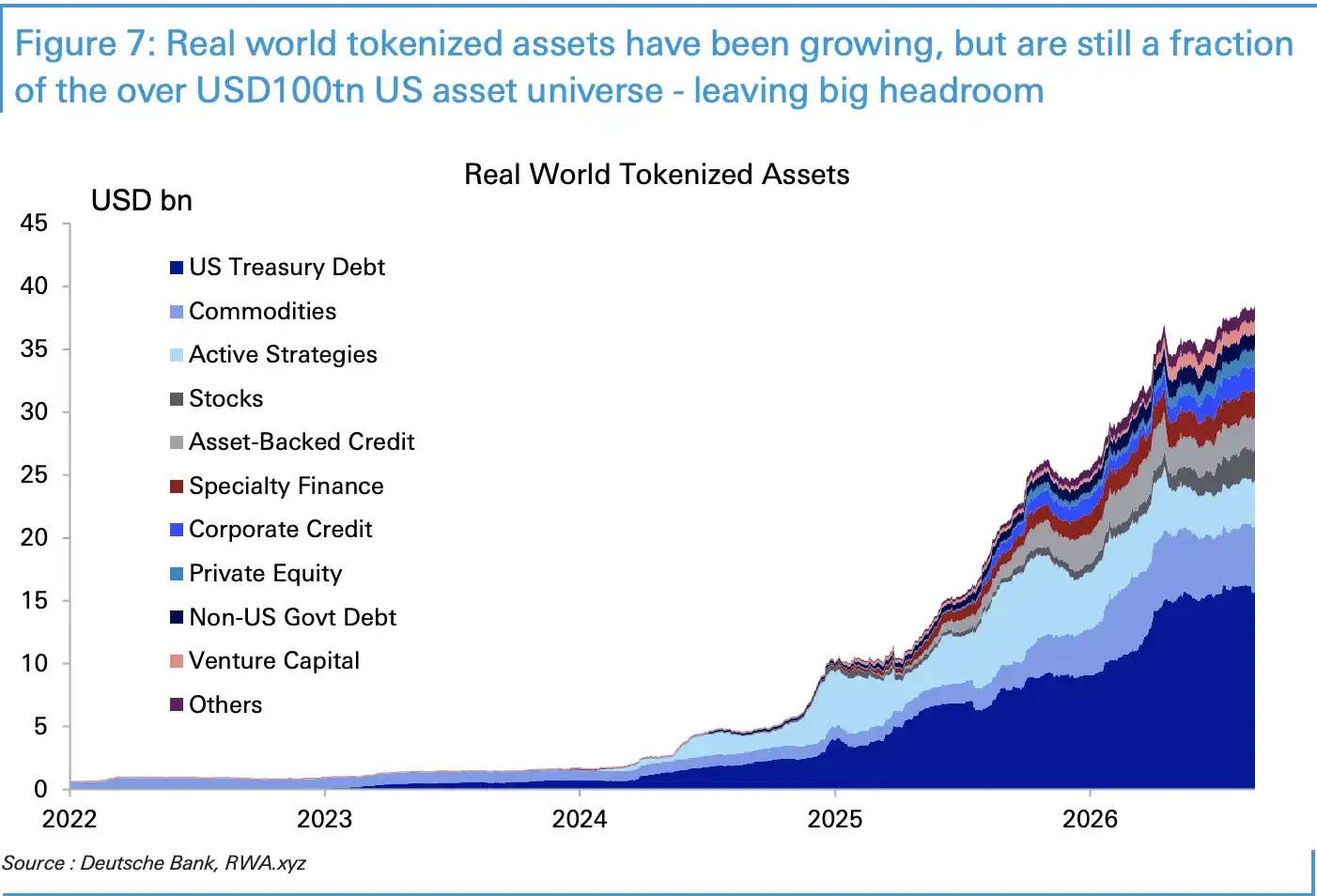
Globally, tokenized real-world assets currently total about $40 billion, according to the report. Against more than $100 trillion in US assets, that leaves substantial room for growth. Market forecasts cited in the report put tokenized assets at $2 trillion to $30 trillion in the 2030s.
The dollar’s risk map is shifting
Deutsche Bank said this dual bet on capital and technology is reshaping the dollar’s behavior. The US funding structure is moving away from official-sector-led, long-duration, geopolitically driven inflows and toward private-sector-led, shorter-duration inflows driven by technology returns.
That change raises the correlation between the dollar and equity markets and weakens the currency’s historical role as a hedge against stock-market risk. Under that logic, the dollar becomes more directly tied to the outcome of the AI race. If AI capital spending fails to generate economic returns, or if the US loses its lead in technology competition, an exit by large pools of private capital could hit the dollar directly.
The report also said tokenization lowers frictions not only for inflows, but also for outflows. Higher capital mobility cuts both ways: it can accelerate inflows in favorable conditions and speed up exits when sentiment turns.
A test of the US shareholder-capitalism model
At a broader level, Deutsche Bank described the US approach as "open markets plus closed technology." The country is using open capital markets to draw global funding while keeping AI model weights closed in order to protect corporate pricing power and shareholder returns. Whether that framework holds depends on US AI companies maintaining technological leadership and turning it into durable profitability.
The report goes further and argues that the AI race is not only a contest over technology, but also over economic systems, with the US shareholder-capitalism model itself under pressure.
The internal logic of that model is straightforward: open capital markets attract global money, large capital investment drives innovation, technology leadership supports pricing power, and high profits bring in more capital. For that loop to hold, AI companies must be able to charge global users substantial subscription fees and monetize intellectual property in overseas markets.
Deutsche Bank said the loop is clearly vulnerable. If AI business models fail to generate enough economic return, or if US firms lose pricing power, corporate profits would come under pressure. That would weaken the central case for foreign capital inflows and add strain to already elevated fiscal deficits.
The bank also said AI revenue could improve the US current account by about 1 percentage point over the next decade through stronger service exports, but that outlook depends heavily on whether US AI companies can preserve pricing power and successfully monetize international users.
In the end, the report casts the AI race as a final test of the US belief that free and open capital markets consistently produce the best innovation outcomes. The result, Deutsche Bank said, will help determine whether that belief still holds and whether the dollar can retain its role as the world’s central capital hub.