
Alphabet will release its fiscal 2026 second-quarter results after the U.S. market closes on July 22. Heading into the report, investors have been focused on one central question: whether expanding AI-era capital spending is becoming a drag on profitability or an early sign of future growth.
In a report published on July 20, Deutsche Bank said recent market worries have centered on slower search growth, a delay in the rollout of a new Gemini model, and continued increases in AI spending. Its view, though, is that the more important variable is not capex itself but whether Google Cloud revenue growth comes in well above current expectations. If cloud demand materializes as expected, the bank said, the incremental profit over the next few years could be enough to absorb a higher level of AI investment, leaving room for upward revisions to Alphabet’s overall earnings power.
For investors, the key issue in this earnings release is not simply whether capex rises again. Deutsche Bank said management’s tone on cloud demand, backlog trends, and the timing of future revenue realization may matter more, because those signals could shape how the market values Alphabet during this AI investment cycle.
Google Cloud is the main variable in Deutsche Bank’s call
Deutsche Bank’s most optimistic view in the report was tied to Google Cloud.
The bank raised its forecast for Google Cloud’s second-quarter revenue growth to 70% from 65%, and said growth could accelerate to 75% in the second half of 2026.
That forecast rests on three points. First, AI compute demand remains above available supply, and Google has recently rented part of SpaceX’s compute resources. Second, Google Cloud’s backlog had reached $462 billion by the end of the first quarter of 2026, up 400% year over year. Third, some hyperscale cloud providers, including Amazon, have already started raising prices for parts of their cloud offerings.
Deutsche Bank also said the market is materially underestimating the future size of Google Cloud’s revenue base. It forecast Google Cloud revenue of $190 billion to $195 billion in 2027, compared with consensus expectations of about $142 billion. At a 30% profit margin, that additional revenue alone could add about $15 billion in GAAP operating profit, or roughly $1 in earnings per share.
Capex estimates move higher, but so does financing capacity
Deutsche Bank also sharply increased its forward capex estimates for Alphabet’s AI infrastructure buildout.
Alphabet had previously guided to 2026 capex of $180 billion to $190 billion and said 2027 would be “significantly higher” than this year. Based on backlog trends, Deutsche Bank estimated Google needs about 11.5GW of compute capacity to meet existing demand, with another roughly 10GW required in its base-case scenario for 2027.
Using a build cost of about $30 billion to $35 billion per GW, the bank now expects 2027 capex to reach about $325 billion, up from its prior $250 billion estimate. It sees 2028 capex rising further to $365 billion to $370 billion.
The analysts added that Google’s mix of TPUs and NVIDIA GPUs could leave its unit build cost below what the market currently fears.
Deutsche Bank said Alphabet’s financing position remains strong. During the current quarter, the company has completed roughly $65 billion to $70 billion in financing, including a $10 billion investment from Berkshire Hathaway, two equity financings totaling about $36 billion, an at-the-market issuance program of up to $40 billion, and multi-currency senior debt issuance.
As of the end of the first quarter of 2026, Alphabet held about $127 billion in cash and investments, as well as about $107 billion in private securities. Deutsche Bank expects cumulative operating cash flow to reach about $420 billion by the end of 2027.
Its conclusion was that Alphabet’s core issue is not that capex is too high. The market, in Deutsche Bank’s view, is paying too much attention to spending and not enough to how quickly Google Cloud revenue may convert.
Search growth has not stalled, and ad budgets are shifting toward AI
The biggest concern around Google Search has been the possibility that AI Overview changes traditional search traffic patterns.
But Deutsche Bank said its channel checks point to a different shift in advertiser behavior. Some advertisers are maintaining their existing search budgets, while a growing number of brands are experimenting with budget allocation toward AI Overview and also increasing AI-related ad spending tied to Google Search and ChatGPT.
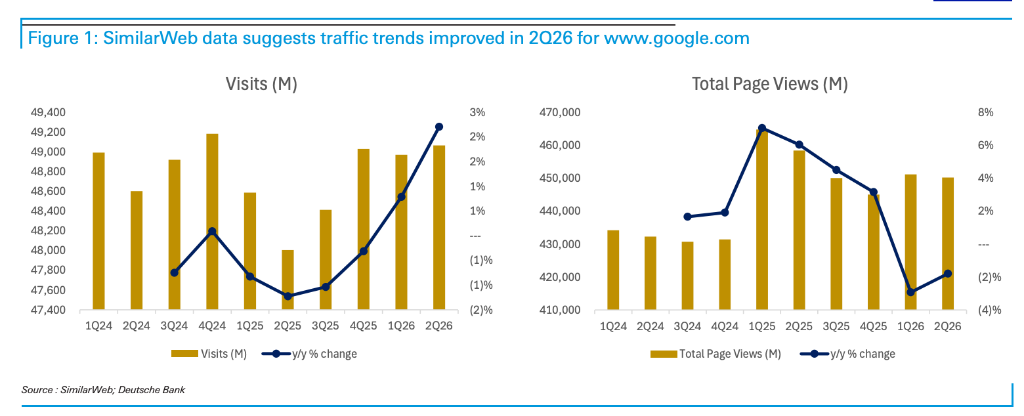
SimilarWeb data showed that both visits and page views on Google’s websites improved in the second quarter of 2026 from the first quarter. Based on those figures, Deutsche Bank maintained its forecast for Google Search to grow 16.5% year over year in the second quarter on a constant-currency basis, followed by 14% growth in the third quarter.
The analysts said that even though the new Gemini model has been pushed back somewhat, existing AI models are still improving ad efficiency and the fundamentals of the advertising business have not materially changed.
Gemini launch delay is not seen as a turning point
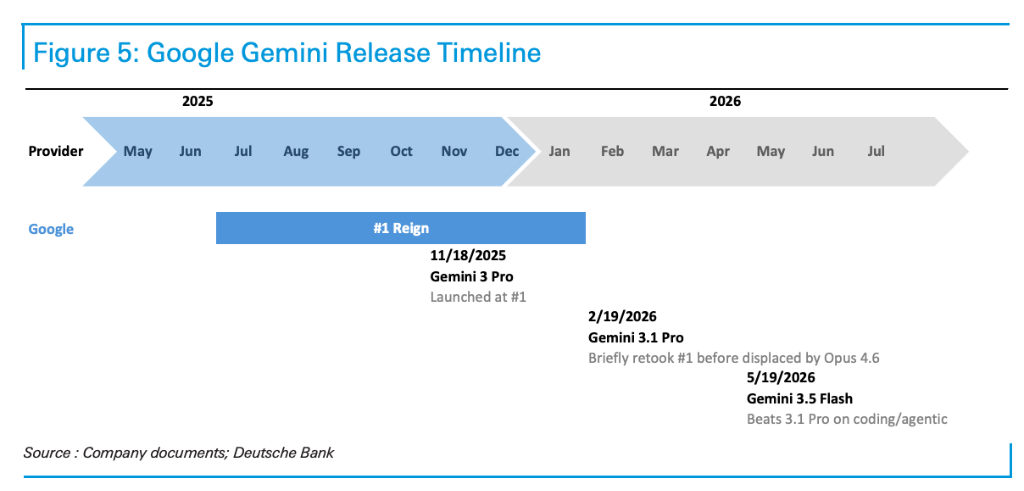
The delayed launch of Gemini has been another market focus. Google previously said at I/O 2026 that Gemini 3.5 Pro would arrive later, but the new model has not yet been formally released.
Deutsche Bank said the timing change has not altered the broader user growth trend. SimilarWeb data showed that Gemini web traffic and page views continued to increase in the second quarter, though growth slowed. Sensor Tower data showed that Gemini app downloads were below their 2025 peak, but total sessions kept rising.
Against peers, ChatGPT remains in the lead, though session volume has been broadly flat over the past 12 months. Meta AI posted stronger growth after launching Muse Spark. Grok, by contrast, has seen declines in both downloads and session volume this year.
Based on those data points, Deutsche Bank said the timing adjustment for Gemini is a short-term event and does not change Alphabet’s long-term AI competitiveness.