

Deutsche Bank says global markets are pricing in a combination that looks friendly for risk assets but offers almost no margin for error: strong growth, limited rate hikes, contained energy supply disruption and softer oil prices.
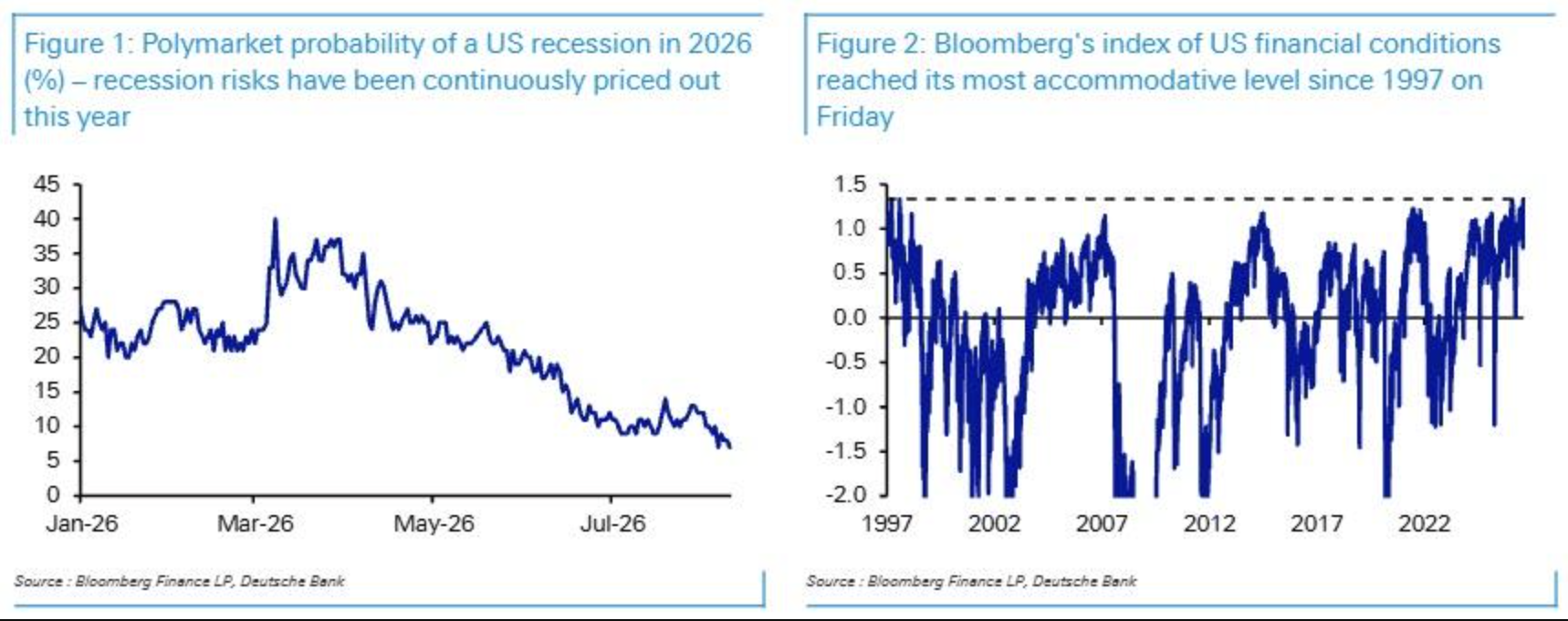
In a recent report, Deutsche Bank macro strategist Henry Allen said record-high U.S. equities and low credit spreads show investors still expect the economy to remain resilient. At the same time, rate markets are only pricing in a limited amount of additional Federal Reserve tightening. If inflation fails to cool as expected, or if growth continues to surprise on the upside, that policy path may need to be repriced quickly.
The bank sees a similar split in energy markets. Brent crude has pulled back sharply from recent highs, but the Strait of Hormuz has not returned to normal traffic and no agreement to restore passage has been reached. In Deutsche Bank’s view, oil prices and the forward curve are implying a recovery in supply conditions that still sits some distance from the logistical and infrastructure risks on the ground.
For investors, the key issue is not just where growth or oil prices stand today. It is whether several optimistic assumptions can all hold at once. Deutsche Bank said that if strong growth feeds inflation pressure again, or if supply disruption in energy drags on, the current relationship between risk assets, rates and inflation expectations may break down.
A gap is opening between growth signals and rate pricing
Signals from U.S. risk assets remain upbeat. The S&P 500 hit another record high last Friday, earnings growth has stayed firm, and credit spreads remain tight. The Atlanta Fed’s GDPNow model is estimating U.S. third-quarter annualized growth at 5.8%.
Financial conditions also remain loose. Bloomberg’s U.S. financial conditions index rose last Friday to its most accommodative level since 1997, while the July unemployment rate fell to 4.1%, a 13-month low. Taken together, those indicators still point to resilience in economic activity.
Rate markets, however, are not fully aligned with that growth picture. U.S. PCE inflation was 3.7% in June, still above the policy target, yet fed funds futures are pricing in only about 31 basis points of tightening by the December meeting and a cumulative peak of roughly 47 basis points by next June.
Deutsche Bank said markets are currently trying to hold together four ideas at once: strong growth, easy financial conditions, inflation above target and only mild Fed tightening. The bank does not think that mix can last indefinitely. The adjustment, it said, could come through faster disinflation, weaker risk assets, or a more hawkish Fed path than markets now expect.
Historical patterns point to the risk of more tightening
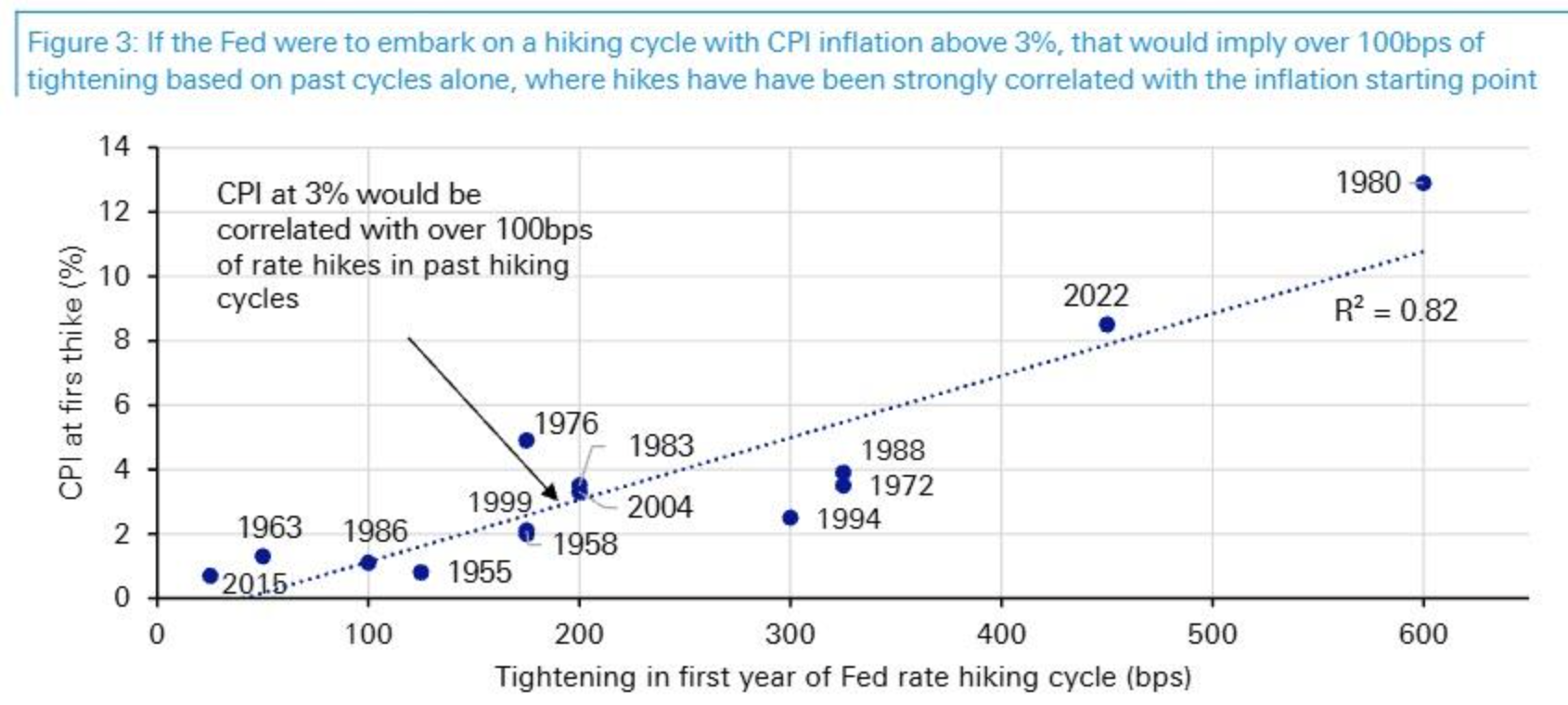
Allen said that over the past 70 years, the inflation level at the start of a Fed hiking cycle has shown a fairly strong relationship with the amount of tightening delivered in the first year. Based on the current 3.5% CPI inflation rate, the historical pattern would imply more than 100 basis points of tightening in year one, even if inflation moderates by year-end.
That stands in contrast to futures pricing, which implies less than 50 basis points of cumulative hikes. Deutsche Bank said that if both growth and inflation stay resilient, markets may be underestimating the chance that the Fed shifts to a firmer stance.
The bank pointed to 2022 as a useful reference point. At the start of that cycle, markets expected a relatively mild path and the Fed began with a 25 basis point increase. It later moved to 75 basis point steps, delivering 450 basis points of tightening in the first 12 months and 525 basis points over the full cycle.
The report also said a one-and-done outcome has been rare in history. Since the start of the 21st century, 2015 was one of the few exceptions. Back then, the second hike came a full year later, largely because economic data weakened and raised concern about a broader slowdown.
Oil pricing is diverging from geopolitical reality
Falling oil prices are a central pillar of the market’s optimistic setup, but Deutsche Bank said that price action does not fully match supply conditions.
Brent crude is currently around $88 a barrel, down from more than $100 a barrel three weeks ago and well below the intraday high above $120 seen in April. Even so, the Strait of Hormuz remains disrupted, no agreement has been reached to restore normal transit, and shipping volumes are still far below pre-conflict levels.
Infrastructure risk has not gone away either. Over the weekend, the Houthis claimed an attack on Saudi Arabia’s Jazan refinery, underscoring the uncertainty still hanging over crude supply chains.
Even with those risks unresolved, the market is still pricing in supply normalization. Twelve-month Brent futures are trading more than $10 a barrel below front-month contracts, a structure that reflects broad expectations for lower oil prices ahead. Deutsche Bank said that view depends heavily on the Strait of Hormuz reopening, and that has yet to happen.
Supply shocks may still be underpriced in inflation
According to the report, energy markets have already seen one of their sharpest swings since 2022. In July alone, Brent crude rose by nearly $30 a barrel over three weeks, briefly moving back above $100, before giving up much of that move. Even after the pullback, Brent is still up more than 40% since the start of the year.
European natural gas prices are also sitting at relatively elevated levels for the year. Deutsche Bank said that kind of volatility suggests supply shocks have not disappeared, even if broader inflation pricing remains fairly restrained.
Potential sources of pressure include continued disruption in the Strait of Hormuz, tariffs that remain part of the global economic backdrop, and the possibility of a strong El Niño later this year. If food and energy prices stay under pressure, inflation expectations could rise and increase the risk of wages and prices reinforcing each other.
That leaves room for a more uneven disinflation path than markets appear to expect. For central banks, energy and supply-side risks could limit how quickly policy can turn more accommodative.
Stocks, inflation and rates are not telling the same story
Since the Iran conflict began in late February, equities, credit markets and inflation swaps have all shown a high degree of sensitivity to moves in oil. In the second half of July, when Brent moved back above $100 a barrel, equities pulled back. In August, as oil prices eased, risk assets rebounded and pushed stock indexes to fresh highs.
Short-term inflation expectations broadly followed the same path and declined as oil retreated. Rate markets did not move in lockstep. Even as stocks bounced and oil fell, bond yields kept rising and reached new highs.
Deutsche Bank said part of that may reflect the recent Fed meeting, strong global economic data and firmer risk appetite. Still, the macro signals coming from different asset classes remain in conflict. Equities and credit are closer to a resilient-growth, manageable-oil scenario, while rates appear to still reflect the longer-lasting effects of geopolitical tension and energy shocks.
The current market setup needs several things to go right at once
For current pricing to be validated, Deutsche Bank said markets would need supply-driven growth, falling inflation, easing geopolitical risk and the reopening of the Strait of Hormuz at the same time. That mix would support corporate earnings and equities while reducing the need for aggressive central bank tightening.
Artificial intelligence-driven productivity gains could help on the supply side. But the report also noted that recent price action in areas such as memory chips shows AI demand itself may create new inflation pressure.
That is why Deutsche Bank sees the main risk not in a single variable spinning out of control, but in the market’s optimistic assumptions failing to hold together. If the economy stays strong, financial conditions remain loose and inflation stays above target, pressure for more rate hikes would increase. If energy supply disruption continues, the case for lower inflation and lower oil prices would weaken as well.
In the bank’s view, the market is not devoid of positive factors. The problem is that the room for error built into current pricing is very small. Any meaningful deviation in those conditions could force investors to reassess growth, rates and risk assets.