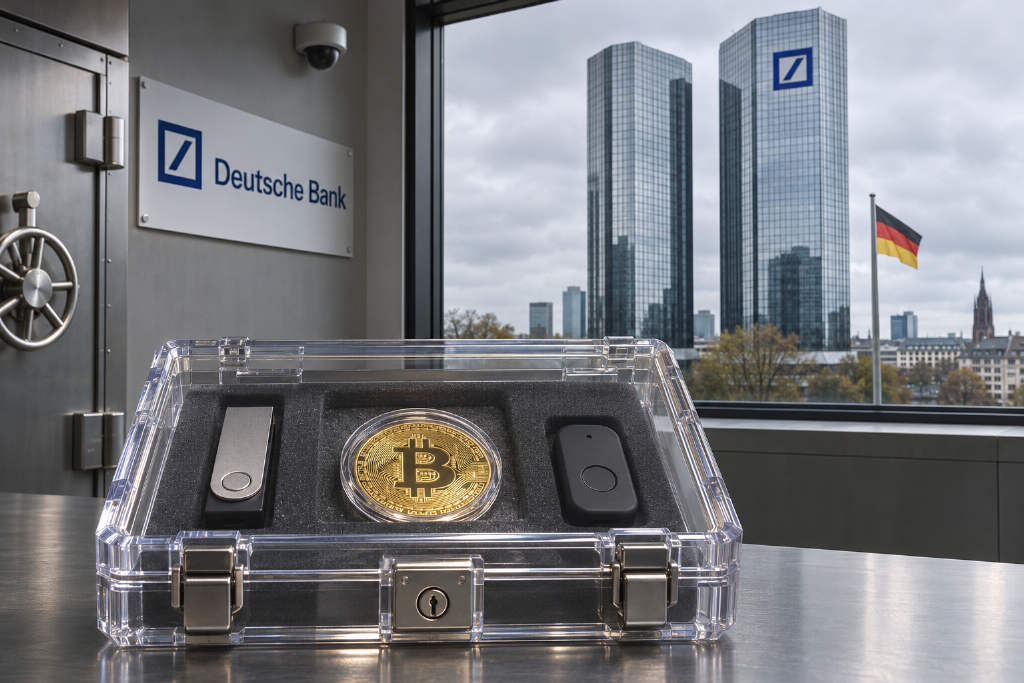
Deutsche Bank has activated its digital asset custody platform for paying clients, allowing institutions and corporations in Europe to hold bitcoin with Germany’s largest lender less than two months after the plan was first unveiled. The bank announced the service on September 16, saying it would go live with initial clients this year once regulators signed off, and it now supports bitcoin, ether and three stablecoins: USDC, EURC and EURAU. Under the model, Deutsche Bank manages wallets and private keys on behalf of clients, who can store assets and transfer them to third parties, avoiding the need to build their own custody infrastructure. The product page details hardware security modules for key storage, a choice of warm and cold storage, multi-factor authentication, segregation of client assets and customizable approval workflows, with access via the Autobahn gateway or the Corporate Bank portal. The service is booked out of Frankfurt, available in Germany and passported across Europe, and is described as compliant with the European Union’s MiCA crypto rules, targeting institutional investors, multinationals, governments, sovereigns and wealth managers. Alongside the launch, Deutsche Bank signed a memorandum of understanding with Deutsche Asset Management (formerly DWS) to explore commercial and technical collaboration in digital assets, including tokenized money market funds, crypto exchange-traded commodities and stablecoins built around the custody platform; the asset manager oversees about €1.22 trillion and already backs AllUnity, issuer of the EURAU stablecoin. Deutsche Bank has told Reuters it plans to expand the platform to Asia next year, joining a growing list of major banks offering bitcoin custody, including BNY Mellon in the U.S., Standard Chartered in Singapore and Absa in South Africa, while Coinbase this week secured a full federal trust charter from the OCC. The launch comes as bitcoin trades near $73,900, close to its lowest level since August after a hotter-than-expected U.S. inflation report.
Deutsche Bank has switched on its long-planned digital asset custody service for paying clients, opening the door for institutions and corporations in Europe to hold bitcoin with Germany’s largest bank.
The lender said Wednesday that the platform is now live, less than two months after it first announced the initiative. On September 16, Deutsche Bank disclosed that it would roll out digital asset custody this year once regulators gave their approval. That condition has now been met, and the service has gone into production with its first users.
According to the product page, the custody platform currently supports bitcoin (BTC), ether (ETH) and three stablecoins: USDC, EURC and EURAU. Under the arrangement, Deutsche Bank manages wallets and private keys on behalf of clients. Users can store their assets on the bank’s infrastructure and instruct transfers to third parties, a setup pitched as a way for institutions to avoid building and maintaining their own crypto custody stacks.
“In the medium term we aim to deliver a fully integrated, regulated ecosystem that supports the custody, tokenisation, and settlement of digital assets,” said Paul Maley, global head of trust and securities services at Deutsche Bank.
The bank has not identified its first clients, disclosed how many have signed up or revealed what it charges to hold coins. The offering is aimed squarely at institutional and corporate customers rather than retail investors.
The technical description on the product page highlights private keys stored in hardware security modules (HSMs), a choice between warm and cold storage, multi-factor authentication, segregation of client assets and a customizable approval process for transfers. Clients can reach the service through Autobahn, Deutsche Bank’s multi-channel gateway, or via its Corporate Bank portal.
The custody business is booked out of Deutsche Bank AG in Frankfurt. It is available in Germany and offered across Europe through passporting arrangements. Target clients include institutional investors, multinational and corporate treasuries, governments and sovereign entities, and wealth managers. Deutsche Bank describes the platform as compliant with the European Union’s Markets in Crypto-Assets (MiCA) regulatory framework.
For now, the menu of services is deliberately narrow. Deutsche lists custody, external transfers and internal moves between warm and cold storage as the initial capabilities, with “further capabilities planned.” The September announcement said the asset list may expand in response to client demand and that tokenized financial instruments are on the roadmap.
The earlier release also carried a familiar warning for bitcoin users: crypto assets held in this way are not covered by a deposit-guarantee scheme of the kind that protects eligible bank deposits.
Alongside the launch, Deutsche Bank signed a memorandum of understanding with Deutsche Asset Management, the money manager it mostly owns and that was known until recently as DWS. The agreement is intended “to explore comprehensive commercial and technical collaboration opportunities in the digital asset space,” the bank said.
The two firms plan to examine tokenized money market funds, crypto exchange-traded commodities and stablecoins built around the new custody platform. Deutsche Asset Management’s chief product officer, Manfred Bauer, said it plans to launch a tokenized money market fund, according to a report. As of September 30, the asset manager oversaw about €1.22 trillion.
Deutsche Asset Management already backs AllUnity, the joint venture that issues EURAU, one of the three stablecoins supported by Deutsche Bank’s custody service.
Deutsche Bank has also told Reuters it wants to bring the service to Asia. In October, the bank’s corporate banking chief said the lender plans to expand the platform into the region next year.
The launch places Deutsche Bank alongside a growing list of large banks that now hold bitcoin for clients. BNY Mellon became the first major U.S. bank to offer digital asset custody in 2022. This year, Standard Chartered moved to offer custody in Singapore, while South Africa’s Absa became the first bank on the continent to custody bitcoin.
In the U.S., Coinbase this week won a full federal trust charter from the Office of the Comptroller of the Currency (OCC), another sign that crypto custody is becoming a regulated banking business on both sides of the Atlantic.
The timing is not ideal for new inflows. Bitcoin traded near $73,900 on Wednesday morning, close to its lowest level since August after a hotter-than-expected U.S. inflation report on Tuesday.
This article, “Deutsche Bank Switches On Bitcoin Custody for Paying Clients,” first appeared on Bitcoin Magazine and is written by Micah Zimmerman.

This article was originally published by Bit.Fan. For more cryptocurrency news and market insights, visit www.bit.fan. Disclaimer:
The market information, project data, and third-party content displayed on this platform are for industry information sharing only and do not constitute any form of investment advice or return commitment.
Cryptocurrency trading carries high risks. Users should fully assess their risk tolerance and make independent decisions. All profits, losses, and legal responsibilities are borne by the users themselves.