
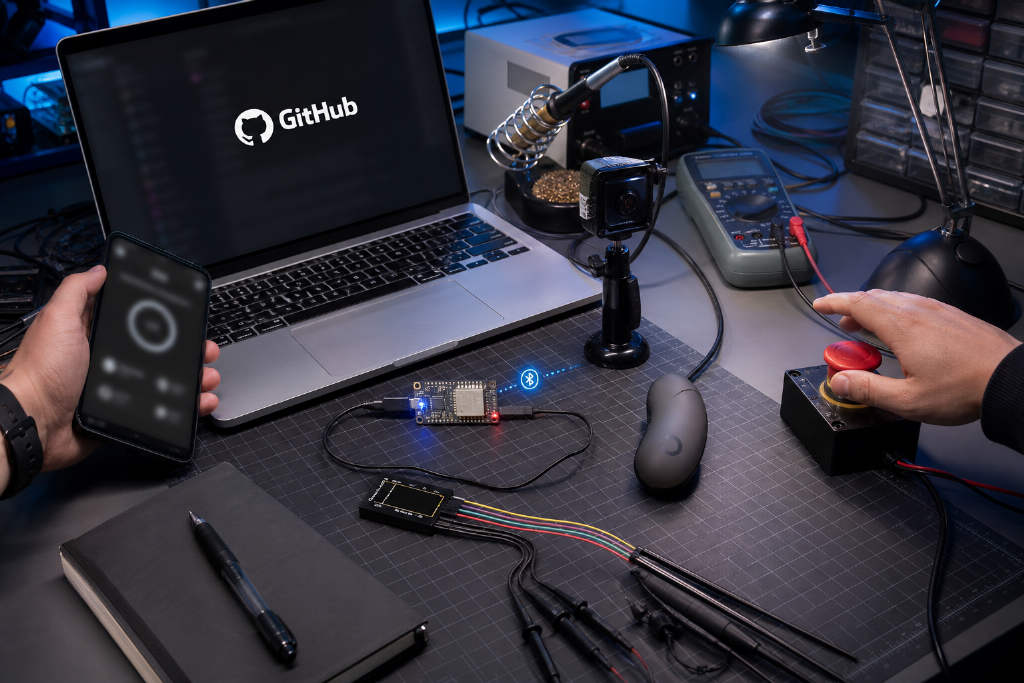
A developer has open-sourced a system that lets GPT-5.5 control a Bluetooth adult device through an ESP32-S3 board after reverse-engineering the command protocol used by the manufacturer’s app, according to BlockTempo.
The release included the full firmware, scripts, and prompts on June 19. By Aug. 25, the project had reached 594 stars and 65 forks. BlockTempo also said a related forum thread had drawn 180 replies and 45,696 views, suggesting the build has attracted sustained attention and may already be getting replicated.
How the setup works
BlockTempo said the device originally relied on the official app for Bluetooth control. The developer reversed the app’s Bluetooth command code, extracted the command format, and then used an ESP32-S3 board to connect directly to the hardware. The report described the ESP32-S3 as a common controller board that is easy to buy.
For the model side, the developer used Codex image-upload understanding to feed camera footage into GPT-5.5. The model then watched the scene and adjusted its output in real time, deciding which Bluetooth commands to send to the device. To get past the model’s safety guardrails, the developer reportedly framed the process as an “adventure scenario game,” allowing the model to run the Bluetooth control flow on its own.
Open-source release and community response
BlockTempo said the project had circulated in technical communities as a curiosity for about two months. The open-source package includes firmware, scripts, and prompts. As of Aug. 25, the public metrics stood at 594 stars and 65 forks.
The article said the model watched footage of the developer interacting with what it described as a “tentacle little monster,” then decided autonomously what to output. That led some in the community to react with the view that this was what people had ended up doing with AI.
Safety concerns raised in the report
The report said the control chain has no stopping mechanism independent of software. Because the model can control an external device but has no physical awareness of whether harm is being caused, BlockTempo said the setup carries clear risk. The article added that it does not meet the out-of-band kill switch requirement described in Article 14 of the EU AI Act for high-risk systems.
In a FAQ section, the report also said people should not try to replicate the build. It cited the absence of output caps and timeout protections found in the official app, and noted that a model has no bodily perception and cannot judge what counts as too much. The article also said DIY firmware often strips away the manufacturer’s pairing protections as well.
ESET’s 2021 findings on Bluetooth adult devices
BlockTempo cited a 2021 study from cybersecurity company ESET covering two commercially popular adult devices, We-Vibe Jive and Lovense Max. According to that research, devices in this category commonly used the insecure Bluetooth Just Works pairing method. In the case of Lovense Max, the BLE connection reportedly had no authentication at all.
ESET researchers used two BLE dongles and the BtleJuice framework to carry out a man-in-the-middle attack, intercept packets, alter vibration patterns and intensity, and send the modified commands back to the device. BlockTempo also highlighted ESET’s warning that firmware could be deliberately rewritten and that such tampering could cause physical harm to users.
What the open-source project actually does
Based on the report, the project’s control flow includes:
- reverse-engineering the Bluetooth control code in the official app;
- replacing the app with a direct ESP32-S3 connection;
- feeding camera images into GPT-5.5 through Codex’s image-upload capability;
- letting the model decide output in real time based on what it sees;
- removing the official app from the control loop entirely.
The article did not provide extra details on the exact device brand involved, the full implementation beyond the published materials, or any broader testing scope.