
Competition in AI infrastructure is shifting from model access to proof. As model supply expands across closed-source frontier systems, open-source releases, vertical models and fine-tuned deployments, developers face a harder question: what exactly are users getting when they call a model service?
DGrid said that question now reaches beyond model labels, lower prices or faster responses. In production use, developers still need to verify whether the returned output actually comes from the model being advertised, whether service quality remains stable over time, whether latency, availability and format compliance can be observed, and whether users can detect model replacement, downgraded service or rerouting to another provider.
On Aug. 25, 2026, DGrid announced the launch of validator nodes. In the company’s framework, the change sits inside its existing PoQ mechanism, or Proof of Quality. DGrid presents the rollout not as the addition of a routine participant role, but as an infrastructure-level step that moves verification from a protocol logic into continuous network execution, with staking adding economic weight to that process.
From access to verification
Early AI infrastructure products largely focused on access. Developers did not want to manage different APIs, authentication methods, pricing systems and invocation logic for each model vendor, which led to AI gateways and aggregation platforms that put multiple models behind one entry point. That reduced integration costs and made routing, billing and monitoring easier to engineer.
DGrid argues that scale changes the problem. Once model calls move into broader production environments, simple access is no longer enough.
The company describes three core issues. The first is authenticity: if a provider says it serves a specific model, how does a user confirm the result was not replaced or downgraded? The second is continuity: strong performance today does not guarantee stable service tomorrow under higher load or after policy changes. The third is auditability: when quality moves, users need data rather than a platform’s explanation.
DGrid says the problem is sharper in an open model market, where supply is richer and service quality is more uneven. In that setting, one-time listing reviews are not enough to maintain long-term standards, and trust falls back to a basic question: why should a user believe that a given call really came from the model being claimed?
DGrid positions validator nodes as a way to move that trust from statement to verification.
What validator nodes do
In many crypto networks, nodes handle consensus, block production or ledger maintenance. DGrid assigns a different task to validator nodes: ongoing audits of AI inference service quality.
According to the company, validator nodes run PoQ checks against LLM providers on the network. Their role is not to log transactions, but to act as network participants that continuously assess model services.
DGrid says the process includes four actions:
- sending randomized, blind-test requests to providers;
- simulating usage scenarios that are closer to real user behavior rather than fixed benchmark runs;
- evaluating results across output quality, response latency, stability and format compliance;
- recording the verification results as public, traceable on-chain records.
The emphasis is on continuity and blind testing. If test requests are fixed, providers can optimize for the test set. If verification happens only before listing, later degradation, substitution or quality drift can be difficult to catch.
That is why DGrid frames validator nodes as more than a way to check whether a model can produce an answer. In the company’s telling, the deeper question is whether a provider is consistently delivering the same service it claims to offer.
The article uses a specific example: a provider may claim to serve a high-tier model, while routing some requests to a cheaper model to lower costs. Ordinary users may struggle to detect that difference. DGrid says persistent PoQ testing by validator nodes can identify gaps between service quality and provider claims, then write those results into the network.
The intended result is a shift from platform self-attestation to network verification.
Dynamic reputation in an open model market
DGrid contrasts this model with more traditional platform governance, which it says usually relies on access review, user feedback and platform monitoring. Each method has value, but each also has limits: reviews are static, feedback often arrives late, and monitoring remains a centralized black box.
The company says validator nodes turn provider performance into a continuously updated public reputation layer.
- Data disclosure: provider performance is no longer confined to internal dashboards and becomes visible to the network.
- Reputation accumulation: high-quality service can build reputation through long-term performance.
- Risk detection: poor service, false claims or unstable routing can be identified more easily.
- Decision support: developers can choose based on quality records, not only model names and prices.
Under that structure, competition shifts from packaging to service delivery. Without a verification system, DGrid says, providers may win traffic through lower prices, packaging or marketing. If quality performance is recorded on an ongoing basis, the basis of competition moves back toward actual service capability.
DGrid says it is not trying to build a simple shelf for model listings. It is trying to build an AI service market organized around quality reputation. In that sense, validator nodes are different from ordinary model aggregation platforms: the aim is not just more efficient model access, but a verifiable order for an open AI market.
PoQ as the rule set behind verification
Validator nodes are the executors. PoQ is the rule set they follow.
PoQ, short for Proof of Quality, is described by DGrid as its proprietary on-chain quality verification mechanism, supported by five technical papers. In DGrid’s framing, the system is meant to answer a direct question: in a decentralized AI network with multiple models and providers, who is actually delivering high-quality inference service?
DGrid notes that this is not a simple technical scoring exercise. AI output is inherently uncertain. The same prompt can produce different results under different models, temperature settings and contexts. In production, service quality also depends on more than model capability alone:
- online stability, or whether the provider remains reliably available;
- response efficiency, or whether the service returns results within a reasonable time;
- format compliance, or whether output follows the structure required by users or applications;
- model consistency, including whether model substitution, degraded service or opaque routing occurs;
- long-term reliability, or whether service quality holds over time.
DGrid says PoQ is therefore not about assigning a one-time static rank to a model. It is about building a mechanism for continuous verification of model service quality.
The design is broken into four parts:
- randomized requests, which reduce the room for providers to optimize around a fixed test set and make verification closer to real calls;
- blind testing, which makes it harder for providers to tell in advance which requests come from validator nodes and lowers the chance of performing well only on test traffic;
- multi-dimensional evaluation, which looks beyond answer quality to latency, stability and format adherence in actual business scenarios;
- on-chain records and economic weighting, which combine verification results with validator nodes and staking so that quality judgments carry public weight.
DGrid’s argument is that PoQ turns quality in AI inference from a subjective experience into a network metric that can be tracked over time. Users have often had to rely on personal experience, platform pages or third-party benchmarks to judge model service quality. DGrid says those approaches are either too partial or unable to reflect real-time service conditions. PoQ is meant to fill that gap in the live inference market.
Viewed that way, PoQ has been the protocol-layer verification logic in DGrid’s system. Validator nodes move that logic into network-level execution, and staking adds economic weight on top of it.
DGrid describes PoQ not simply as a feature, but as a trust protocol inside the network. It defines how providers are evaluated and how reputation and selection emerge in an open model market.
How staking fits in
If PoQ answers how quality is verified, staking answers how the verification network gets economic security.
DGrid says users can delegate $DGAI to validator nodes, and stake affects a node’s operating weight in the network. The company says staking should not be viewed only as a yield product. In its design, staking serves at least three functions:
- user participation, giving users a way to join the verification network by delegating $DGAI and tying their economic interest to specific validator nodes;
- node weighting, with stake affecting operating weight so that a node’s influence in the network reflects the trust it attracts;
- network security, by giving PoQ an economic layer that links quality verification to incentives and responsibility.
DGrid says this is where the mechanism becomes a closed loop after the validator-node launch. Without staking, validator nodes would function more like technical evaluators. With staking, validator behavior, network weight and incentives are connected. PoQ produces quality judgments, validator nodes execute those judgments, and staking adds economic commitment behind them.
DGrid argues that this matters in an open AI market because a more open market needs a way to weight participant behavior. Platform review alone is hard to scale across dynamic provider changes, and user feedback often arrives too slowly. By adding staking, DGrid says it can place quality verification, reputation accumulation and economic incentives inside the same system.
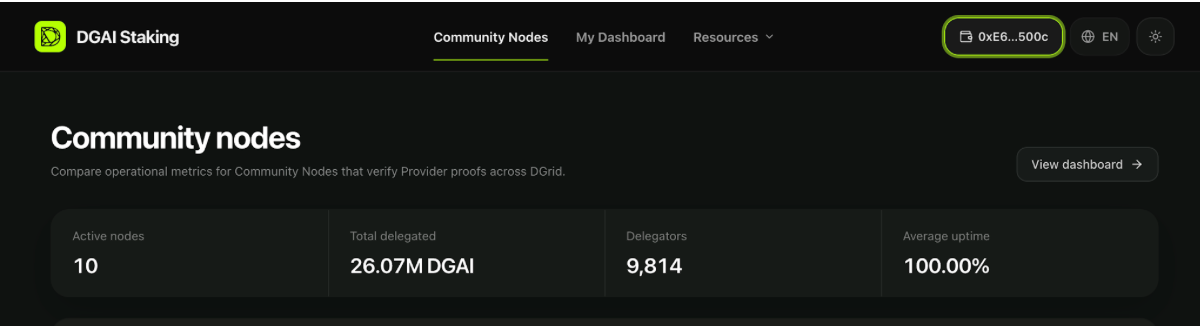
According to the DGrid staking page, total staked volume exceeded 26M $DGAI within 48 hours of the validator-node launch, with nearly 10,000 users participating.
The page referenced in the article is https://staking.dgrid.ai/.
The market DGrid says it wants to build
DGrid describes its infrastructure as a stack connecting model access, supply, verification, execution and economic weighting inside an AI inference market.
- Unified access layer: the AI Gateway provides an OpenAI-compatible API, and developers can use one API key to access 200+ models, with intelligent routing, load balancing and Compute Unit-based unified billing intended to reduce vendor lock-in and migration costs.
- Open market layer: the Model Marketplace lets providers list models, set prices and settle revenue through on-chain smart contracts, while PoQ adds a public and verifiable quality signal for open supply.
- Quality verification layer: PoQ, backed by five technical papers, uses randomized blind testing, multi-dimensional evaluation and on-chain proof to verify the service a provider claims to deliver, without touching real user call data.
- Network execution layer: validator nodes turn PoQ from protocol logic into a quality audit carried out continuously by network participants, aimed at strengthening authenticity, stability and consistency in AI services.
- Economic security layer: staking links $DGAI delegation, validator-node operating weight and network incentives, which DGrid says upgrades quality verification into an economically secured system executed by validator nodes and weighted by staked capital.
The company’s broader thesis is that AI inference will increasingly resemble a market rather than a closed service run by a single platform. In that market, there will be more models, more providers, changing prices and more dynamic routing. What becomes scarce is not only access to models, but the ability to keep proving that model services are real, stable and auditable.
DGrid presents validator nodes and PoQ as an infrastructure answer to that problem. The approach does not ask a centralized platform to tell users which provider to trust. Instead, the company says continuous verification, public records and economic weight can allow reputation and selection to emerge through the market itself.
That is the main significance DGrid attaches to the validator-node launch. The update is framed not as a simple staking entry point or a routine product release, but as a step from a model-access network toward a verifiable AI inference market.
Publication note and disclaimer
The article says that as AI agents, on-chain applications and developer tools rely more heavily on model inference, the standards used to judge AI infrastructure are changing. Access still matters, but the ability to prove service quality is becoming a dividing line.
It also says the DGrid validator-node launch offers a case worth watching: PoQ continues to handle quality verification, while validator nodes and staking push that system into network execution and economic weighting. For an open AI market, the value of such a mechanism may lie in making trust verifiable.
The original article includes a disclaimer stating that markets involve risk and the article does not constitute investment advice. Users should consider whether any opinions, views or conclusions in the article fit their own circumstances, and they bear responsibility for decisions made on that basis.