
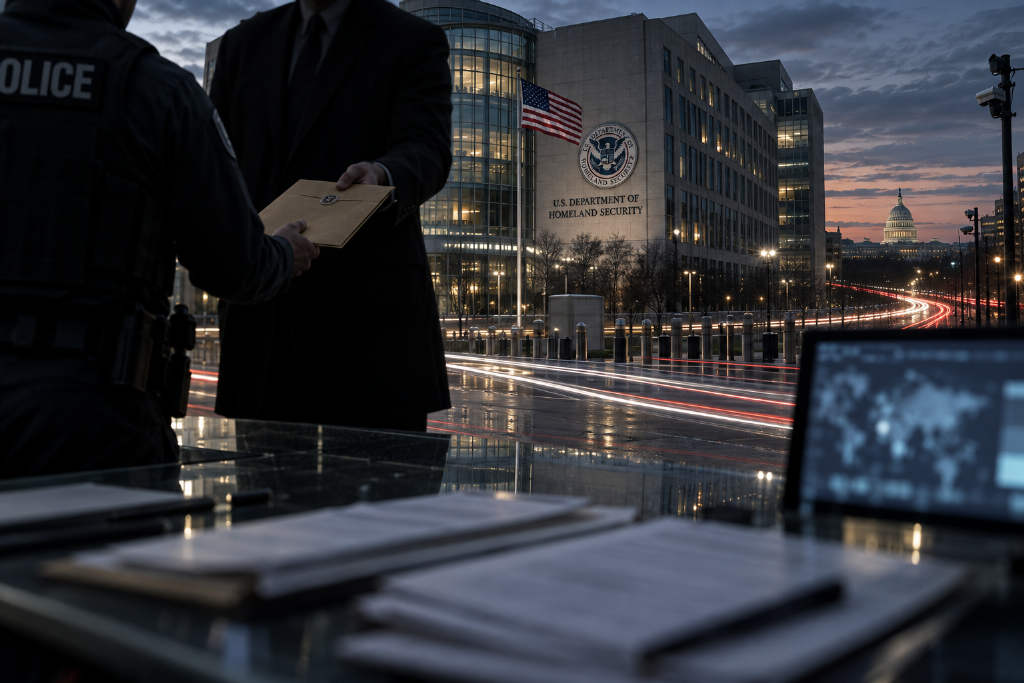
Coin Center’s Laz Pieper argues in a CoinDesk opinion piece that the U.S. Department of Homeland Security has been aggregating Americans’ financial activity data, analyzing it and then giving local law enforcement tips on potential criminals. He describes that practice, known as predictive policing, as authoritarian because it depends on mass surveillance to gather enough information to decide whether someone could be a criminal in the eyes of the state.
Pieper opens with a blunt claim: targeting Americans based on what their spending habits may reveal about their politics is an abuse of the financial system. His argument is that information does not speak for itself. The party that collects and interprets the data controls the story. In this case, he says, the state becomes the narrator, deciding which dots to connect and what picture to paint. That creates obvious room for abuse because large pools of data can be selectively used to justify almost any conclusion and then support official action.
To make the point, he quotes Cardinal Richelieu: 「If you give me six lines written by the hand of the most honest of men, I will find something in them which will hang him.」 Pieper says predictive policing works in much the same way. Law enforcement watches a person’s movements, associations and transactions to decide whether that person might commit a crime, then acts on that suspicion. In the current setting, he writes, part of that process is built on financial surveillance, which means transaction histories are effectively treated as evidence before any wrongdoing has been established. He calls that both unconstitutional and un-American because it reverses the idea of innocent until proven guilty and leaves people in a permanent state of suspicion.
Montana stop tied to a DHS predictive team
The clearest example in the column is Kyle William Olson. Pieper says a traffic stop in Montana was triggered by a Border Patrol Predictive Intelligence Targeting Team, or PITT. A DHS memo produced in Olson’s criminal case and shared with 404 Media said the team had identified 「financial activity patterns commonly associated with illicit narcotics activity,」 but did not explain which records were reviewed or how the government obtained them.
Police later found marijuana in Olson’s vehicle. Pieper says that outcome does not answer the core question. His point is that the government was secretly analyzing Olson’s finances before officers had identified a specific crime, and that is the part he says should alarm the public.
Alek Schott case and the Fourth Amendment dispute
Pieper also points to reporting on Alek Schott. According to the column, Schott was pulled over for allegedly drifting between lanes, and officers searched his truck for drugs. No drugs were found. The Associated Press reported that federal agents had monitored Schott’s travel patterns through license-plate scans and other surveillance technologies.
Schott is now suing Bexar County, along with the sheriff and some deputies, alleging violations of his Fourth Amendment rights. Pieper says the lawsuit is justified. He quotes the Institute of Justice, which wrote: 「Police must have a fact-based suspicion of a crime before making a stop, a valid reason to extend that stop, and either a warrant, consent, or an objective reason to believe there’s contraband inside to search a vehicle. In Alek’s case, the deputy failed to meet any of these criteria and instead used an unjustified traffic stop to probe into crimes Alek hadn’t committed.」
For Pieper, the Olson and Schott cases raise the same set of questions. Where did the suspicions come from? As with other stops reported by 404 Media, he says the evidence suggests DHS Border Patrol helped instigate them. That leads to the next issue: how DHS obtained the underlying data in the first place.
FinCEN and the Bank Secrecy Act framework
On financial records, Pieper points to the Financial Crimes Enforcement Network, or FinCEN, the Treasury Department bureau that oversees compliance with the Bank Secrecy Act. Under that law, financial institutions must keep records and report certain large or suspicious transactions to the government to help detect money laundering and other illicit activity. FinCEN then shares information with other federal agencies for regulatory purposes. Pieper says that is likely how DHS received the data.
He argues the reporting system is broad by design and often broader in practice. Financial institutions, he writes, tend to over-report in order to reduce the risk of non-compliance. The result is widespread suspicious activity reporting and a large stockpile of information on Americans’ financial lives inside FinCEN.
Pieper rejects the idea that this makes the public safer. Financial transactions, he says, can function like confessions about a person’s beliefs, associations and desires. Those details are deeply personal, and they can also become the basis for discrimination. He says this is not theoretical. Financial surveillance and financial censorship have long been used in both Western democracies and authoritarian states to identify and silence political dissidents.
Examples from Canada, post-Jan. 6 banking scrutiny and a Trump order
The column reaches outside the DHS cases to show how financial systems can be used for political targeting. Pieper notes that in 2022, Canadian Prime Minister Justin Trudeau used emergency powers to freeze the personal and corporate bank accounts of protesters, framing the move as necessary for safety and security. He writes that Canada presents itself as a liberal democracy, yet acted no differently from China that same year, when WeChat banned the accounts of protesters. Pieper highlights WeChat because it combines payments and messaging in a single, deeply integrated platform.
He says the United States has shown the same vulnerability. Citing a 2024 congressional report, Pieper writes that after the Jan. 6 attack on the U.S. Capitol, banks were pressured by FinCEN and the FBI to identify 「extremism」 by looking for spending habits associated with conservative views, including purchases of 「religious texts.」 He says the point is not to relitigate the riot itself. His argument is that using spending patterns to infer political beliefs and then report Americans to law enforcement is an abuse of the financial system. In his view, spending behavior in the Washington, D.C. area that appears to reflect conservative views should not by itself trigger reporting to authorities.
Pieper adds that the issue is not confined to one political side. In 2025, President Trump issued an executive order designating Antifa as a domestic terrorist organization. The White House then followed with a memo directing law enforcement to 「identify and disrupt financial networks that fund」 domestic terrorism and political violence. Again, Pieper says he is not arguing over whether Antifa poses a threat. He says the mechanism is the same one used against conservatives after Jan. 6. He also cites the CATO Institute’s question about how far financial institutions might go in the name of compliance. Some activity may clearly indicate terrorism, he writes, but the line becomes much less clear once political views enter the analysis. He quotes the institute’s formulation: 「Will onboarding documents include a questionnaire about a customer’s feelings about fascism?」
Energy-use surveillance and Pieper’s proposed response
Pieper says the examples he lists are politically charged and largely tied to financial surveillance, but the broader problem is not limited to bank records. Information from many sources can be used in the same way. He points to Sacramento, California, where local law enforcement obtained residents’ energy-usage data to identify who was illegally growing marijuana. He says the result was predictable: innocent residents were harassed, which in his view shows the danger of giving law enforcement too much information.
His conclusion is that predictive policing is wrong, but it is also the product of a much older surveillance structure built around the American public. Those surveillance tools, he writes, have given the state the power to target anyone for anything before a crime has been committed, if a crime was ever going to be committed at all.
Pieper says DHS should stop PITT from using financial information and other data for predictive policing. He calls on Congress to direct the Government Accountability Office, or GAO, to conduct an independent audit of DHS data sources, targeting criteria, retention practices, false-positive rates and information-sharing arrangements, and to assess whether the program complies with the Fourth Amendment and other applicable laws. He says the GAO should be required to publish its findings.
He also argues that Congress must make sure federal agencies cannot bypass Fourth Amendment protections by using secret profiles to manufacture suspicion. Judicial authorization, he writes, should be required before DHS can use sensitive financial records in an investigation tied to a specific suspected crime. He also calls for full disclosure whenever federal data analysis triggers a traffic stop.
Pieper closes by saying surveillance places everyone at the mercy of the state, where ordinary activities, associations or beliefs can be treated as criminal or potentially criminal, while the people affected have little ability to defend themselves. He says the state should not use information to decide whether someone may be a criminal and then tip off local law enforcement on that basis. Americans, he writes, should be able to live authentically and with dignity without fear of wrongful prosecution.
CoinDesk notes at the end of the piece that the views expressed are those of the author and do not necessarily reflect those of CoinDesk, Inc. or its owners and affiliates.