
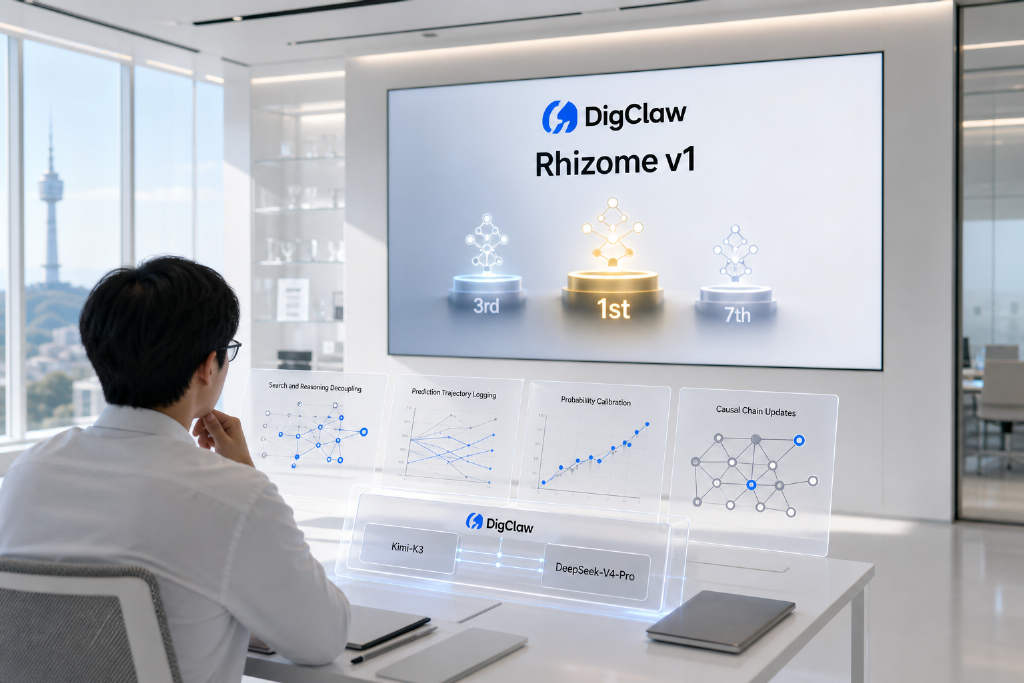
DigClaw said its Rhizome v1 forecasting framework ranked No. 1, No. 3 and No. 7 on the FutureX evaluation platform in July, with the three placements coming from separate runs on different foundation models. The models cited in the article include Kimi-K3 and DeepSeek-V4-Pro, and DigClaw said it was the only participant to place the same framework in the Top 7 across multiple base models.

According to the article, the results came from 59 real-world forecasting questions spanning politics, economics and technology. The questions were submitted before the correct outcomes existed, and the company said there was no possibility of training-data leakage.
DigClaw said the performance supports a thesis it has been trying to validate: forecasting capability can accumulate outside the base model. In its framing, stronger foundation models can improve the system, but prediction trajectories, settlement feedback, calibration experience and an evolving workflow remain inside the forecasting system itself.
Why DigClaw treats the result as external validation
DigClaw described the ranking as the first outside validation of its answer to a larger question: how forecasting should actually be done. The company said it does not view the result as a one-off competition outcome.
The article argues that, as forecasting tasks become more standardized and engineered, AI is increasingly expected to handle complex prediction work at scale. DigClaw then lays out its central objection to a pure large language model approach: LLMs learn correlation rather than causation. Extracting patterns from past text is not the same thing as predicting the future.
It lists three weaknesses. First, the model has a blind spot on causal direction. It may know A and B often appear together, but not whether A causes B, B causes A, or both are driven by a third factor C. Second, intervention reasoning breaks down. The article uses the example of asking what a Federal Reserve rate cut would do to Southeast Asian tech stocks, arguing that an LLM lacks the causal graph required for that kind of intervention analysis. Third, calibration is missing. A model’s “70% probability,” in DigClaw’s view, is not probability in a calibrated statistical sense and instead reflects a byproduct of token distribution.
DigClaw also argues that existing alternatives have limits. Prediction markets rely on liquidity, and pricing becomes unreliable on niche questions. Pattern matching with LLMs lacks causal structure. End-to-end training introduces outcome bias, where a logically rigorous but wrong reasoning path gets penalized while a rough judgment that happened to land on the right answer may be reinforced.
That, the company says, is the reason DigClaw exists. It describes its system as forecasting infrastructure built with causal structure as the skeleton, probabilistic computation as the engine, and search intelligence as the data pipeline. Its working assumption is that forecasting should not be completed end-to-end by a single model. Search, causal reasoning and probabilistic inference are treated as three orthogonal capabilities that should be handled by separate specialized systems and then combined in a structured way.
Three top-10 finishes and cross-base-model transfer
The article calls FutureX one of the most challenging real-time forecasting leaderboards now available. It publishes weekly prediction questions tied to real-world events, accepts submissions before outcomes are known, and settles the results afterward.
DigClaw said the dataset is hosted on HuggingFace and the evaluation framework is open-sourced on GitHub, making the results reproducible and verifiable. Rhizome was run on three different base models under the same forecasting framework and the same operating conditions. Each run generated and submitted answers independently, with no cross-model aggregation.
That point matters in the company’s argument. The No. 1, No. 3 and No. 7 rankings were not produced by combining multiple models into one ensemble answer. DigClaw presents them as three separate executions of the same system method across three base models, a cleaner test of transferability across model backbones.
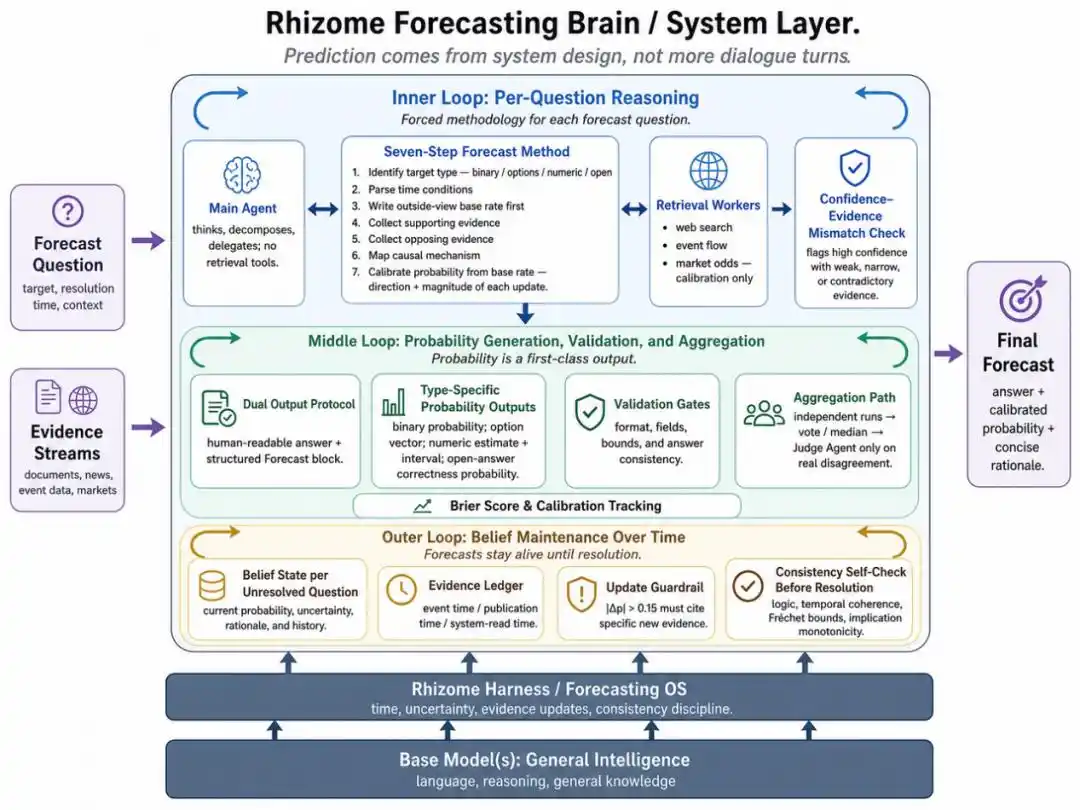
At the same time, the article does not dismiss the importance of foundation models. Base models still provide general capabilities in language understanding, reasoning and tool use. What the FutureX result is meant to show, DigClaw says, is that search organization, time handling, probability expression, evidence maintenance and long-horizon run control can become system-level capabilities that sit outside model weights.
Design decision one: separate search from reasoning
In the technical report cited in the article, DigClaw says the first major engineering choice behind Rhizome is to decouple search from reasoning and let multiple models play different roles.
Its core claim is that search quality and reasoning quality are orthogonal problems and should not be optimized inside the same model at the same time. The article contrasts Rhizome with mainstream DeepResearch agents such as Perplexity and Gemini Deep Research, which it characterizes as systems that bind search and reasoning together. In DigClaw’s view, that setup drags down search with reasoning burden and contaminates reasoning with search noise.
Rhizome instead splits them cleanly. The search agent is tasked only with finding relevant information. The reasoning layer only performs structured reasoning over the evidence that has already been gathered. DigClaw argues that forecasting does not need a system that simply answers the user’s question correctly. It needs one that discovers as many relevant signals as possible.
That is why, in the article’s description, the search agent is optimized for relevance rather than accuracy. If the search system is trained to “find the answer,” it may over-prefer material that already looks like a conclusion, which DigClaw sees as dangerous in forecasting tasks.
Training uses a reinforcement learning framework called SearchRL, with two tracks running in parallel:
- Track A: RL fine-tuning on open-source 8B and 30B parameter models using search relevance as the reward. The article cites Search-R1 at COLM 2025 and ReSeek at ICML 2026 as references.
- Track B: an external search-constraint harness built for closed-source models such as Claude and GPT.
DigClaw said different base models show stable differences on forecasting tasks. Some are better for long retrieval sessions and complex reasoning. Some are stronger at quantitative modeling. Others have an edge in cost and response speed. Rhizome therefore places forecasting protocol, agent orchestration, tool calling and result evaluation outside the base model, so institutions can choose a model according to task value and operational scale.
Design decision two: preserve trajectories and calibrate probabilities
The second design pillar is complete trajectory recording. DigClaw said Rhizome keeps a versioned record for every prediction, including the time conditions and settlement criteria of the question, the evidence available at prediction time, the agent orchestration and tool-calling process, the final answer and probability, and the model and system version used in that run.
Because these records are created before outcomes are known, DigClaw says they preserve the system’s real judgment under uncertainty. Once the event settles, Rhizome appends the real-world result to the same record and reviews what information was available at the time, which contrary evidence was missed, and whether the error came from retrieval, time judgment, reasoning, answer expression or probability calibration.
The article draws a distinction between two kinds of wrong calls. A high-confidence mistake and a near 50-50 mistake are both logged as wrong, but they reveal different kinds of system failure.
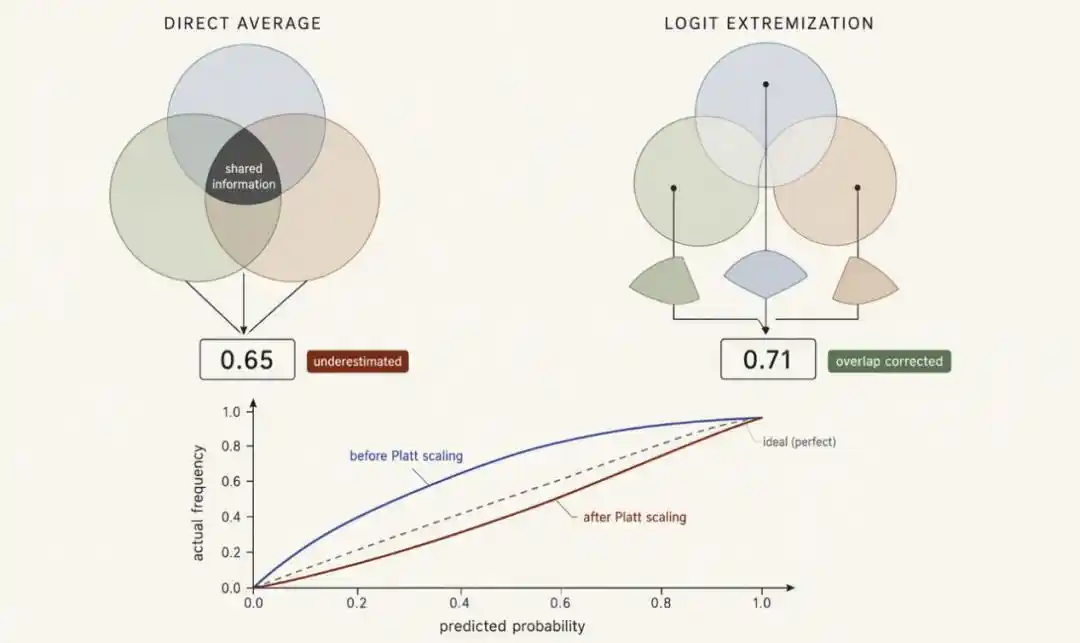
Rhizome also runs multiple independent predictions on the same question. Instead of averaging them directly, DigClaw said the system aggregates them in logit space and then adjusts extremization intensity using the Brier Score from already settled questions. If the information carried by different trajectories is more independent, the aggregate can move more decisively. If the evidence overlaps heavily, the adjustment becomes more restrained.
On top of that, Rhizome applies Platt scaling to settled questions to identify persistent overconfidence or excessive conservatism and calibrate later probabilities. The target is straightforward: events assigned a 60% probability should occur around 60% of the time over the long run, and events assigned 80% should occur around 80% of the time.
Each run is tied to the system version and key configuration that produced it, so any shift in probability or abnormal result can be traced back to a specific cause. DigClaw said this continuity remains even if the foundation model is upgraded or replaced. The problem definition, evidence record, belief changes, settlement results and calibration experience stay intact.
The company argues that this feedback dataset cannot be fabricated in bulk after the fact. Every sample has to be recorded before the future event happens and then wait for reality to provide the answer. Code can be replicated, the article says, but time-accumulated data assets cannot be rushed.
Design decision three: causal-chain-aware updates
For unresolved events, DigClaw says a forecasting system has to keep absorbing fresh information and decide whether the prior probability should change. Rhizome stores a belief state for unresolved questions and records three timestamps for each piece of evidence: when the event occurred, when the content was published and when the system read it.
If new information fully duplicates what is already on record, the system skips the update. If new evidence conflicts with older evidence, the earlier item is not deleted. The revision process itself is preserved. The article also sets a hard trigger: when a single probability move exceeds 0.15, the system must be able to point to the specific new evidence that caused it.
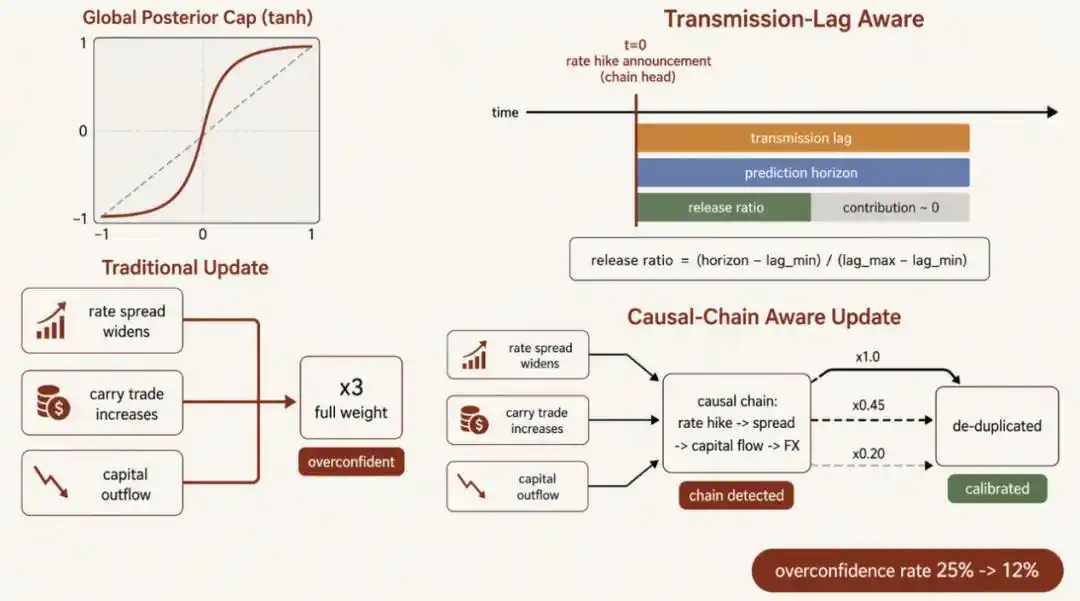
The tougher issue, in DigClaw’s framing, is whether new evidence represents several independent forces or several signals left by the same causal chain at different points. The article gives an example involving a rate-hike announcement, interest-rate differentials and capital flows. Those signals may appear one after another, but they are not necessarily independent pieces of information. If the system counts them separately, the same underlying cause may be double-counted and push the forecast into excessive confidence.
To address that, Rhizome is developing what DigClaw calls a causal-chain-aware Bayesian updating framework. Before a piece of evidence is allowed to affect the forecast probability, the system first identifies the causal transmission chain it belongs to and then adjusts its weight based on the relationships inside that chain.
The framework, as described in the article, has four layers:
- A causal knowledge base that stores validated causal chains and records transmission lags, impact decay and historical credibility for key relationships.
- Same-chain signal deduplication, so later signals from the same causal chain are not counted again at full weight.
- A global posterior cap that limits the cumulative impact of multiple signals pointing in the same direction, with constraint strength adjusted by the forecasting horizon.
- Transmission-lag awareness, so after the head event in a chain occurs, the system updates gradually according to the transmission process instead of immediately pricing the full effect into the tail event.
DigClaw said this framework has completed prototype implementation and preliminary validation inside its internal forecasting system and has already guided multiple investment decisions in practice. The article reports that, compared with direct Bayesian aggregation, same-chain signal deduplication and the global posterior cap lowered the overconfidence rate from about 25% to 12%, where overconfidence is defined as forecasts above 85% that ultimately turn out to be wrong.
Why an investment firm is building forecasting models
The article links the research directly to investing. It says Newborn Ventures was launched by DigClaw and is presented as the world’s first investment and incubation firm driven by AI-based Beta trend mining. DigClaw’s trend-forecasting base is described as the underlying technical framework for that AI-native VC.
Its thesis is simple: investing is fundamentally a forecasting problem. Whether a sector will break out, whether a team will emerge as a winner, and whether a technology will become mainstream are all forms of prediction. The article says traditional investing depends on partner experience, intuition and information advantages, while DigClaw believes those judgments can be systematized and modeled.
From a wider angle, the article breaks investment returns into Beta, driven by events and trends, and Alpha, tied to asset-specific characteristics. DigClaw argues that Alpha research is already relatively mature, but Beta — forecasting macro events and trend direction — still lacks a truly effective AI solution. That is the gap it says it wants to fill.
In DigClaw’s view, once forecasting becomes a callable, integrable and calibratable parameter rather than pure intuition, it can be embedded in many more decision settings. For listed companies, that would mean strategic anticipation and risk warning before supply-chain shifts or policy direction become obvious. For investment institutions, it would mean identifying value before consensus forms. For government-guided funds, it would mean evaluating industrial trends and policy effects through a systematized method.
The same forecasting capability, the article says, is being tested publicly on FutureX, used internally for investment decisions, and opened as a service to industrial companies, financial institutions and government-guided funds. DigClaw said the FutureX first-place finish is a starting point, not an endpoint, for both DigClaw and Newborn Ventures.
About DigClaw and Newborn Ventures
DigClaw is described in the article as an AI technology company focused on predictive intelligence, with a mission to build forecasting infrastructure that is calibratable, auditable and integrable. Its flagship Rhizome framework combines causal reasoning, probability calibration and search intelligence in a three-layer architecture meant to create system capability independent of the underlying model. In that setup, the base model can change while forecasting assets continue to accumulate.
The article says DigClaw’s forecasting system has already received external validation on public evaluation platforms including FutureX and that the same capability is being applied to investment decisions, industry trend analysis and strategic risk assessment, while being opened for collaboration with industrial players, financial institutions and government-guided funds.
Newborn Ventures is described as an AI-native early-stage venture capital and incubation firm. Its core belief is that investing is forecasting, and that judging whether a category will accelerate, whether a team will succeed, and whether a technology will become mainstream can all be turned into structured, model-driven prediction tasks.
According to the article, Newborn Ventures uses its self-developed Deep Research Agent and causal forecasting system to track innovative signals in AI reasoning around the world and find structural opportunities that the market has not yet priced in — what it calls true Beta. From first contact to investment decision, the firm says it has rebuilt every step with AI and promises clear feedback with technical depth within 48 hours.
The article states that it was republished with authorization from QbitAI and that the views belong to the original author. It credits the piece to the WeChat public account "量子位" and names the author as Yunzong.