
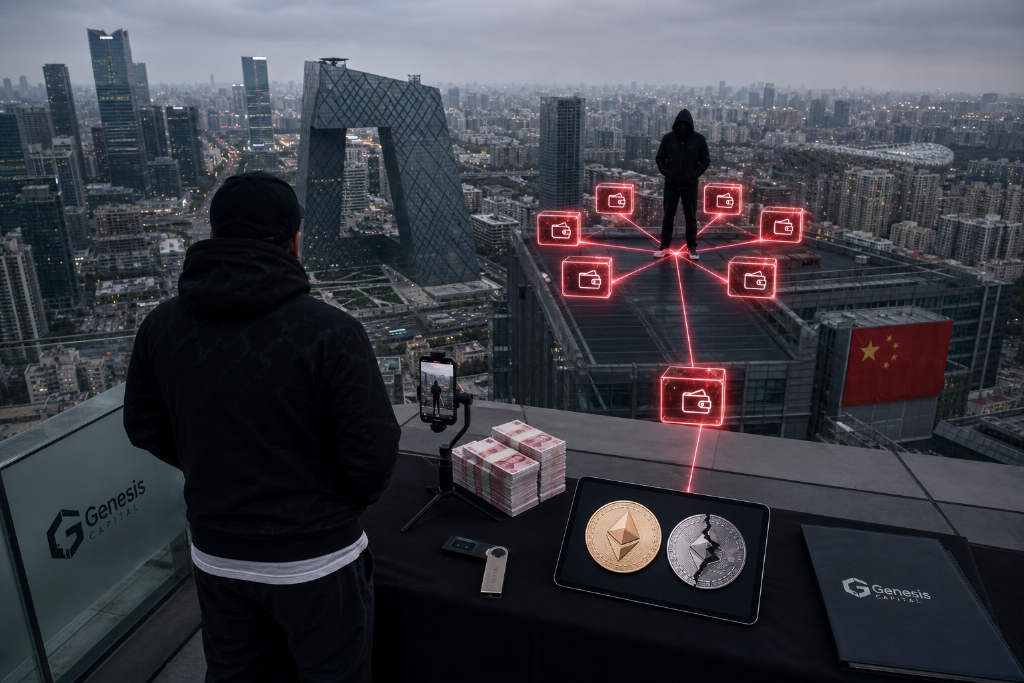
A dispute involving tens of millions of yuan in crypto assets has spread quickly across China’s digital-asset community after livestreamer Dishi said he had been trapped in an eight-year scheme.
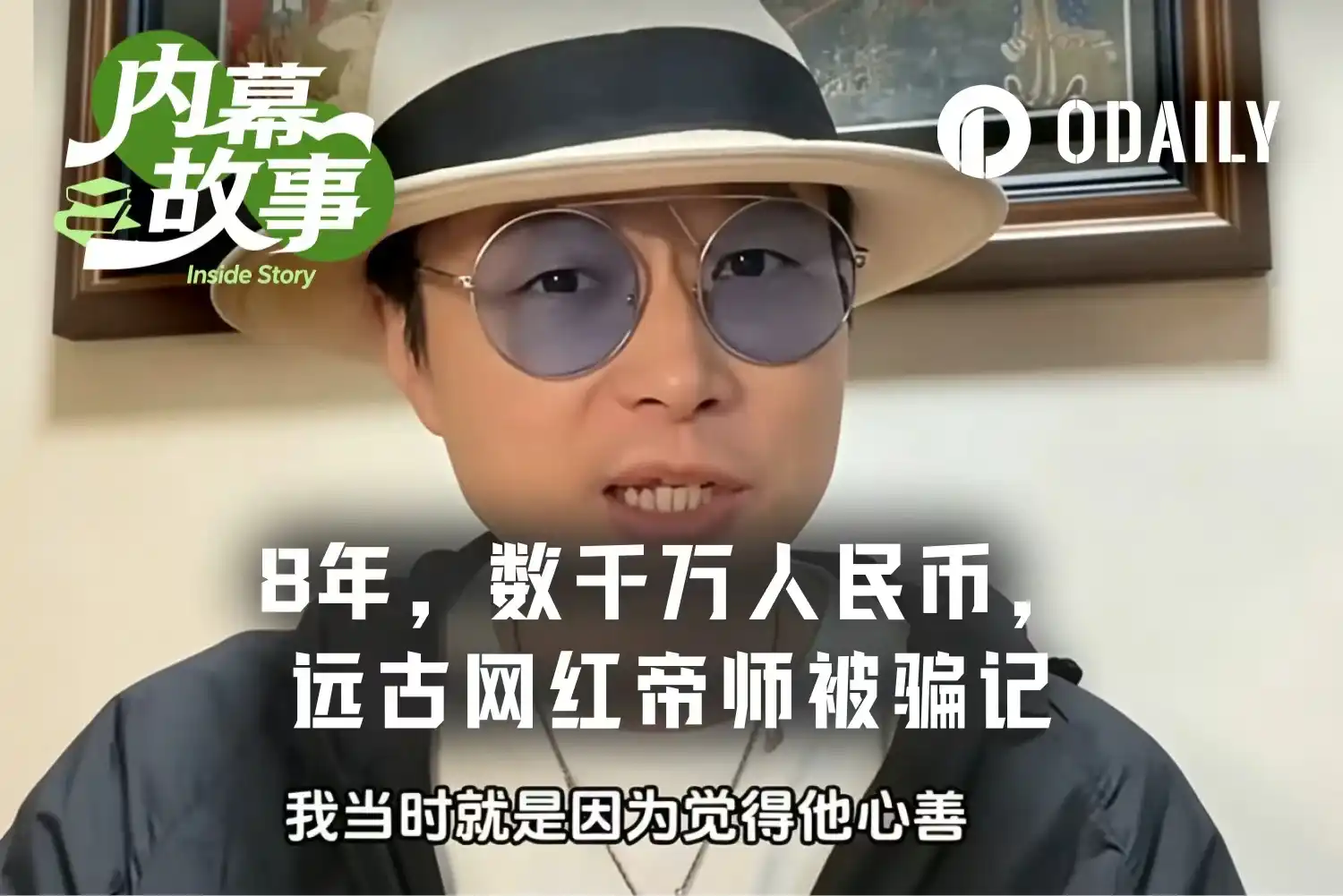
In a recent livestream, Dishi said a crypto acquaintance he had known for eight years set him up and caused cumulative losses of tens of millions of yuan. The original report by Odaily noted that one version of the figure was around 30 million yuan. Dishi identified the other party as Sun Zeyu, founder of Genesis Capital. According to Dishi, some of the “Ether” Sun had purchased on his behalf was later found by state-level white-hat researchers not to be real ETH on Ethereum, but token balances on a forked chain allegedly created specifically for him.
Dishi said the chain contained just seven addresses in total. Six, he claimed, were arranged by Sun Zeyu, and only one belonged to his own wallet. Over the years, Sun had also helped him cash out several million yuan, which Dishi said convinced him the assets were genuine. Those successful withdrawals became the basis for deeper trust.
Dishi added that he had even introduced friends to Sun for crypto purchases and had stepped in as a guarantor in at least one planned deal. That transaction was later dropped for unrelated reasons. In Dishi’s telling, had it gone through, at least 10 million yuan from a friend might also have been exposed.
He said the losses could have grown to hundreds of millions of yuan if the issue had not been discovered in time as crypto prices moved higher. At the time of the original report, there had been no police filing notice or court judgment. Any final legal conclusion, including whether the conduct constitutes fraud, remains for judicial authorities to decide.
Who the two men are
The case drew attention not only because of the amount involved, but also because both sides had once held visible positions in their respective fields.
Dishi, whose real name is Sun Zixuan, was born in Beijing in 1984. During the early boom years of Chinese livestreaming, he became known as a leading outdoor streamer. He once said he had “seen a dragon,” a claim that led some internet users to nickname him “the man who has seen a dragon.” In 2016, he began livestreaming on Quanmin TV. In 2018, at the peak of the sector’s popularity, he moved to Penguin Esports and quickly became one of the platform’s most recognized outdoor hosts. His streams included outdoor adventures, food reviews, celebrity interviews, gossip, rumors, and historical content. Public accounts cited in the report said he had livestreamed dinners with actress Song Dandan and her son, attended a Huayi celebrity gala, and visited esports team bases. At his peak, his account had millions of followers.
His career took a major hit in 2022. On June 9 of that year, the Second Inspection Bureau of the Beijing Municipal Tax Service under China’s State Taxation Administration said streamer Sun Zixuan was suspected of tax evasion. Authorities found that from 2019 to 2020 he failed to file tax returns in accordance with the law and underpaid 1.9786 million yuan in individual income tax, concealed livestream tipping income through intermediary companies and evaded another 2.2012 million yuan in individual income tax, and underpaid 347,600 yuan in other taxes and fees. The final amount, including recovered taxes, late fees, and fines, reached 11.7145 million yuan. The tax case badly damaged his streaming career, and he faded from public view for a period afterward.
Sun Zeyu, the other central figure in the report, had long been active in crypto. Public information cited by the article said he entered the blockchain sector in 2013, making him one of China’s earlier crypto practitioners. In 2016, he participated as a partner in the founding of Kusun Wallet, a hardware wallet focused on secure storage of crypto assets. In December 2017, he and Zhu Huaiyang co-founded Genesis Capital, which focused on venture investment and investment-banking services for the blockchain industry.
In media coverage, Sun had been described with titles including “special commentator invited by CCTV,” “blockchain advisory committee member at Peking University’s Financial Technology Innovation Lab,” and “founding partner of Genesis Capital.” In an interview with The Guardian, he was quoted as saying that within ten years, Bitcoin would be worth “one villa per coin.” In 2018, Jiemian referred to him in a report as “the most sincere post-90s person in the crypto circle” and said he had accumulated a nine-digit fortune over six years. After Genesis Capital was established, he was linked in the article to investments in projects including DeepBrain Chain (DBC), IOS, AELF, JEX, and Game.com.
The report said the two met in 2018, when both appeared to be on the way up. Dishi was at the peak of his influence and earnings in livestreaming, while Sun Zeyu was a hot crypto investor familiar with digital-asset deals. One had capital to allocate. The other appeared ready to provide expertise and execution.
How Dishi says the eight-year scheme worked
According to Dishi’s account, he first connected more deeply with Sun after another friend of Sun had taken nearly 10 million yuan from him. Sun then offered to help him “win it back” through quantitative trading and, Dishi said, earned his trust by delivering a 4x return. After that, Dishi bought Bitcoin through Sun several times without apparent problems. Later, worried about the safety of leaving funds on exchanges, he followed Sun’s suggestion and placed assets into Kusun Wallet, which he now says opened the door to an asset swap.

His description of the mechanics can be broken into several stages.
Step one: build trust through public identity and small successful deals
Sun’s public image as the founder of Genesis Capital, co-founder of Kusun Wallet, and a media-visible crypto figure helped establish credibility. For someone outside the technical core of the market, those labels could function as a direct trust signal.
At the beginning, Dishi said Sun bought mainstream cryptocurrencies such as Bitcoin and Ether on his behalf, and everything looked normal. When Dishi needed cash, Sun could also arrange withdrawals of several million yuan. Those completed transactions strengthened confidence and made later, larger commitments easier.
Step two: replace real ETH with assets on a private forked chain
Dishi said the central issue involved part of his Ether position. In his telling, Sun did not use the relevant funds to buy actual ETH on Ethereum mainnet. Instead, he allegedly created a private forked chain and issued lookalike tokens there, then presented those balances as if they were real Ether.
Because Dishi was not a technical specialist and had limited ability to verify on-chain assets himself, he said he could not tell whether the “Ether” displayed in his wallet corresponded to actual mainnet assets or to digital symbols existing only on a private chain. For him, wallet balances were visible, tokens were received, and large withdrawals could occur. That was enough to sustain the appearance of legitimacy.
Later, Dishi said, investigators found that the chain had only seven addresses, six tied to Sun’s side and one belonging to him. In the framework of Dishi’s accusation, that meant his real money had never been represented by genuine market-traded ETH, but by figures recorded on a private ledger controlled by the other party.
Step three: broaden the investment scope
Beyond delegated crypto purchases, Sun also recommended other investment opportunities, including a cryptocurrency exchange he operated in South Korea, according to the report. Dishi said he kept adding funds because he trusted him.
Step four: maintain the illusion and delay discovery
Dishi’s account suggests the arrangement lasted because it kept producing positive signals. Withdrawals, occasional profits, market updates, and even routine holiday greetings all reinforced his belief that the investment relationship was functioning properly and that the asset value was rising.
The article said this process lasted eight years and involved tens of millions of yuan. Dishi said he did not uncover the alleged “fake chain, fake Ether, fake coin” issue until 2026, after hearing about a series of other money-related disputes involving Sun and then commissioning a professional investigation.
Other public allegations cited in the report
The report said Dishi was not the only person to raise complaints over delegated investments involving Sun Zeyu.
In February 2026, Wublock recorded a podcast that was released in April under the title “Sun Zeyu delegated-investment victims: how did a crypto big name turn into a scammer?” Two guests described separate disputes with him.
The first was William Lu, also known as Qingtian, an early crypto industry participant. According to the program, in 2022 he joined a primary-market delegated investment in TIA, the token of Celestia, through an intermediary and paid Sun about $300,000. The two sides signed a written contract listing Sun’s name, ID number, receiving address, and signature. After TIA went live, however, William Lu said he never received the corresponding tokens and Sun then disappeared.

The second was Luzi, founder of BitRing and a Web3 entrepreneur. According to the account cited in the report, in early 2021 his team transferred about $1.5 million to Sun under the name of a wealth-management style investment. Of that amount, a partner had previously put in $500,000 and later added another $1 million. Luzi said Sun promised annualized returns in the low double digits and gave an oral principal-protection assurance. Soon afterward, Sun said the funds had all been lost in a liquidation event, but never provided trading records or proof of liquidation, returned none of the money, and later became unreachable.
Those two alleged victims estimated that three to four victims could be confirmed on social media, with single-case amounts ranging from hundreds of thousands of dollars to more than $1 million. Another crypto industry figure identified only as “94” was said to have lost about $1 million. The article added that more victims may not yet have gone public.
On recovery efforts, the report said victims believed Sun was no longer in mainland China. It also mentioned an unverified rumor that he was in Cambodia and under the control of forces associated with local compounds. The article did not present independent confirmation of that claim, but said cross-border pursuit in crypto-related disputes is often difficult.
From one case to broader market risks
The article argued that the Dishi case is not an isolated one and that delegated-investment schemes are only one part of a wider risk picture in crypto.
- PlusToken pyramid case: In 2020, police in Yancheng, Jiangsu, broke the PlusToken online pyramid scheme case. It involved 310,000 BTC and 9.17 million ETH, with the assets valued at more than 40 billion yuan at the time.
- Delegated-investment disappearances: Since the ICO boom of 2017, there have been repeated cases in which intermediaries collected funds and vanished, project teams colluded with agents, or fake tokens were passed off as real ones.
- Fake wallets and fake exchanges: Phishing websites, malicious wallet apps, and sham exchanges continue to cause major losses for users each year.
These cases differ in form, but the common thread is the use of information asymmetry and trust to move real money or mainstream coins away from investors and replace them with assets that cannot be redeemed or have no real value.
The article said the Dishi dispute stands out because it appears, in his telling, to have pushed the logic of a trust-based acquaintance scam to an extreme. A slow-moving setup that preserves appearances can be harder to detect than a simple grab-and-run.
Four warnings highlighted by the report
Do not hand your assets to someone else to hold
The report quoted a basic crypto principle: “Not Your Key, not your coin.” If you do not control the private keys, you do not truly control the assets. No matter how prominent or familiar the other person is, delegated buying, delegated investing, or delegated custody means handing away control. In Dishi’s account, he said he did not even realize in time that some of what he held might not have been real coins.
Learn how to verify that assets exist on a real public chain
The article said investors should at minimum know how to check whether assets exist on a real public blockchain through block explorers. It cited Etherscan for Ethereum and Blockchain.com for Bitcoin. Under that logic, a “chain” with only seven addresses would not be verifiable on the public infrastructure used for the actual networks.
Build enough basic knowledge before investing
The report said crypto investing carries a high technical threshold, involving public-chain architecture, wallet security, smart-contract risk, and on-chain analysis. For people outside the sector, the suggested paths were either to hire a truly professional team with qualifications and custody arrangements for compliant operations, or to spend enough time learning the basics and practical verification methods on their own. The most dangerous position, it said, is to think you understand the field while lacking the ability to distinguish a fake chain from a real one.
Be wary of referrals from acquaintances and promises of high returns
The report also said many investment traps begin with a recommendation from someone familiar: special allocations, principal-protected products, or stories about 100x tokens. Any crypto investment that promises principal safety, fixed returns, or guaranteed profits deserves strong skepticism. That includes DeFi arbitrage setups that may look attractive on the surface.
As of the article’s publication, there had been no official police case notice or judicial ruling tied to Dishi’s allegations. The final legal characterization remains unresolved. Even so, the combination of Dishi’s public account and the additional claims cited in public interviews has again put the risks of over-the-counter crypto dealing, delegated investing, and third-party custody under scrutiny.