
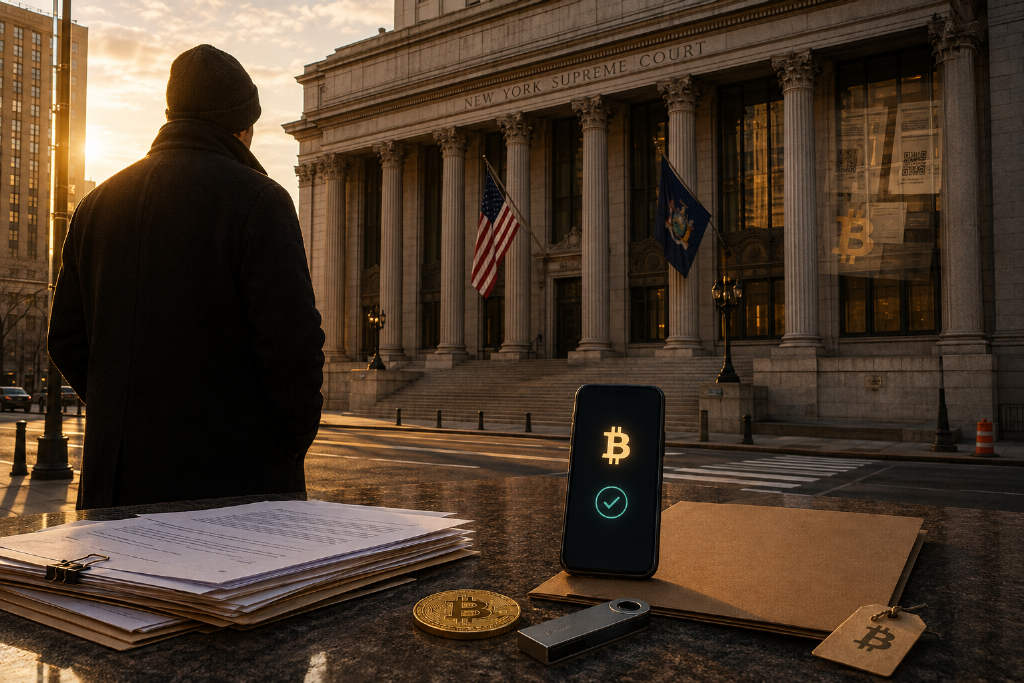
A Bitcoin address that had not moved since Nov. 5, 2011 transferred its entire balance of 40.00001152 BTC on Sept. 3, 2026 at 14:35 UTC, in block 965,330. The coins were acquired when Bitcoin traded at about $3, putting their original value at less than $120. At the time of the transfer, the holdings were worth about $3.09 million. By press time, with Bitcoin at $80,962, the same amount was worth about $3.24 million.
Galaxy Research tagged the address as "Noah Doe #38097" and linked it to a New York lawsuit that names 39,069 allegedly abandoned Bitcoin addresses. The plaintiffs in that case are trying to secure legal ownership of about 3.8 million BTC. Depending on the valuation date, reports cited the stash at roughly $285 billion to $293 billion.
A wallet from Bitcoin's early years woke up after 14 years and 10 months
The address first received 40 BTC on Nov. 5, 2011, a period the crypto community has often described as the "Satoshi era" because Bitcoin was still in its early life. Then nothing happened for nearly 15 years.
That changed on Sept. 3, 2026, when the address moved all 40.00001152 BTC in one transaction. Galaxy Research said the paper gain amounted to 2,571,899%. The firm also noted that this is a price-appreciation figure, not a realized profit calculation, because moving Bitcoin from one address to another does not mean the coins were sold.
Two legal notices were delivered over the Bitcoin blockchain
On-chain records on mempool.space show that the address received two dust transactions carrying legal messages during its dormant period.
The first arrived on July 30, 2025 in block 907,848. Its OP_RETURN field read: "LEGAL NOTICE TO WALLET OWNER: Go To Webpage: salomonbros.com/legal-notice." OP_RETURN is a field in Bitcoin transactions that can store a short text string permanently on-chain. Salomon Brothers Strategic Advisors is identified in the report as the plaintiffs' blockchain adviser.
The second came on May 22, 2026 in block 950,574. That message used the phrase "COURT-ORDERED LEGAL NOTICE" and included a URL pointing to a notice page for case number 153119/2026. The same batch was sent to five addresses, each receiving 546 satoshis, or 0.00000546 BTC.
In practical terms, the court allowed the Bitcoin blockchain itself to be used as a channel for service. Wallets that the plaintiffs described as abandoned received tiny transfers carrying the legal notice. CoinDesk reported that the plaintiffs' adviser broadcast 98 such notice transactions between blocks 950,446 and 950,576, and the notified wallets had 90 days to respond.
What the $293 billion lawsuit is trying to do
The case is styled as ABC Company, XYZ Company and Noah Doe v. John Does 1-39,069. It was filed in New York County Supreme Court on March 11, 2026 under case number 153119/2026 and amended once on May 1. The plaintiffs are an individual using the pseudonym "Noah Doe" and two Wyoming limited liability companies.
They argue under New York Personal Property Law § 7-B, a statute tied to lost property. In the case, Noah Doe is described as the "finder." The law was originally written for situations in which someone finds property and the original owner does not reclaim it.
Researchers reviewing the complaint estimated that the 39,069 named addresses held about 3.7 million to 3.8 million BTC. Based on Bitcoin's price at different moments, the value cited in reporting ranged from $285 billion to $293 billion. The list reportedly includes addresses tied to Bitcoin creator Satoshi Nakamoto and one address connected to the Mt. Gox theft.
The plaintiffs say the wallets were identified through an algorithmic screening process, that a police report was filed, and that holders were notified through small on-chain transactions carrying legal messages.
Pushback has already reached the courtroom
The case had been heading toward a default judgment path, but New York State Supreme Court Justice Kathy J. King signed an order on June 4, made public on June 5, pausing the proceedings. The pause followed an amicus filing from New York attorney Ian R. Cohen challenging the plaintiffs' legal theory.
Cohen argued that the Bitcoin blockchain is a public ledger and that public addresses do not show that the plaintiffs control the relevant private keys. He also questioned whether on-chain service satisfies constitutional due-process requirements. David D. Lin, counsel for the plaintiffs, asked the court to vacate or modify the stay, saying no defendant had appeared and the case should keep moving.
On June 30, a holder identifying as "John Doe 33" formally appeared and moved to dismiss, becoming the first wallet owner to contest the matter in court. On July 10, the Bitcoin Policy Institute sought to intervene as a defendant. Conner Brown of the institute said a plaintiff victory would create pressure for institutions and individuals to give up self-custodied property entirely.
Wallet activity has weakened the abandonment argument
Address movements have become a direct problem for the plaintiffs' theory. Alex Thorn of Galaxy Research said that since the suit was filed, 52 named addresses have moved 34,335 BTC, worth about $2.48 billion, and 29 of those addresses moved after receiving notice. By July, the plaintiffs had already removed 44 addresses from the list after they became active following the start of the case.
After seeing another wallet move earlier, Thorn said the coins were "obviously not abandoned."
The coins moved, but there is no public sign of a sale
As for the Sept. 3 transaction itself, the report said the receiving address, bc1qgg5qnpdnstrqv247t7czuyguzn8daxhr82rfk7, had only one incoming transaction by press time. The full 40.00001152 BTC remained there, with no outgoing movement.
The destination uses the bc1 native SegWit format, which first appeared in 2017. In other words, a wallet created in 2011 shifted its coins into a format introduced years later.
The transfer shows that someone still controls the private key to the old address. Public blockchain data does not reveal who that person is, and it does not prove the Bitcoin was sold. As of press time, no disputed Bitcoin had been awarded to the plaintiffs, and the ownership question remained unresolved.
Two questions at the center of the case
Can a long-dormant Bitcoin wallet be treated as ownerless property?
There is no final answer at this stage. The plaintiffs in case 153119/2026 are trying to use New York Personal Property Law § 7-B to claim ownership of 39,069 dormant addresses, but the court paused the proceedings in June and had not awarded any Bitcoin to the plaintiffs by press time.
What is an OP_RETURN legal notice on-chain?
OP_RETURN is a field in a Bitcoin transaction that can store a short text string. In this case, with court approval, the plaintiffs used transfers carrying 546 satoshis to write legal notices to the blockchain and send them to the named wallet addresses. CoinDesk reported that recipients had a 90-day response window.