
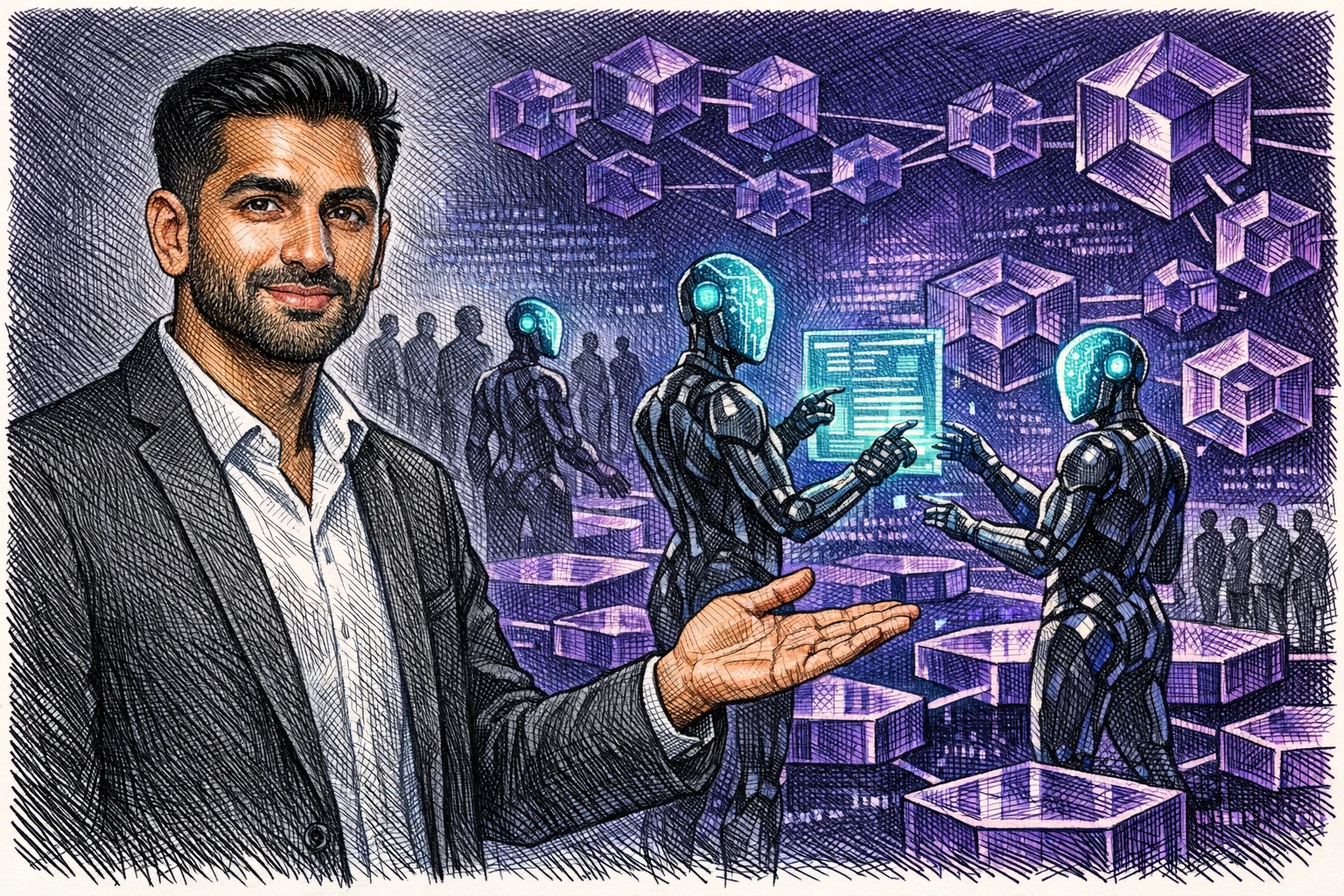
Still sweating every large crypto transaction after a decade of use? Dragonfly managing partner Haseeb Qureshi says it's not your fault—you were never the target user. In a recent Bankless podcast, he dropped a provocative thesis: blockchain has been AI agent infrastructure from day one.
Crypto's minefield is harmless to AI
Haseeb points to countless anti-human design choices: address poisoning attacks, expired approvals, phishing URLs, blind signing. For humans these are nightmare traps, but AI agents parse them as straightforward code. “I never worry about a wire transfer accidentally ending up in North Korea,” Haseeb said, “yet every time I sign a crypto transaction, that thought crosses my mind.” After a decade of blaming users for poor security habits, he suggests the real problem is that the technology chose the wrong user base.
Smart contracts were meant for AI
Haseeb recalled his early vision: smart contracts replacing legal contracts, no lawyers needed, purely code-based agreements. But even at Dragonfly, token purchases still require legal contracts—smart contracts are just “extra insurance.” The issue: legal contracts are riddled with randomness—jurisdiction uncertainty, randomly assigned judges and juries, unenforceable clauses. Yet humans paradoxically find legal contracts more predictable than smart contracts. “That’s our bounded rationality,” he explained. “Humans can’t process code as well as AI. But AI can analyze EVM bytecode line by line with 100% certainty. The original promises of crypto—better enforcement, better property rights—can only be realized by AI agents.”
Future finance: Just speak, AI handles the rest
Haseeb described a near-future where users never open a DeFi interface, compare TVL, or audit contract security. You simply tell an AI, “I think rates are going up, hedge me,” and it automatically selects protocols and executes strategies. Brand loyalty and network effects will be replaced by AI-driven rational selection, with efficiency captured entirely by the consumer.
Two tracks: Safety vs frontier
The transition won't be instant. Haseeb predicts a dual-track landscape: Safety track—major firms like OpenAI and Google take a conservative approach, requiring human approval for every trade to avoid legal liability. “If Claude loses user money, Anthropic can't afford that headline.” Frontier track—open-source AI agent projects like OpenClaw operate with user risk acceptance, preferring command lines, raw data, direct key access—bypassing all human-centric UI. He compared it to early cars: “In ten years we'll look back in horror that humans manually blind-signed transactions, checked addresses with their eyes, and relied on Twitter to confirm a protocol wasn't hacked.”
Dragonfly's $650M fund eyes AI × Crypto
Discussing Dragonfly's newly raised $650 million fund, Haseeb said the team is “heavily focused” on the AI-crypto intersection. “AI agents are general intelligence—they'll use the same tools we do, so there may not be many AI-specific investment targets. But if you believe the AI agent thesis, it's like believing China lifts its crypto ban—everything goes up, overall demand increases are bullish for crypto.”