
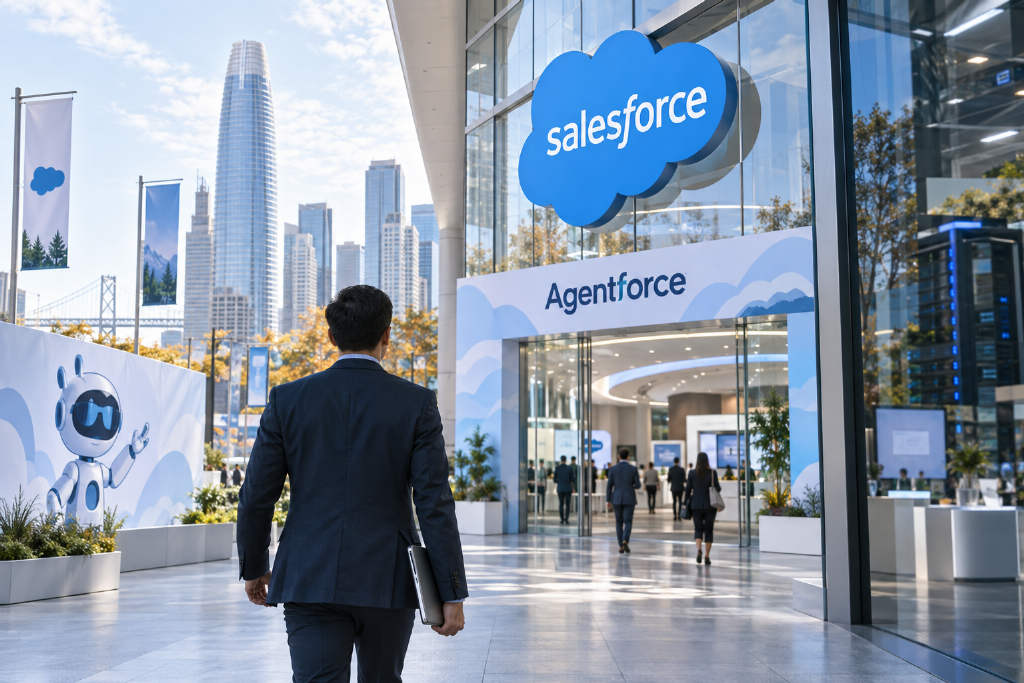
After two years of AI spending dominated by infrastructure winners, Dreamforce 2026 has brought the debate to a different place: can AI agents turn demos into real revenue?

For most of the recent AI trade in U.S. equities, the cleanest money was made on the infrastructure side. Nvidia, Taiwan Semiconductor Manufacturing Co., Broadcom, and the broader chain tied to power and optical modules all benefited from the same simple thesis: as long as large models kept getting bigger, compute would remain the hardest currency in the market.
By the fall of 2026, though, after hundreds of billions of dollars in capital expenditure flowed into data centers, investors have started asking a narrower and more practical question. When does that compute show up as actual revenue on income statements?
That shift was already visible in trading on Sept. 14. As discussion grew around a possible slowdown in the pace of AI development, chip stocks came under pressure. At the same time, cybersecurity names CrowdStrike and Palo Alto jumped more than 13% in a single day, while Salesforce and ServiceNow, both of which had spent long periods moving sideways, saw buying return.
That is the backdrop for Dreamforce 2026. Strip away the keynote packaging and the event is trying to answer one question for the market: can AI agents move from polished demonstrations to cash-generating products?
From copilots to systems that complete work
For the past two years, most enterprise AI products were still variations of a copilot model. A worker asked a question, and the software summarized documents, drafted emails, wrote code, or organized meeting notes. It improved efficiency, but a human still had to sit in front of the screen and keep feeding instructions.
This year, Salesforce is telling a different story.
Take Hunter, the agent designed for prospecting. In the earlier copilot model, software might help polish a cold email. The new design is meant to let the agent build a plan, pull data, and keep following up over a period of weeks. Ahead of Dreamforce, Salesforce expanded the Agentforce lineup in one move, adding Casey for customer service, Paige for IT and HR, Carter for e-commerce shopping, Hunter for sales, and Marshall for back-office supply chain processes.
These agents are built to work across systems, across steps, and across time. The workflow described in the article runs from identifying potential customers to building a plan, following up over time, adjusting strategy as new customer information arrives, requesting approval from a salesperson when needed, and then continuing the task.

That process can last for weeks or longer. Hunter is still in pilot and is expected to reach general availability in November, so it is not yet a mature mass-market product. Even so, the business logic underneath it has changed.
The old relationship between people and AI was largely a loop of prompts and responses. What enterprises may want to buy next is a form of digital labor that can read data, call tools, execute tasks, and leave an audit trail behind.
Once the product shifts from a feature to digital labor, return on investment becomes easier to measure. A chatbot can be judged in subjective ways. A customer service agent that cuts ticket volume, a sales agent that builds pipeline, or a back-office agent that reduces manual work can be measured against what the enterprise paid for it and how much work it completed.
That, in the article’s framing, is the point where AI starts to touch a real business threshold.
Dreamforce’s commercial signal: charging for work instead of seats
This is also where Dreamforce 2026 becomes most interesting. Product demos can always be edited to look impressive. Commercial traction comes down to two things: whether there is real revenue and whether there is real usage.
Salesforce’s latest quarterly results offered several figures the market is watching closely:
- Agentforce annual recurring revenue, or ARR, rose past $1.5 billion, up 240% year over year.
- Combined ARR for Agentforce and Data 360 came in near $3.9 billion, up more than 210%.
- Agentforce and Slack have completed 7 billion cumulative Agentic Work Units, with 3.2 billion in the second quarter alone, up 97% from the prior quarter.
The article notes that the $1.5 billion ARR figure includes Slackbot and other AI assets, which leaves room for debate over presentation. Still, it suggests enterprise customers are no longer only experimenting.
Salesforce’s customer examples point in the same direction:

- At Engine, about 50% of chat inquiries can now be fully resolved by its agent.
- At Perk, about 60% of sales pipeline is built by a sales agent.
- At Autism Queensland, about 70% of administrative requests are handled by an agent.
- At Hibbett, AI is involved in about 90% of core shopping flows.
- When Anthropic uses Fin, about 79% of the customer service conversations that reach Fin can be resolved automatically.
Those figures are not measured on the same basis, and all of them come from Salesforce’s own disclosures. The article does not treat them as proof that the entire agent sector is mature. What they do show is a change in what buyers care about. The question is no longer only whether the model sounds smart. It is how much work the system is actually taking on.
Salesforce’s pricing model is changing with that shift. Agentforce now offers Flex Credits. Under the current public pricing, 100,000 credits cost $500, and one standard Agent Action consumes 20 credits, which works out to about $0.10 per action. That lets enterprises pay based on usage when an agent updates a record, handles a process, or executes an action.
The article argues that this may matter even more than the $1.5 billion ARR figure itself.
Traditional software-as-a-service, or SaaS, has long been built around the seat as its core unit. If a company has 1,000 employees, the vendor sells 1,000 accounts. Agents are supposed to let fewer people complete more work. If a task that once required 10 people can be handled by three people plus a group of agents, a vendor that still depends only on seat pricing runs into an awkward problem: the more successful the AI becomes, the fewer human seats remain to sell.
In that sense, Salesforce’s push toward usage-based pricing is an attempt to define a new billing unit for a post-SaaS era.
If agents commercialize, the value chain broadens
If this transition holds, the impact will not stop with Salesforce.
For the past several years, the key word in AI investing was capital expenditure. Training models required GPUs. GPUs required data centers. Data centers required power, networking, optical modules, and storage. As long as hyperscalers kept raising capex, the infrastructure chain had room to keep benefiting.
Once agents become real commercial products, AI adds another value chain. It moves from the model layer into enterprise workflows, then into enterprise data, identity systems, permissions, security controls, and live business systems.
In that setup, companies such as Salesforce and ServiceNow control workflow. Platforms such as Snowflake connect enterprise data. Security vendors including CrowdStrike, Palo Alto Networks, SailPoint, and Varonis face a more complex problem as the number of agents grows.

A future enterprise may not only employ tens of thousands of people. It may also run thousands or even tens of thousands of non-human identities. Those agents could read internal files, call APIs, modify CRM records, send emails, operate code, and even participate in transaction processes.
That changes the security questions. Who is the agent? What can it see? What can it do? On whose behalf is it acting? If something goes wrong, can the action be traced? The closer agents get to real production environments, the more identity, permissions, data governance, and runtime security move from back-office concerns to the center of the AI application layer.
That is why the Sept. 14 rotation into cybersecurity stocks matters in the article’s view. AI’s attack surface is expanding from human accounts, devices, and servers to a growing population of agents with autonomous execution capability. The piece argues that CrowdStrike and Palo Alto were not only reacting to short-term sentiment, but also to a widening AI attack surface.
Two hard tests remain: margins and self-cannibalization
The commercialization path is still far from complete, and the article points to two immediate hurdles.
The first is margin pressure. Every time an agent takes an action, there is a real cost behind it in inference, retrieval, and cloud resources. After those costs are paid, it remains unclear whether vendors can preserve the kind of high gross margins that traditional SaaS investors are used to.
The second is self-cannibalization. Can the revenue added through usage grow faster than the revenue lost as human seat counts shrink? If not, the shift may amount to little more than moving revenue from one pocket to another.
As interfaces fade, the back end may become more valuable
Dreamforce 2026 also introduced another change that could make this test more revealing.
Salesforce’s new AIforce is opening up the data, workflow, business logic, permissions, and governance that used to sit inside the Salesforce CRM interface to newer AI interfaces such as Claude, Slack, and Agentforce Coworker.

Claudeforce is launching with 37 prebuilt sales skills. Agentforce Coworker reached 100,000 user activations within 35 days of launch, though the article is careful to note that activations are not the same thing as sustained active users or paying customers.
That points to another possible shift in enterprise software competition. In the past, Salesforce’s CRM interface was the center of gravity. In the future, users may not need to open Salesforce at all. They may ask AI inside Claude or Slack to call the data and workflows that sit behind Salesforce.
Put differently, the interface may matter less, while the back-end layers of data, permissions, process, and business logic become more valuable.
AI may be entering a third phase
Viewed over a longer cycle, the article says the AI trade has already gone through two clear stages.
The first stage was training AI, where the biggest beneficiaries were GPUs, advanced manufacturing, and ASICs. The second stage was building AI, where data centers, power, optical communications, and storage absorbed huge capital spending.
The signal coming out of Dreamforce 2026 is that the market is now running into a third stage: turning compute into productivity.
That path is not fully proven, and the article does not argue that software has already taken the baton from semiconductors. What it does say is that enterprise AI is showing, for the first time, a more complete commercial loop: someone buys an agent, the agent starts doing work, the work creates usage, and the usage becomes software revenue.
The loop is taking shape, even if it remains uneven. In the end, the article’s conclusion is simple: the next winner will be the company that can convert enterprise anxiety over AI spending into profit that shows up on the balance sheet.