
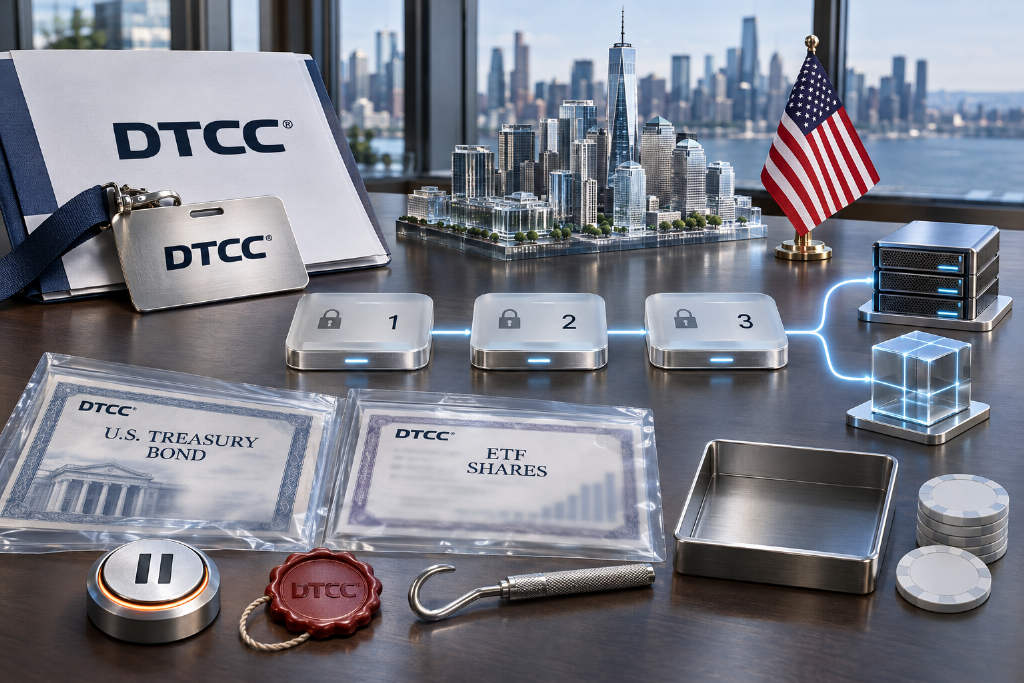
Institutional tokenization may be scaling first in a far narrower form than many market participants expected: not as free trading, but as the movement of collateral and securities rights inside a system built with whitelists, pause controls, and recovery powers.
That is the core takeaway from DTCC’s newly launched Tokenization Service. The product sits on top of one of the largest securities backbones in the US market, yet the live version does not turn stocks, ETFs, or Treasuries into freely transferable onchain instruments in the way many crypto users would understand the term.
Instead, it creates a controlled framework in which eligible securities can be tokenized and moved between approved wallets while the legal and operational center of gravity remains with traditional market infrastructure.
DTCC has launched the service, while DTC remains central to the legal and operational structure
The article draws a distinction between DTCC and DTC that is important to the structure of the service. DTCC, the Depository Trust & Clearing Corporation, is the broader group that operates core clearing and settlement infrastructure for US capital markets. DTC, the Depository Trust Company, is the group’s central securities depository and the entity that handles custody, book-entry records, and participant-facing rights in this setup.
DTCC announced and built the service. DTC is the entity that carries the securities, records the rights, and manages participant wallets.
On Oct. 28, 2026, DTCC formally launched its Tokenization Service. According to the DTCC launch announcement dated Oct. 28, 2026, the initial signatories include 20 DTC participants, among them JPMorgan, Citi, Bank of America, Morgan Stanley, Fidelity, UBS, State Street, and Citadel Securities. The service connects to Canton Network and to a private Besu network built by DTCC.
The same announcement says DTC services and holds more than $114 trillion in securities, while DTCC subsidiaries processed $4.7 quadrillion in securities transactions by notional value in 2025.
Those figures can easily create the impression that US capital markets have effectively moved onchain. The live product is much more limited.
The first version moves the securities leg, not the cash leg
The article describes the service as a freight elevator that moves securities but not money. That framing comes from the way the product works today.
Securities can move 24/7 between registered wallets, but those transfers are free-of-value. In other words, delivery can occur without DTC processing the corresponding payment. DTC does not handle the cash leg. The tokenized positions also do not currently carry collateral value or settlement value inside DTC’s own risk management framework. If a participant wants to return to traditional end-of-day settlement, the token must be burned and the original book-entry entitlement restored.
Those details are attributed in the article to DTCC’s Tokenization Service FAQ dated March 3, 2026.
This is why the service should not be read as an unfinished DeFi market. It is a system for moving securities rights faster while preserving institutional control.
Retail investors cannot directly use the service
The article says the answer for most retail investors is simple: not yet.
The current service is for DTC participants. Only those participants can register wallets with DTC, convert eligible securities into tokens, and move them between approved wallets. A retail investor cannot simply connect a personal wallet to DTS or send the token to any address.
If brokers or custodians eventually expose this functionality to clients, the access path would still run through a connected DTC participant. Brokers or custodians would manage client sub-wallets, identity checks, conversion, and exit. Even if an end user controlled the private key to a sub-wallet, the direct rights holder in DTC’s legal framework would still be the relevant DTC participant.
The article also notes that the live networks are Canton Network and DTCC’s private Besu network, and that the first batch includes only 34 eligible securities. Public materials do not list any retail platform already offering DTS token deposits, withdrawals, or trading to ordinary investors.
Even where a user reaches the token through a participating institution, the constraints remain clear. Transfers can go only to registered wallets. DTC does not process the cash payment tied to the securities movement. The token cannot yet serve as collateral or settlement value inside DTC’s own framework. Returning to traditional settlement or handling some corporate actions still requires burning the token and restoring the conventional book-entry position.
The article’s conclusion is blunt: institutions can use the elevator; ordinary wallet holders cannot. What moves is a securities entitlement, not a complete trading experience.
The token carries rights, but the building still belongs to the incumbent system
The article asks readers to imagine holding a tokenized US Treasury in a wallet. On the surface, it may look like any other onchain asset. It has a contract address, it can be transferred, smart contracts can recognize it, and it may even be used in collateral workflows.
But the token is only one layer in the rights chain.
The article says at least four gates remain in place:
- whether DTC recognizes the token as corresponding to a real securities entitlement;
- whether the receiving wallet has been registered;
- whether cash can move at the same time as the security;
- and who can alter the outcome in cases such as dividends, stock splits, mistaken transfers, or lost private keys.
DTCC’s answer, as presented in the article, is that legal rights can move with the token, but none of those gates has been removed.
The underlying securities remain registered in the name of DTC’s nominee, Cede & Co. The token represents a securities entitlement held by a DTC participant under Article 8 of the Uniform Commercial Code. DTC’s LedgerScan system scans onchain transfers and maintains DTC’s own record as the official book of record. The first version does not fundamentally rewrite the legal relationships among issuers, DTC, brokers, and end investors.
The article attributes those points to the SEC no-action letter and DTCC’s application dated Dec. 11, 2025. It also stresses that a no-action letter is not a permanent approval. It is a statement that, under specified facts and conditions, the SEC staff would not recommend enforcement action.
So the change is not that stocks have escaped intermediaries. The article’s formulation is sharper: intermediaries have extended their books onto blockchain rails.
How a security enters and exits the tokenized system
The article lays out the tokenization flow in several steps.
First, a DTC participant sends a conversion instruction from its existing DTC account. DTC checks whether the security is eligible, whether the wallet is registered, and whether the transfer would breach collateral monitoring or the participant’s net debit cap.
Second, DTC moves the traditional book-entry entitlement into a Digital Omnibus Account. The underlying security does not leave DTC. It moves from the participant’s ordinary account into a pooled account tied to the tokenized representation.
Third, the ComposerX Factory minting system creates the token and sends it to the participant’s designated registered wallet. LedgerScan then tracks where the token sits and reconciles the onchain token supply against the quantity of securities in the omnibus account.
Fourth, the token can move directly to another registered wallet without requiring DTC to post each transfer one by one on the traditional books. If the asset moves across networks, DTC burns the token on the original network and remints it on another approved network. The article says this is not a free bridge of the same token across chains.
Finally, if the holder wants to return to the traditional market, DTC burns the token, releases the corresponding security from the Digital Omnibus Account, and books the entitlement back into the participant’s account.
The article says the real efficiency gain here is shorter waiting and reconciliation time when institutions reallocate securities rights between accounts. It does not automatically solve price discovery, matching, credit approval, cash financing, tax treatment, client onboarding, or final exit.
The July production event showed what the system can do, and what it still does not do on its own
The article points to a limited production event on July 15, 2026. According to DTCC’s announcement from that date, JPMorgan converted the Nasdaq-100 ETF QQQ into a token and posted the tokenized asset as margin to CME Group. Other participants demonstrated US Treasury repo, securities lending, cross-network transfers, and delivery versus payment, or DVP. More than 30 institutions took part.
DTCC did not disclose transaction amounts, ongoing usage frequency, or capital savings from that event.
The article draws a line between that demonstration and the formal first version of the product. Digital cash, atomic settlement, and the collateral-focused Collateral AppChain can be arranged with other systems. DTS itself still handles only the securities entitlement. Any DVP arrangement sits outside DTC.
The article’s analogy is simple: an elevator can connect to a cashier, but that does not make the elevator itself a cashier.
Why collateral movement is easier to scale than open trading
The article argues that free trading gets more attention, but collateral movement is more likely to produce immediate economic value.
A fully onchain trade would need to solve participant access, order matching, market surveillance, securities delivery, cash payment, fail handling, and corporate actions at the same time. If any one of those pieces remains offchain, the result may be little more than a new front end with the old back office still doing the real work.
Collateral transfer is a narrower problem. If an institution suddenly needs to post margin overnight, it may not need to sell a Treasury. It may only need to move an already owned, mutually accepted asset from a custody account to a clearinghouse or counterparty-controlled address. In that setting, speed alone can reduce prefunding needs and lower the risk of missing a margin deadline.
The article cites Broadridge as supporting evidence. Broadridge said on Aug. 10, 2026 that its Distributed Ledger Repo platform processed $8 trillion in repo transactions in July 2026, with average daily volume of $365 billion, up 28% year over year. The article notes that this platform did not build a 24/7 retail Treasury exchange. It moved tokenized collateral inside existing institutional trading and post-trade workflows.
That does not prove DTCC adoption. It does show where institutions appear willing to pay: faster funding and faster collateral turnover, not necessarily a rebuilt market structure from day one.
The article frames this as a sequel to the 1973 dematerialization model
One of the article’s central comparisons is historical. In the late 1960s, Wall Street was not dealing with blockchain congestion. It was dealing with paper congestion.
Citing DTCC’s September 2020 paper Dematerialization Today, the article says average daily US stock volume was about 10 million shares in 1967 and roughly doubled to about 20 million shares three months later. Paper certificates and manual settlement overwhelmed back offices, producing hundreds of thousands of unsettled trades each day. Exchanges at one point closed on Wednesdays, shortened hours on other days, and extended settlement to T+5.
The solution was not to have every investor personally hold paper stock certificates. It was to centralize custody, stop moving the original certificates around, and change rights on a central ledger instead. DTC was created in 1973. Most securities later came to be registered in the name of Cede & Co., while investors held beneficial interests through brokers and layered records.
The article says DTCC’s current move rhymes with that structure:
- In 1973, paper certificates stayed still while a central ledger moved rights.
- In 2026, the underlying security stays still while registered wallets move rights.
- Both upgrades preserve central custody and final correction powers.
- Both first address back-office throughput rather than eliminating intermediaries.
This historical framing also explains why DTCC did not try to replace the heart of the market in one step.
ASX is presented as the cautionary example
The article contrasts DTCC’s approach with the Australian Securities Exchange, or ASX.
ASX had tried to replace its CHESS system with distributed ledger technology. The project began in 2016–2017, was paused in 2022 because of design complexity, scalability, stability, and governance issues, and led to a write-down of about A$245 million to A$255 million. In 2026, ASX also acknowledged that its 2022 statements describing the project as “progressing well” were misleading.
The article attributes those points to the Australian Securities and Investments Commission, or ASIC, on Oct. 27, 2026. It identifies ASIC as the regulator overseeing local companies, financial markets, and financial services.
The lesson, in the article’s reading, is straightforward: do not replace the heart first. Build a freight elevator next to the old system, limit the assets, limit the wallets, limit the networks, keep the master switch, and then watch real traffic.
That may be less dramatic than “capital markets fully onchain,” but the article argues it is more likely to survive.
What the current numbers do and do not prove
Economic usage is still unproven
The article says DTS has not published post-launch transfer volume, collateral turnover, financing cost reductions, or capital savings. The first batch includes only 34 eligible securities, far from tokenizing the full $114 trillion base. It cites Unchained on Oct. 28, 2026 for the 34-security figure and the lack of disclosed formal trading volume.
So, in the article’s view, economic validation is still blank. The $114 trillion figure is DTC’s custody base, not onchain outstanding value.
Behavioral usage is also not established
More than 30 institutions joined the July 2026 limited production event. Twenty DTC participants signed on at formal launch in October. The article says that signing proves willingness to connect, but not repeated use, and certainly not that assets are moving continuously rather than sitting idle in registered wallets.
The more meaningful data point would be repeated movement, pledging, release, and refinancing of the same Treasury positions over the course of a month.
Institutional backing is strong, but the regulatory footing is limited in time
The article says DTS was designed with an industry working group involving more than 150 institutions, and that the signatories include major banks, brokers, custodians, and market makers. That is a strong institutional endorsement.
But the SEC’s position is not a permanent license and not a certification of commercial success. The no-action arrangement dated Dec. 11, 2025 lasts only three years from launch, and the SEC explicitly retains the right to modify or withdraw its position.
Technical validation has moved beyond proof of concept
Canton and the private Besu network are now in formal service, and the July event included real asset conversion and several production-style transactions. That shows the system is no longer just conceptual.
What remains unproven, according to the article, is sustained heavy-load operation, repeated cross-network use, and the handling of chain forks, network outages, private-key incidents, and large-scale corporate actions.
Control has not disappeared. It has been encoded into the product
The article says the most important thing to understand about DTS is not how decentralized it is, but how it carries traditional financial control onto blockchain infrastructure.
Only DTC participants can register wallets. Tokens can move only to registered wallets. DTC also independently screens against the Office of Foreign Assets Control, or OFAC, sanctions lists. Even if an end user controls a client sub-wallet private key, DTC still recognizes only the relevant participant in the legal chain.
More importantly, each chain includes a root wallet controlled by DTC. The article says this wallet can mint, burn, transfer, or forcibly convert tokens without the holder’s private key in order to address mistaken transfers, theft, corporate actions, and malicious conduct. Management keys are, in principle, stored in cold storage except for keys needed for day-to-day operations.
The article does not treat this as a hidden backdoor. It treats it as a condition for the product to exist at all. Traditional legal rights, bankruptcy remoteness, and corporate action protections remain because DTC has not left the control plane.
Its formulation is precise: the promise here is not that no one can change anything. It is that only one regulated and accountable entity can do so under specified conditions.
Legal certainty and permissionlessness are not the same thing.
The first beneficiaries are institutions moving collateral, not retail traders seeking weekend stock access
The article says the first beneficiaries are institutions that move collateral every day among custodians, clearinghouses, and counterparties.
Possible gains include shorter asset transfer times, faster margin calls and collateral substitutions, lower prefunding needs, reuse of the same securities record across applications, and ownership and location reconciliation that is closer to real time.
DTC, in turn, gains a control point for the next generation of securities back-office infrastructure. Wallet providers, network operators, and collateral applications gain access opportunities. Brokers continue to control client onboarding, wallet registration, exit back to traditional books, and parts of the corporate action process.
The article also stresses that no native crypto token is required for this mechanism. Value is captured through service fees, operating efficiency, financing cost savings, and customer relationships, not through a governance token that capitalizes future revenue in advance.
For retail investors, the friction changes rather than disappears. A token seen onchain may be transferable, but not to any address. It may be sellable, but not with simultaneous cash receipt. It may carry the same economic exposure, yet still depend on a broker for dividends, voting, reversion to traditional securities, and exception handling.
Putting the asset onchain does not automatically turn the broker into a replaceable user interface.
A reasonable rollout path does not mean a market already exists
The article offers what it calls the strongest defense of DTS: criticizing the first version for lacking a cash leg is a bit like criticizing the first railway for not covering the whole country.
DTC never claimed the first release would handle every part of trading. Participants can arrange DVP outside DTC, and the July production event already showed digital cash and atomic settlement in connected setups. The decision not to assign collateral value or settlement value to the token inside DTC’s own framework is presented as a way to keep systemic risk within a limited range. First prove that securities rights can move safely, then connect cash, lending, and more networks.
The article says that defense is valid. But it does not justify counting future capabilities as if they already existed. Infrastructure that can support a business line is not the same as institutions repeatedly using it and extracting economic value from it.
Its judgment is that DTCC has crossed the threshold of technical viability, but not yet the threshold of market formation.
A four-layer framework for evaluating any tokenized RWA
The article closes with a framework for analyzing tokenized stocks, funds, Treasuries, or private assets. Do not stop at the contract address. Ask four questions.
1. Can rights travel?
When the token moves to a new wallet, does the legal securities entitlement move with it? Whose ledger is final? Is the underlying asset bankruptcy remote?
The article says DTS is relatively strong here because LedgerScan is the official book of record and the token remains within the UCC Article 8 framework.
2. Can identity travel?
Can any wallet receive the asset, or only approved wallets? If a client changes brokers, can the original wallet still be used? Who can freeze or reject a transfer?
DTS is clearly permissioned. Only registered wallets can receive the token, and DTC participants are responsible for wallet activity.
3. Can value travel?
Can the securities leg and cash leg settle atomically? Once collateral moves, can the receiver immediately confirm valuation, haircut, and enforcement rights? If securities move on a weekend but cash does not, how much has really been solved?
The article says DTS in its first version completes only the securities leg. The cash loop and DTC-internal settlement value are still missing.
4. Can the lifecycle travel?
Can dividends, stock splits, voting, maturity payments, taxes, and error correction all be handled onchain? If something goes wrong, who can forcibly convert or recover the asset?
DTS retains full intervention powers, and some corporate actions may still require detokenization first. The article notes that DTCC’s March 2026 FAQ also said details for some corporate action workflows were still to be published.
Under this framework, passing only the first layer gives an onchain certificate. Passing the first two gives a digital security inside a permissioned network. Passing the third as well begins to resemble an onchain settlement market. Only when all four layers operate reliably does the article think it makes sense to talk about a composable capital market.
Three likely misreadings, and the risks that remain
The article identifies three common mistakes.
The first is treating the $114 trillion custody figure as if it were already onchain. It is only the reachable asset pool, not the value already inside DTS.
The second is treating 20 signatories as 20 active users. Signing, connecting, piloting, repeating transactions, and becoming economically dependent are five different stages.
The third is treating 24/7 transferability as a 24/7 market. If cash, financing, valuation, exit, and corporate actions still depend on business-hour systems, what moves on weekends may be only one leg of the process.
The article also says the strongest alternative model may not be another public blockchain. Broadridge has already reached scale in repo. Banks’ own tokenized deposit and collateral networks can also provide synchronized settlement inside closed systems. DTCC’s strength is its asset coverage and legal foundation. Its weakness is the breadth of coordination required and the slower pace imposed by regulation and industry consensus.
Three years from now, the article says, the most likely failure mode is not a smart contract suddenly going to zero. It is a system that is safe, compliant, and rarely used repeatedly.
The institutions are real, but so are the operational and legal risks
The article emphasizes that this is not an anonymous RWA project wrapped in institutional branding.
DTC is a regulated clearing agency, a New York limited purpose trust company, a state member bank of the Federal Reserve System, and has been designated since 2012 as a systemically important financial market utility. The underlying securities are held at DTC, not in offshore reserves that a project sponsor merely claims exist. Those points are attributed to the SEC no-action letter and DTCC application dated Dec. 11, 2025.
The article also says the structure does not rely on a high-yield token to attract public funds, so it lacks the incentive pattern associated with a typical DeFi rug pull.
But regulated status does not eliminate code risk. As of Nov. 1, 2026, the article says public materials did not provide an independent audit report for deployed DTS smart contracts, a full list of contract addresses, or a line-by-line audit scope. The SEC no-action letter is a limited enforcement position, not a security audit and not a guarantee for each approved network.
The risks the article highlights are concrete:
- failure in root-wallet key management;
- a temporary divergence between LedgerScan and onchain state;
- a broker insolvency or refusal to execute detokenization promptly;
- corporate actions forcing token conversion at a critical moment;
- failure in external cash settlement after the security has already been delivered;
- and uncertainty over whether the service is extended, replaced, or refiled when the three-year authorization window ends.
In this model, the biggest danger is not that a project team disappears with the money. It is that the onchain half of the process happens while the legal or operational half fails to keep pace.
The article’s 12-month baseline and the signals it would watch
The article sets a baseline expectation for the next year. By Oct. 31, 2027, it expects DTS to add at least one more approved network and to produce at least one publicly disclosed recurring collateral or securities financing workflow from a signatory participant, rather than another one-day demonstration.
At the same time, it does not expect DTS to become a permissionless stock-trading layer open to any wallet within those 12 months. Wallet whitelists, DTC recovery powers, and broker responsibility are expected to remain because, in the article’s view, they are not temporary scaffolding. They are part of the legal certainty of the product.
The article says it would lower its assessment if any of the following occurred:
- no participant discloses repeated usage, transfer volume, or capital savings by October 2027;
- new networks are added only as technical integrations, with no cross-network asset movement;
- tokenized securities still need to return frequently to traditional books to complete financing, dividends, or settlement;
- the cash leg remains stuck in bespoke over-the-counter arrangements and never becomes repeatable DVP;
- or the path for extending the three-year authorization remains unclear by the end of 2027.
If those signals appear together, the article says the claim that an institutional onchain capital market has formed should be rejected. The more accurate conclusion would be that DTCC built a compliant onchain registration interface, but not a new capital market.
The article ends with a disclaimer that it does not predict the price of any token, stock, or related asset and does not constitute advice to buy, subscribe, lend, borrow, or pledge assets. References to DTCC, Canton, Besu, Broadridge, and other products are used only to explain the structure, control model, and risks of institutional tokenization.




