
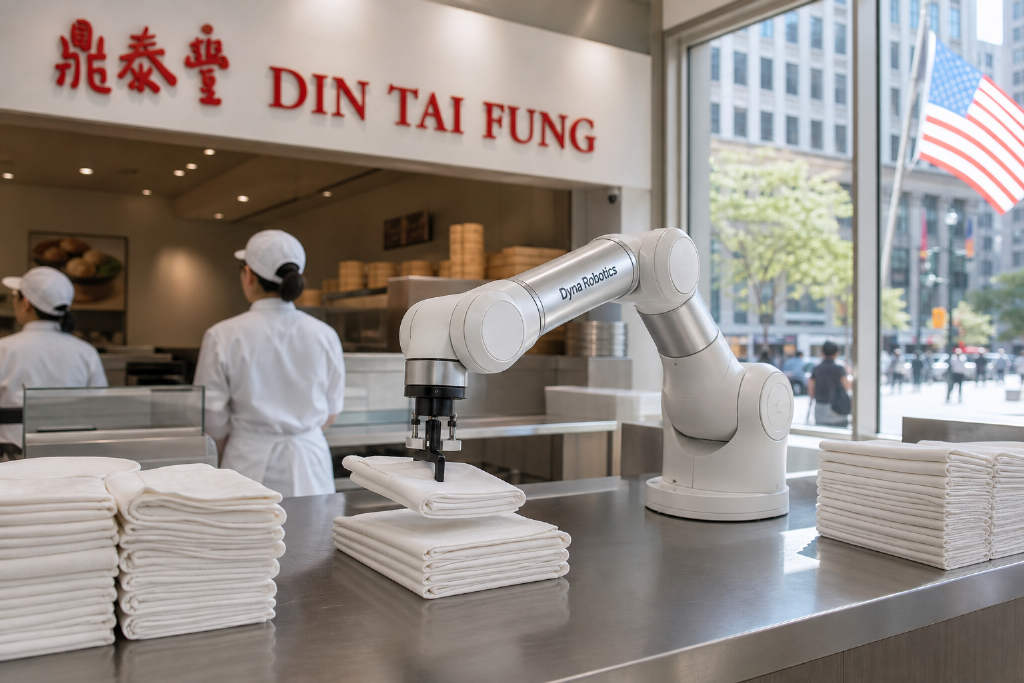
Dyna Robotics said its robot product line has crossed the return-on-investment threshold and is now being deployed across Din Tai Fung’s U.S. locations. In a report published this week, titled Not Just a Model, But a Product, the company focused less on model intelligence and more on whether the product can hold up in a real operating environment.
Din Tai Fung used as the operating benchmark
The company said the proof point comes from Din Tai Fung in the United States. The report described the chain as the brand that officially claims the highest single-store revenue in the U.S. restaurant market, and said the robot system is being rolled out across its American store network.
Din Tai Fung’s requirement was straightforward: one robot had to fold 1,500 napkins within an 18-hour shift schedule. Dyna Robotics said Dyna-2 produced 1,590 napkins in a day, clearing that threshold, and did so without needing to run at full speed.
Beyond restaurants, the company said its robots are also being deployed in logistics warehouses, hotels, and data centers. Dyna projected that cumulative installations could reach the hundreds by the first half of 2027.
Instruction changes instead of hardware changes
Dyna said Din Tai Fung’s napkin basket has 10 fixed stacking positions, but the folding style assigned to each stack is not hard-coded into the machine. Those assignments are determined by the instruction given at the time.
That means one store may use only five stacks while another uses all 10. If a location wants to change the arrangement, it can do so by changing the instruction rather than replacing the full system or bringing in engineers for recalibration.
The company also said a newly installed unit at a new store can reach payback in as little as three days. For chain brands opening stores on a fast cycle, that figure sits at the center of Dyna’s commercial case.
In that framing, Dyna is not trying to sell a single-purpose napkin-folding machine. It is selling labor that can be reassigned through text instructions: folding napkins one day, switching to another item with a new command the next, and then moving into a different operating environment after that.
How Dyna-2 was trained
Dyna said Dyna-2 was built on a different training approach from some peers. According to the company, the model was trained on more than 1 million hours of first-person human daily-life video, which it said is equivalent to one person watching continuously for 170 years. Dyna also said the training process did not include any teleoperation logs produced by humans controlling robots.
Put simply, the company’s claim is that the model learned by watching how human hands fold and place objects, rather than relying on a robot to gather experience mainly through repeated trial and error in the field. Dyna described this path as a scaling law that grows robot capability directly from human life video and said it is the first in the industry to make that route work.
The clearest result, according to the report, is in zero-shot deployment. That refers to a robot entering a completely new site and starting work without any customized training. Dyna said Dyna-2 reached an 87% quality pass rate in that setting, compared with 46% for Dyna-1.
On speed, Dyna-2 was reported at 95 napkins per hour with a 93% target-hit rate. Dyna-1 was listed at 35 per hour with a 75% target-hit rate. Based on those figures, the new version improved both throughput and task quality.
B2B subscription model
Dyna Robotics said it uses a B2B subscription model, with customers paying monthly to use the robots instead of purchasing the hardware outright. The company did not disclose the monthly fee.
That structure shifts spending from a one-time capital purchase to an operating expense spread over time. In the company’s presentation, that lowers the financial risk for chain operators trying new automation tools: if the system does not fit, they can cancel the subscription rather than carry idle depreciating equipment on the books.