
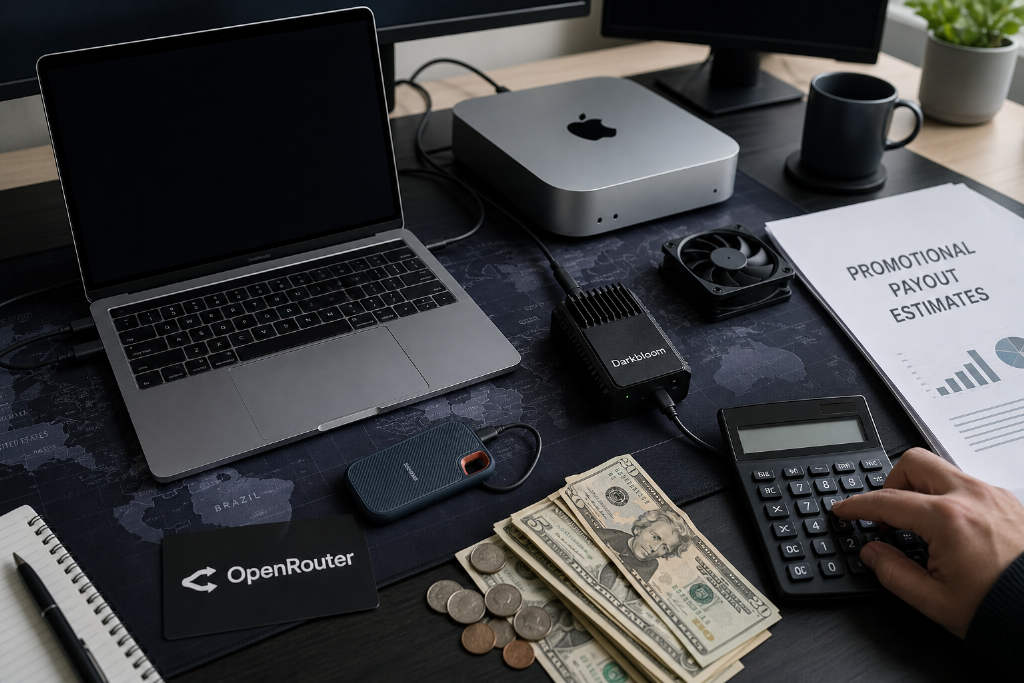
Eigen Labs launched Darkbloom in April as an experiment to link idle Apple Silicon Macs into a distributed AI inference network. On Aug. 21, engineer Gajesh Naik said on social media that Darkbloom had been upgraded into a paid inference provider on OpenRouter and was recruiting more machine owners to join.
The pitch is straightforward: let an unused Mac act as an AI inference node and earn money. The issue is that the returns shown in public testing have come in far below the project’s promotional figures.
How Darkbloom turns a Mac into an inference node
Darkbloom’s setup is built to be easy for developers to adopt. Instead of rewriting software, a developer can switch an API endpoint to one provided by Darkbloom, and requests are then routed into a compute network made up of Macs.
Those requests first go to an orchestrator running inside a confidential virtual machine, then get assigned to hosts that have installed Darkbloom’s tooling. On the host side, the machine connects through WebSocket. The task is decrypted inside Secure Enclave and then passed to Apple’s MLX framework to run inference on the GPU.
Privacy is central to the design. In the technical white paper cited by the report, Naik wrote that the macOS kernel blocks outside access to the process memory tied to the workload, while debuggers and memory-reading APIs are disabled at the system level. If the machine is rebooted, the process is terminated and the data is erased at the same time. Plaintext data remains only briefly in encrypted memory at the orchestrator, and the project says it is neither logged nor retained. The privacy model is compared with Apple’s Private Cloud Compute.
The models listed as supported include Gemma 4 26B, GPT-OSS 20B, and Qwen 3.6 35B A3B. All use a mixture-of-experts architecture. For hardware, the project recommends at least 36GB of unified memory.
The published network metrics do not match the revenue pitch
Naik described a network that already has some scale: about 900 hosts registered, 250 machines online, more than 42 million inference requests processed, roughly 4.5 billion tokens handled, and $102,000 in annual recurring revenue.
But those same figures point to much lower average income per machine than the headline estimate. A $102,000 annual recurring revenue run rate works out to about $8,500 a month. Dividing that by 250 online machines yields roughly $34 per machine per month, less than one-third of the project’s stated range of $120 to $200.
Independent testing showed very small payouts from real workloads
Tech blog miyagadget tested Darkbloom with an M1 Max MacBook Pro equipped with 64GB of unified memory. After running for 38.7 hours, the machine had earned $1.4456.
The breakdown helps explain the gap. Nearly all of the income came from a baseline idle reward of $0.002083 every five minutes. Actual inference jobs paid only $0.000001 to $0.000024 each. On that basis, monthly income would come to about $16, nearly five times lower than the $75 estimate shown by the project’s calculator. At the time of the test, network utilization was only 7%.
Bankless reported a similar mismatch. In its tracking coverage, the top host on a 30-day leaderboard posted gross income of about $6, leaving around $3.5 after electricity costs.
No token subsidy, but the economic bottleneck remains
Bankless argued that Darkbloom faces a circular problem. If host earnings stay thin, owners of high-memory machines have little reason to join. Without those machines, the network cannot run larger and more useful models. If the models are not good enough, demand on the client side is harder to build.
At the same time, the report highlighted two points in Darkbloom’s favor. Payments are processed through Stripe and settled in fiat, with no token issuance. Revenue comes from actual inference requests rather than token subsidies. During the alpha period, the platform takes a 0% cut, which means hosts keep all income. The report also noted that the money flows to ordinary people running open-weight models at home, not to heavily indebted data centers.
More user tests widened the gap with the headline numbers
The report said Darkbloom has promoted expected earnings of $120 to $200 per machine per month, while its website calculator has shown estimates as high as $280 to $600.
It also cited a test by crypto user Lao Zhang, whose X account is @cryptoresetlife. He connected an M3 Ultra machine to Darkbloom after seeing claims that it could make $560 a month. After letting it run overnight, the next day’s settlement showed only an extra $0.1 in earnings.
Based on the figures released so far, Darkbloom does appear to generate real income, but the amount remains far below the numbers used in its promotion. For owners of idle Macs, joining the network may still bring in some extra money. The current testing record, though, suggests that the returns are modest at best.