
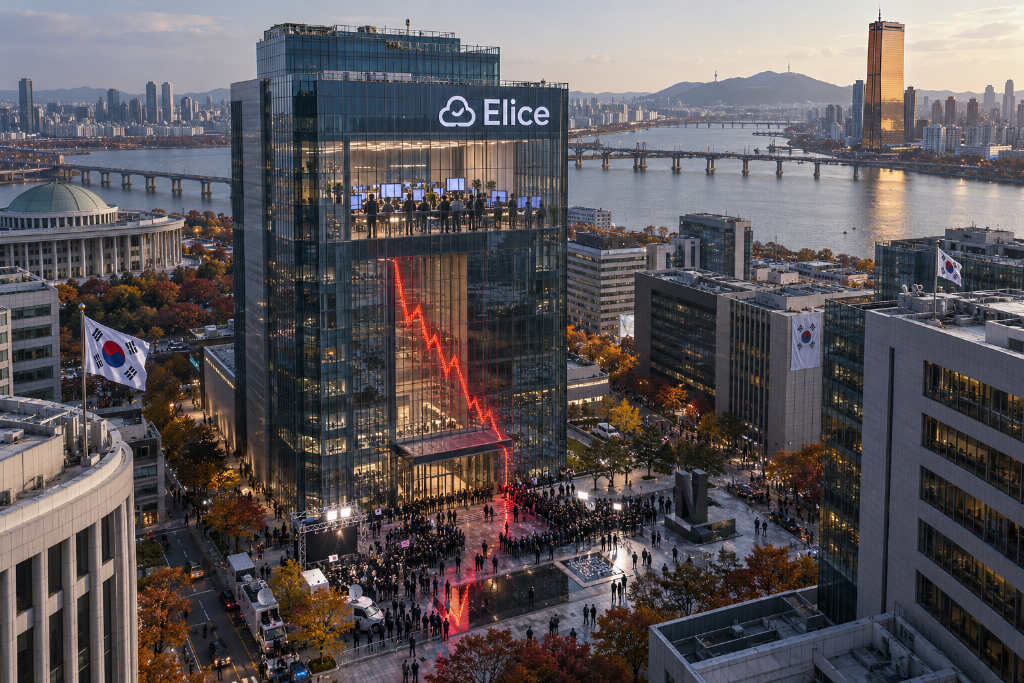
South Korean AI cloud infrastructure company Elice dropped below its offer price on its first day of trading on KOSDAQ on Oct. 20, despite strong demand in its initial public offering. As of 11:10 a.m. Korea time, Elice was trading at 66,200 won, down 26.85% from its 90,500 won offer price. The stock fell as low as 61,000 won during the session, marking a 32.6% decline from the offer price.
The IPO raised about 201.1 billion won, or roughly $151 million, making it the largest KOSDAQ listing this year. The company had already returned to profit in the first half of 2026, yet its shares still faced heavy selling on debut.
Strong demand did not prevent a weak debut
Elice drew interest from 2,367 institutions during bookbuilding, with institutional demand reaching 388.84 times the shares available. In the retail subscription held on Oct. 7 and 8, demand reached 408.26 times. Subscription deposits totaled about 10.2599 trillion won, or around $7.7 billion, equal to roughly 51 times the amount raised in the IPO.
The offer price was set at 90,500 won, the top end of the indicated range of 70,400 won to 90,500 won. The stock opened at 75,700 won, already 16.35% below the offer price. Its intraday high was 77,700 won, and it never climbed back above the IPO price.
Broader market weakness added pressure
South Korean equities were also under pressure on the same day. The KOSPI fell 3.04% to 5,592.89, while the KOSDAQ index dropped 2.73% to 786.81. On timing alone, Elice entered the market on a difficult trading day.
Investors are looking beyond profit
Bloomberg said investors interviewed for the story were focused on the wider AI cloud infrastructure sector rather than Elice alone. Albert Yong, chief investment officer at Petra Capital, said investors had already lost confidence in this type of company before Elice’s listing, especially in the U.S. market. He described sentiment toward AI infrastructure as 「highly volatile and often disconnected from fundamentals」.
The concern, according to the report, is no longer limited to whether these companies can make money. Investors are also asking how much more capital expansion will require.
What Elice does and how its numbers look
Elice was founded in 2015 by three PhD students from the Korea Advanced Institute of Science and Technology, or KAIST. It started in coding education and later shifted into AI cloud infrastructure. Its main businesses now include renting out GPU computing power, building its own data centers, and providing AI solutions to different industries. The company is led by CEO Kim Jae-won.
Cloud has become the core business. Revenue contribution from cloud operations rose from 44.18% in 2025 to 76.2% in the first half of 2026. Bloomberg categorized Elice as a neocloud company, a newer type of cloud provider focused on renting GPU capacity to AI companies. The report placed CoreWeave, Nebius, and Nscale in the same group, distinguishing them from broader cloud providers such as Amazon Web Services and Microsoft Azure.
At a presentation on Sept. 30, Elice said its modular data center system, called AI PMDC, can cut build times from 24 to 36 months to less than three months.
Its profitability has also been under scrutiny. According to its prospectus, Elice posted operating profit of 8.3 billion won in 2024. In 2025, revenue reached 39.5 billion won, but operating profit fell to 5.2 billion won from the previous year. The picture changed in 2026. In the first half, revenue came in at 34.4 billion won, up 200% year over year, while operating profit reached 10.3 billion won after a loss in the same period a year earlier.
Douglas Kim, an analyst at Smartkarma, estimated that full-year revenue would grow 83% and that operating margin would be about 33%.
Comparison with CoreWeave has shaped sentiment
Kim Dojoon, chief executive of Zian Investment Management, said Elice’s cloud business is already generating operating profit, though it remains to be seen whether that profitability can be sustained. He told Bloomberg that investor confidence may have weakened because of CoreWeave, but the two companies have very different financial structures, and investors 「do not need to view this company as particularly risky」.
The report noted that CoreWeave has borrowed against GPUs and customer contracts to finance more GPU purchases, with debt and lease liabilities totaling about $52 billion. As for Elice, current reports have not disclosed how much it has borrowed, so the claim of a different structure remains an investor view rather than a fully detailed comparison.
Peers have also struggled
Elice is not alone. Bloomberg pointed to a series of setbacks across similar companies. Australian data center operator Firmus canceled its planned Sydney listing this month. CoreWeave shares have fallen by more than half from their May peak and dropped more than 15% in a single day on Oct. 14. People familiar with the matter said AirTrunk delayed the listing of its real estate investment trust. Nscale has sought to go public at a valuation of about $30 billion, but investors suggested a range of $16 billion to $19 billion.
Bloomberg said borrowing costs, competition, and doubts over whether massive AI spending will produce long-term returns are all weighing on valuations in the sector.
IPO proceeds are meant to fund expansion
Kim Jae-won told Bloomberg that Elice plans to use the money to expand AI data centers in the Seoul metropolitan area and in the Honam region in southwestern South Korea, including Jeolla. The company also plans to expand overseas with bases in the United States, Japan, and Singapore.
He said, 「We are going all in to become a global leading AI infrastructure provider that covers everything from server rooms to software.」 He added that the IPO is meant to give the company enough financial firepower to carry out that plan.
For AI cloud stocks, the market’s question now is no longer just whether they can make money today. It is also how much expansion will cost and whether that spending can deliver lasting returns.



