

Elon Musk shared a post built around ARK Invest chief futurist Brett Winton’s argument and added a short line of his own: 「The AI riptide is already underway.」
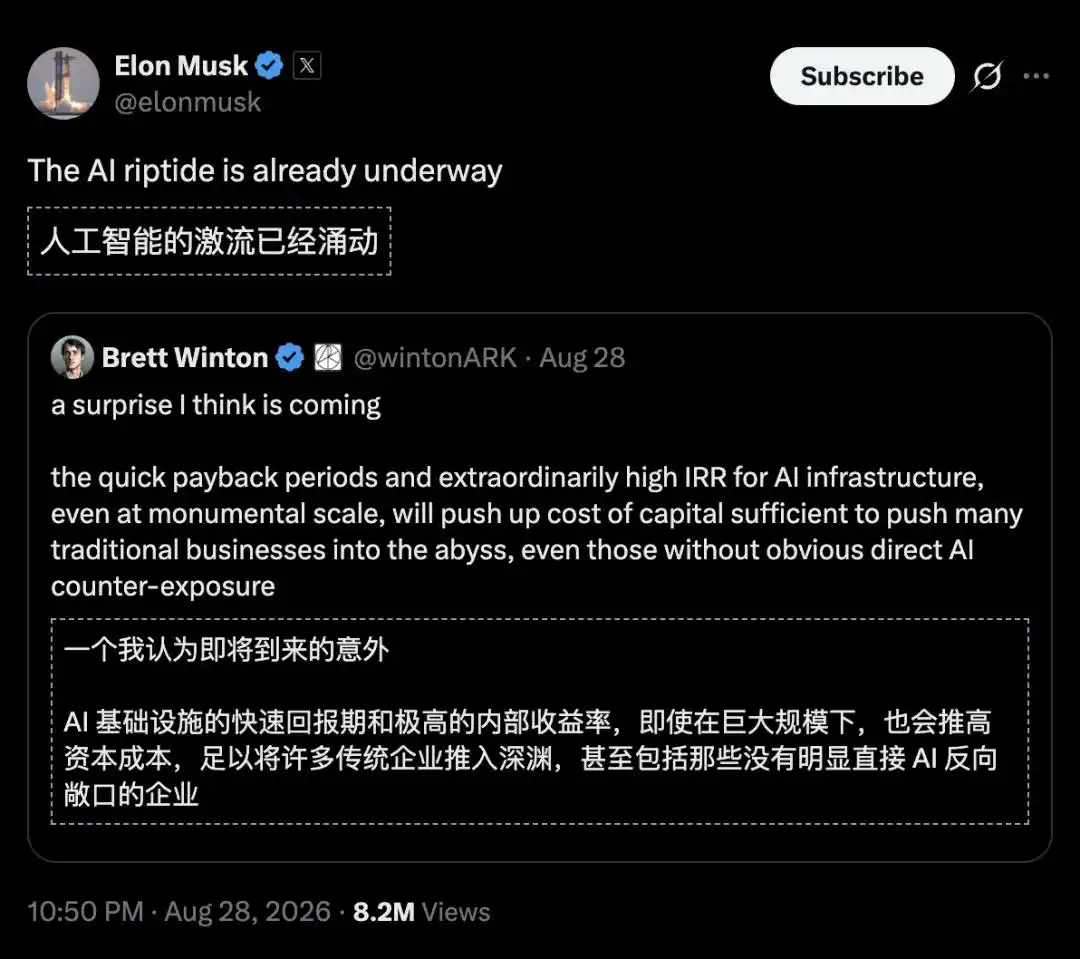
The article frames that comment as more than a reaction to another chatbot upgrade. It ties Musk’s wording to a broader view on artificial general intelligence, or AGI, the approach of the technological singularity, and a rapid reordering of where capital is being deployed.
Musk’s “riptide” comment is linked to his AGI timeline
The piece explains “riptide” as a force that may not look dramatic on the surface but is already pulling strongly underneath. In that reading, Musk was not talking only about product iteration in consumer AI. He was pointing to what the article describes as a much larger transition tied to AGI and the singularity.
It says Musk has repeatedly warned that AGI could soon become smarter than the smartest human beings, and that digital compute on Earth could later exceed the combined biological compute of all human brains on an exponential basis. The article presents that threshold as the singularity.
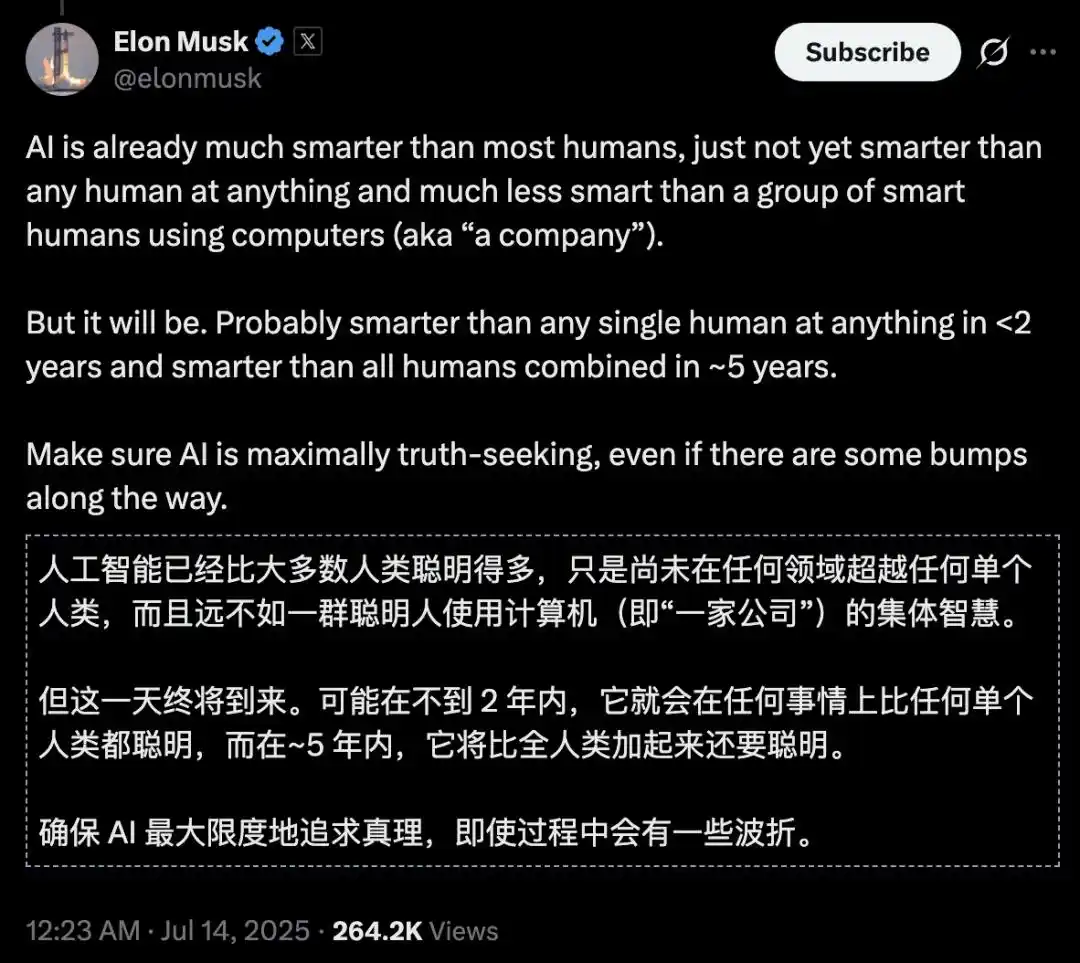
Once that point is crossed, according to the piece, AI would gain the ability to iterate and improve itself, shifting the engine of technological progress away from human-led development and toward machine-driven acceleration. On that basis, the article argues that AGI is no longer being treated like a distant science-fiction concept, but as something that could be reached in one to two years through continued spending on compute, energy, and data.
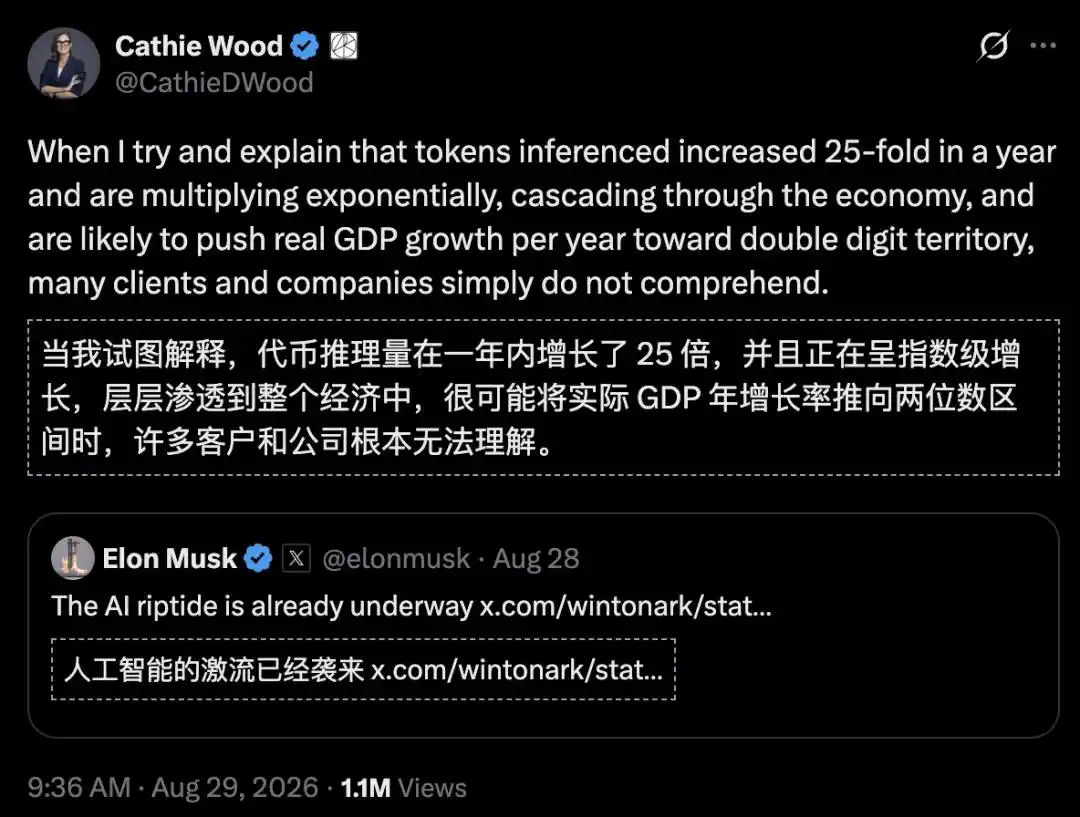
AI inference token usage is said to have jumped 25x in a year
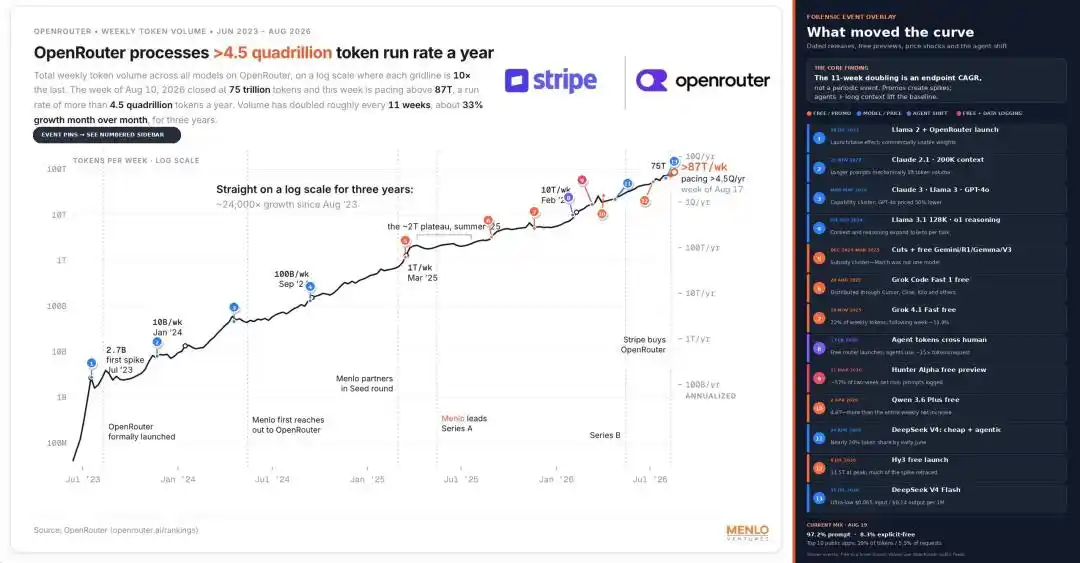
One of the article’s central figures is that global AI inference token usage has risen by about 25x over the past year, not 25%.
It also says total token volume on OpenRouter is doubling roughly every 11 weeks. Cathie Wood, described in the article as “Wood,” argued that token usage is growing exponentially, spreading layer by layer through the wider economy, and could push real GDP growth into double-digit territory.

The article stresses the difference between a conventional growth rate and a multiple expansion. In its example, 100 units growing by 25% would become 125, while 100 units growing 25-fold would reach 2,500.
ARK’s argument extends from token demand to revenue growth
The piece says Cathie Wood believes frontier AI labs are posting annualized revenue growth of 5x to 10x within a period of six months to one year.
It adds that even mature companies that are positioned on what the article calls the “right side” of the AI shift are seeing revenue growth move from 25% toward 30% or even above 40%.
To describe how some incumbents are reacting, the article uses the phrase “deer in the headlights,” arguing that many executives can sense the scale of the shift without being able to process the pace implied by those numbers.
Brett Winton’s core point is capital transfer and crowding out
The article says Winton’s central insight is that capital pools are limited over any given period, so money moves toward the highest returns and the shortest payback windows.
On that logic, if AI infrastructure continues to deliver unusually high internal rates of return and increasingly short payback periods, capital will keep flowing into GPUs, data centers, and AI companies. The article says this pattern is already visible in venture capital, where raising money has become much harder unless a pitch deck is filled with AI and compute language.
It describes that process as an “AI siphon effect” in private markets and says the trend is now spreading downstream.
The article says Nvidia chips are being treated as debt collateral
To build what it calls super-sized AI data centers for the AGI race, the article says companies need enormous amounts of funding and are relying not only on internal cash but also on debt issuance.
Its reasoning is straightforward: compute remains in short supply, completed capacity is easy to sell, and margins are high enough that operators can bear a higher cost of financing. The piece then makes a more specific claim, saying Nvidia chips have become a kind of hard currency. If a data center is built around Nvidia’s ecosystem, those chips can be used directly as collateral for debt.
That combination of high returns, tolerance for higher interest costs, and collateral value is what leads the article to say compute infrastructure is being viewed on Wall Street as a newer and more investment-grade asset class.

Four transmission channels are laid out for traditional companies
The article argues that once AI absorbs a large share of global capital, the amount left for other industries shrinks in the short term. It lays out four ways that pressure could spread:
- First, high returns in AI push up required returns across the market, raising financing costs for traditional businesses and in some cases cutting off access to capital.
- Second, public-market investors rotate away from non-AI names, removing them from core holdings, cutting valuations, and draining liquidity.
- Third, companies refinancing maturing debt face higher interest rates, weaker interest coverage, and heavier pressure on fragile cash flow.
- Fourth, talent follows capital, leaving traditional sectors stuck in a loop of less money, weaker retention, lower efficiency, and even less money.
The article says Musk fully agrees with that framework. It also cites Cathie Wood’s summary that market psychology is shifting away from blind enthusiasm for broad “AI hype” and toward stock-by-stock differentiation between “Oh NO” and “Oh YES.” Musk responded with a brief reply: 「You are right.」
The closing argument focuses on capital, not only competition
The piece ends by arguing that AI may not wipe out traditional companies only because it is better at products or services. In its view, the more immediate threat is that AI pulls away the “capital oxygen” those companies need to survive.

It uses two historical comparisons to make that point: the shift from horse-drawn transport to steam power, and the reallocation of venture money during the mobile internet boom. In both examples, the emphasis is not only on new technology replacing old business models, but on funding being redirected at speed toward the next infrastructure wave.
The article closes with a line attributed to Cathie Wood: 「Facts are stubborn things.」 It then adds that capital has already made its choice and is voting with its feet at a rate of hundreds of billions of dollars per day.
Referenced materials and attribution
The source article lists related X posts from Cathie Wood, MaxForAI, and Brett Winton as references. It also states that the piece was originally published by the WeChat public account Xinzhiyuan, written by David.