
SpaceX places order for 100GW of solar equipment
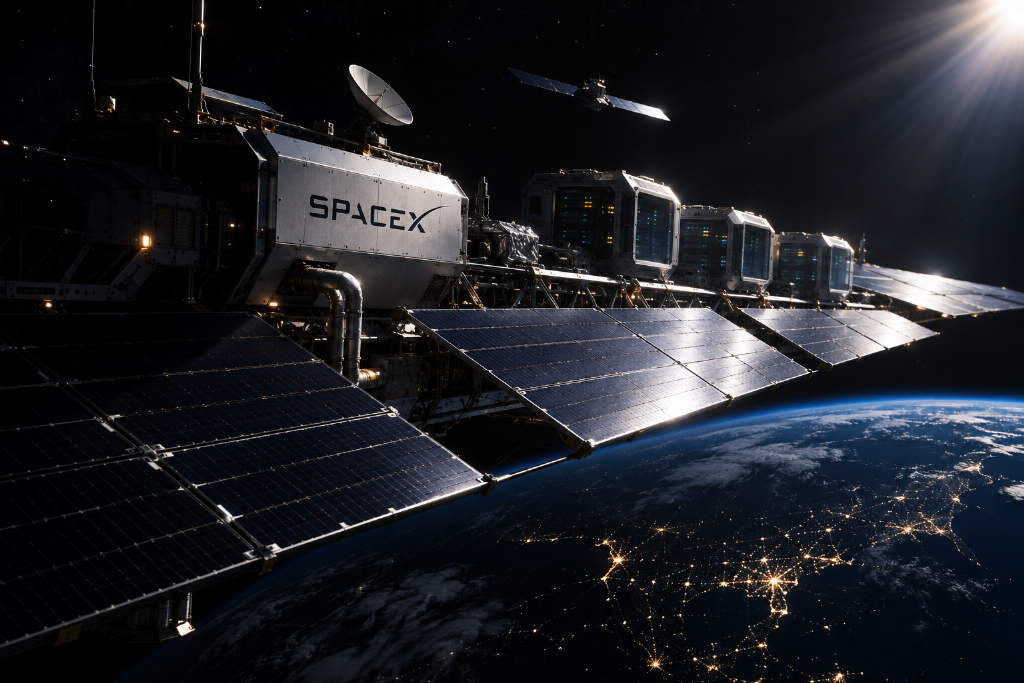
SpaceX CEO Elon Musk said the company has ordered solar cell manufacturing equipment with annual capacity of 100 gigawatts from German solar equipment supplier SINGULUS. The equipment is intended to support SpaceX’s Starmind AI satellite project.
Musk disclosed the order in a post on X on the 11th. Industry estimates cited in the report put the capacity at roughly the same scale as the combined installed capacity of 4.4 Three Gorges power plants in China.
At the World Economic Forum earlier this year, Musk said building AI data centers powered by solar energy in space was the “only option that does not require too much consideration.” He estimated that solar panels in space could produce about 250 watts of electricity per square meter.
Musk compares 100GW in space with 800GW on Earth
Musk also said 100GW of solar generation in space would have an effect comparable to 800GW on Earth. He argued that terrestrial solar power needs to be paired with large amounts of battery storage, while winter conditions can require additional support from fossil fuels or nuclear power.
He added that SpaceX’s long-term goal is to deploy 1 terawatt, or 1,000GW, of energy in space every year.
AWS CEO points to launch, cooling and radiation constraints
AWS CEO Matt Garman offered a more cautious view of space-based data centers in a recent appearance on the Sources podcast. He said it would be difficult to build infrastructure at a sufficient scale unless SpaceX could approach a launch cadence of once a day.
Garman said a GPU rack can weigh as much as one ton. In space, there is no air for convective cooling, and equipment must withstand long-term exposure to space radiation. He said those challenges are not impossible to solve, but large-scale deployment that also meets cost-efficiency requirements is unlikely to be achieved within the next 10 years, or even 20 years.
Garman also said AWS is adding one GPU every 14 seconds, while demand continues to exceed supply.
Taiwanese solar companies develop space-power technologies
According to the Economic Daily News, United Renewable Energy (3576) is working with domestic and international teams to develop perovskite-silicon tandem solar modules for power generation in space. Motech Industries (6443) is also allocating resources to related areas.
Industry participants believe Taiwanese companies could support outsourced module production for later stages of SpaceX’s space-solar project, particularly in batteries and modules with certain specifications. The construction of space data centers remains at an early stage, but solar power is one of the main energy sources in Musk’s plan, creating a potential new area of interest for Taiwan’s solar manufacturers.



