
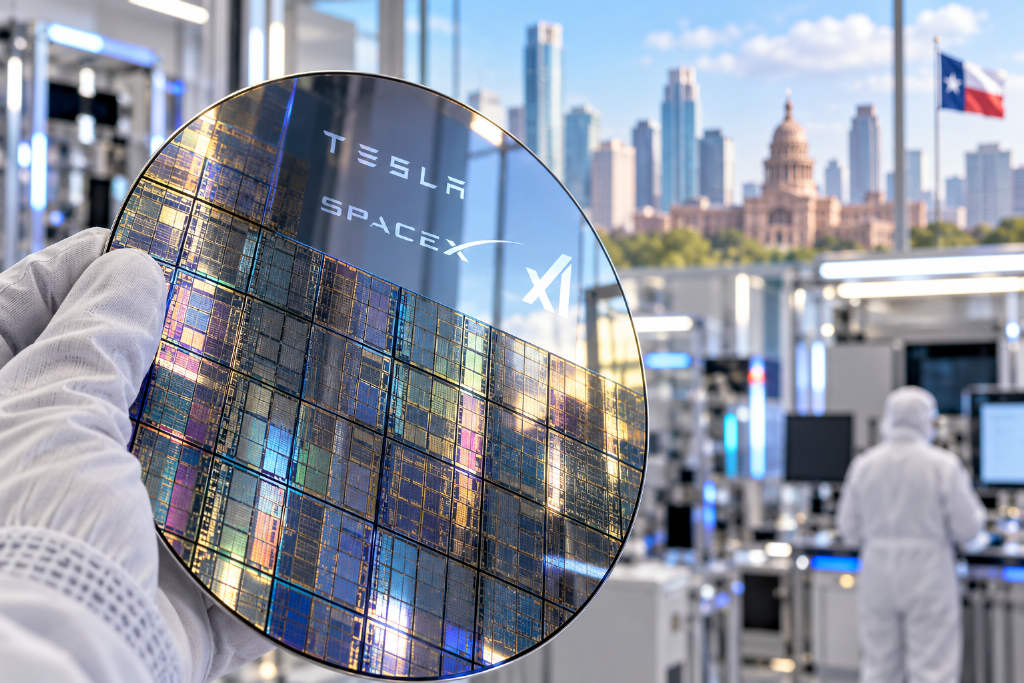
Elon Musk is accelerating supplier outreach for Terafab, a Texas semiconductor manufacturing project, with recent talks involving about 10 South Korean companies across equipment, components, and materials, according to an Oct. 20 exclusive report from Korean media outlet THE ELEC. More than half of those companies have already signed non-disclosure agreements, or NDAs, and moved into product-level discussions. Industry sources cited in the report expect the first-phase facility, with monthly capacity of about 100,000 wafers, to be completed before 2030.
Terafab’s stated buildout plan
Terafab is a semiconductor production project being pushed in Texas by Musk and backed jointly by Tesla, SpaceX, and xAI. It was announced publicly in March this year, though its structure and technical details were not disclosed.
According to the report, the long-range target is a wafer fab capable of processing 1 million wafers per month within 10 years. Initial investment is set at $16.8 billion, and the project is expected to create more than 3,000 jobs. SpaceX signed a tax-abatement agreement with Texas earlier this month and has already started construction. Industry expectations, as cited by THE ELEC, are that the initial facility with capacity of roughly 100,000 wafers per month will be finished before 2030.
Before the mass-production fab is completed, Tesla is also building a pilot fab for research and development inside Giga Texas in Austin. The report says its first priority is to supply chips internally for Tesla’s self-driving and robotics programs, along with chips needed for SpaceX satellites and space data centers. On logic chips, the project is said to be working with Intel while also holding talks with Taiwan Semiconductor Manufacturing Co. (TSMC). Memory production would be built on a separate process line.
SEMICON West became a key supplier meeting point
THE ELEC said SEMICON West 2026, held in San Francisco from Oct. 13 to Oct. 15, was a major venue for Terafab’s procurement team to meet suppliers. On the first morning of the exhibition, Tesla and SpaceX personnel visited booths from about 10 Korean companies on a pre-arranged list, including ENF Technology, Dongjin Semichem, Asflo, BMT, G&G Intech, Unisem, Mico, and Hanmi Semiconductor.
The outreach appears to have been tightly organized. Materials procurement staff handled talks with materials makers, while the head of the gas delivery system spoke with pipeline-parts suppliers. Companies that met the team described the process as highly targeted, saying the visitors appeared to know in advance which firms and products they wanted to discuss. Some companies that had contact that day received NDA contracts the same evening.
Supplier-by-supplier progress across the Korean chain
The report says that before this round of talks, the only Korean Terafab suppliers widely known to the market were equipment makers HPSP and Hanmi Semiconductor. This time, however, discussions stretched from basic pipeline parts and process materials to testing components, covering nearly every area Korean suppliers can provide.
- HPSP: One high-pressure hydrogen annealing, or HPA, tool has already been confirmed for the R&D line.
- Hanmi Semiconductor: The two sides are discussing a thermo-compression, or TC, bonding machine.
- Dongjin Semichem: Talks began two to three months ago, focused on possible material supply for a Texas thinner plant.
- Comico, a Mico subsidiary: Signed a three-party NDA about one month ago and is discussing cleaning services for the Texas pilot R&D line.
- Unisem: Signed an NDA for talks related to environmental equipment.
- ISC: The company, described in the report as the first to commercialize silicone rubber sockets, has moved into sample exchanges and R&D design-data discussions.
- BMT: Had already been in talks over valves and fluid components.
- ENF Technology, Asflo, and G&G Intech: These companies were contacted for the first time in this round, with requests covering process materials, pipeline and valve discussions, and wastewater recycling equipment.
How the supplier list is being built
THE ELEC drew out several patterns from the outreach. First, many of the companies in talks were already suppliers to Tesla or SpaceX. BMT supplies pipeline parts to SpaceX, Comico provides cleaning services to Tesla’s automotive division, and Hanmi Semiconductor supplies equipment used in production tied to SpaceX satellite materials.
Second, the report says Terafab is being led by people with Intel backgrounds, which has pulled parts of Intel’s supplier network into the project. ENF Technology, Asflo, ISC, and HPSP are all Intel partners. It also says procurement personnel with GlobalFoundries backgrounds have moved into related roles, helping bring companies such as Dongjin Semichem into view.
Third, Tesla and SpaceX do not trade with Chinese suppliers, according to the report. One Korean equipment company said that once Chinese vendors are excluded, the number of alternatives becomes limited, while Japanese suppliers tend to be expensive, making Korean companies a practical option. Even so, pricing demands are described as severe. Another industry source said the prices sought were even lower than those offered by Chinese suppliers.
Large overseas suppliers are also active. Fujifilm is said to be in regular discussions with the procurement team over CMP slurry, photoresist, etchants, and cleaning chemicals. People cited in the report said most major materials suppliers have already been in contact with Terafab, though the final supply list will depend on the technologies adopted. Lam Research and Applied Materials have also reportedly formed dedicated Terafab teams.
Fast decisions, but limited confirmed orders so far
Several companies told THE ELEC that the Terafab team moves at a pace unlike that of typical customers. One Korean partner said that even questions sent during the middle of the night in the U.S. could receive replies within 30 minutes to one hour, and that engineers themselves held decision-making authority.
One foreign industry source said Musk had initially explored acquiring production facilities from Intel, TSMC, and Micron, then turned to cooperation after being rejected. The same source said they had never seen this level of execution speed in the industry.
Still, most of the publicly known progress remains at the discussion and NDA stage. The report says the only clearly confirmed order so far is HPSP’s delivery of one HPA tool for the R&D line. Further progress and a more detailed timeline remain to be seen.



