
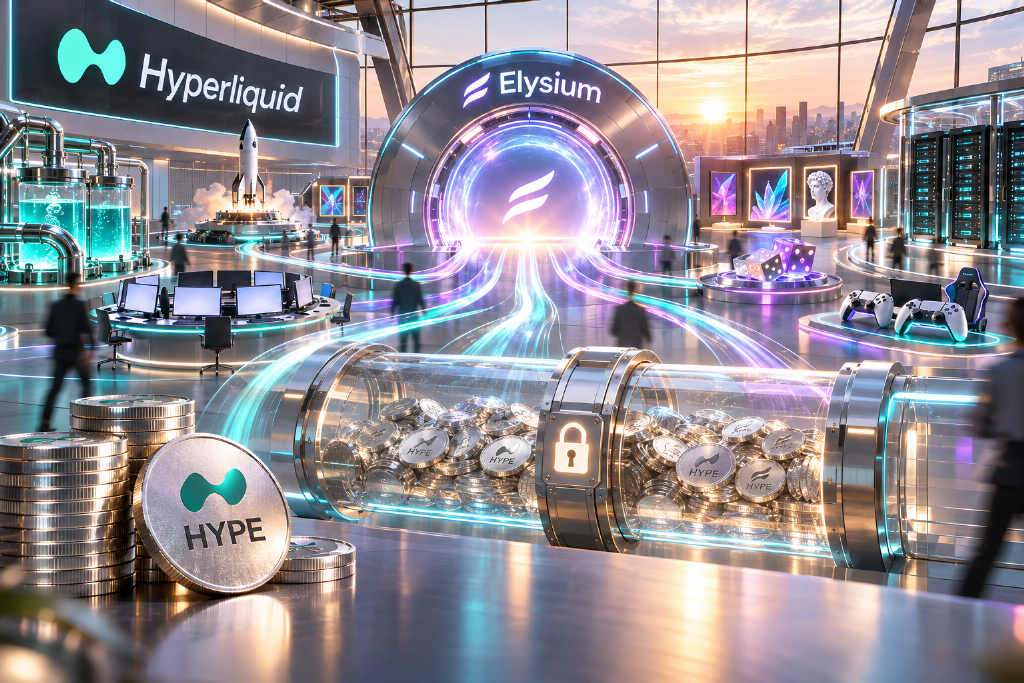
Market attention is building before Elysium has even gone live.
Elysium, the first Layer 2 network in the Hyperliquid ecosystem and built by Kinetiq, is now in the final stretch before mainnet launch. A number of higher-profile projects have already said they will deploy into the network, and capital has started moving early. Data from PerpMe cited by PANews shows that more than 49,000 HYPE has been locked through Elysium’s private mainnet bridge channel, with a value above $4.13 million.
PANews reviewed 29 projects that are drawing attention across the Elysium ecosystem, spanning DeFi, launchpads, NFTs, games, prediction markets and infrastructure.
Launch platforms are competing on issuance design, fee routing and liquidity structure
aka.fun
aka.fun is built around a MemeFi and internet capital markets narrative. The project is trying to combine meme token issuance with real-world assets, or RWA, in a loop that links community attention, onchain trading and RWA-based rewards.
The platform is built on Uniswap V4 and uses Hooks to create programmable market mechanics, including custom fee routing and liquidity rules. In practice, fees generated by meme trading are used to support liquidity, then to acquire RWA, and then distributed to eligible participants under preset rules. The design is meant to reward trading activity and community participation.
aka.fun had previously launched on Arc mainnet, where it mainly used USDC as the settlement asset and explored reward structures combining NFTs and tokens. It has now expanded to the Elysium testnet, where HYPE is commonly used as the trading pair asset.
BunnyPad
BunnyPad focuses on one-click token launches, no upfront real liquidity injection and permanently locked liquidity.
Users can deploy a token with a fixed supply of 1 billion units in a single transaction, and the system automatically creates an internal trading pool. The full 100% supply goes directly into the liquidity pool. The platform uses a virtual liquidity model with an initial market capitalization of about $3,000, which means creators do not need to seed real liquidity in advance. There is no presale and no team allocation. The token contract has no owner privileges and no minting function, and all participants buy from the same pool at market price.
BunnyPad supports HYPE, USDC and KALOS as pair assets. Creators can set separate buy and sell taxes ranging from 1% to 4%. Of that revenue, 70% goes to the creator and 30% goes to the platform. Creators can also designate any X account as the fee recipient, and that account can claim the proceeds after logging in.
The platform has also introduced Bunny Pass, an NFT collection capped at 999 units. After staking, holders can share in trading fees and issuance fee revenue, settled in HYPE or USDC.
Signal
Signal’s main feature is customizable fee distribution. Creators can define fee rules and recipients, directing revenue to holders, long-side participants or token burns.
Signal mainly runs on HyperEVM and supports HYPE, tokenized stocks, stablecoins and commodities as pair assets. Trading fees are usually around 1%. Roughly 70% of those fees can be directed by the creator, including distributions of the paired asset to token holders, opening 1x long positions on Hyperliquid perpetual markets, or buying back and burning the token. The remaining roughly 30% goes to the protocol.
For issuance, Signal mainly uses Uniswap V4 liquidity pools with locked liquidity. Creators do not pay an extra launch fee and only cover gas costs. The platform also offers a real-time trading tape, social Signals that publish trade views through wallet signatures, and Helix, which supports cross-chain asset purchases. Its native token is $SIGNAL, and the protocol uses a fee return mechanism to distribute HYPE to holders.
Oxley
Oxley is centered on auction-based price discovery and presents a route for new assets to start on Elysium and eventually move to the HyperCore order book market.
Instead of fixed-price launches or bonding curves, Oxley uses an auction model based on Uniswap CCA. Participants can set their own budget and the highest token price they are willing to accept, and the market then determines clearing and settlement. Auctions must meet a minimum funding threshold. If they do not, participants are refunded. If they succeed, the project moves into the next trading phase, with part of the funds used to support the liquidity curve.
Beyond auctions, Oxley also supports standard token trading, dynamic bidding and a Pro Mode with tools such as limit orders and take-profit and stop-loss functions.
PerpMe
PerpMe is built around one-click launches and permanently locked liquidity, with the goal of simplifying issuance and making fee allocation more direct.
Users can launch a token with a fixed supply of 1 billion units in one transaction. The full supply is injected directly into a Uniswap V3 liquidity pool, with no bonding curve and no later graduation migration. LP positions are sent to a lock contract with no withdrawal function, making liquidity permanent. Users can choose HYPE, USDC or KALOS as the pair asset, and there is no extra launch fee beyond gas.
Launchers can choose a pool fee of 1% or 2%. Creators receive 80% of the quote-asset-side fee, and that split is fixed at launch and cannot be changed later. Token-side fees are used for burns, and the remaining 20% goes to the platform. PerpMe also includes an anti-sniping mechanism that caps any single wallet at 2% of supply during the first 366 blocks after launch, or about six minutes.
The project also supports AI agents launching tokens on their own and includes a CTO, or community takeover, mechanism that lets the community apply to take over fee-sharing rights after a creator exits. It also provides Elysium cross-chain bridge support.
Ascend
Ascend is described as an official partner and positions itself as issuance and growth infrastructure for the next generation of projects, covering the full lifecycle from token launch to later ecosystem development. Testnet participation requires whitelist access.
Ascend does not currently issue its own protocol token. The platform allocates as much as roughly 50% of trading fees to project creators and uses buybacks, liquidity support and ecosystem exposure to help projects continue growing. It uses a standard trading fee of about 1%, and net protocol revenue is broadly split 50:50 to buy HYPE and KNTQ. Those funds are used for protocol staking and ecosystem incentives, token burns and liquidity construction. Users can also stake HYPE through kHYPE to receive ecosystem token airdrops and extra HYPE rewards.
Ascend also plans to launch Builder Incubator, which is intended to provide selected teams with as much as about $250,000 in funding, and a Strategic Partner Program that shares part of platform revenue with selected projects.
eleos
eleos combines token issuance and trading in one platform and is designed around multiple launch modes, permanently locked liquidity and onchain fee distribution aimed at protecting token holders.
The platform offers four issuance modes: Classic, Taxed, Stocks and Vows. These support fixed-tax launches, custom tax distribution, launches paired with stock-like assets, and as many as eight immutable onchain rules. Among the mechanisms highlighted by PANews: holders can automatically receive tax dividends paid in HYPE without manually claiming; creators can only lower tax rates or redirect their revenue share to holders, buybacks and liquidity, but cannot raise taxes or reclaim already assigned shares; all liquidity is permanently locked; and every tax distribution can be checked onchain. eleos also supports free launches, maximum wallet limits and anti-sniping tools.
Neuriio
Neuriio is trying to turn social influence into a tradable asset and build a market around social exposure.
The project uses X-based login authorization, and only the owner of an account can issue the corresponding token. Each X account can issue only one token for life, and the token name and ticker must match the account handle. Every token has a total supply of 1 billion units. Creators receive no reserved allocation and must buy through the bonding curve like everyone else. After authorization, users choose an account category, fill in a profile and launch the token, which can trade against HYPE or USDC. Once sold out, the token automatically migrates to a Uniswap V2-style liquidity pool, and LP tokens are sent to a burn address for permanent locking. The platform also supports FTF, short for friends that feel like family, allowing as many as four people to co-issue a token.
Its fee model charges 1% per trade. Of that, 10% goes to creators, 40% of pool fees is shared by token stakers, and another portion goes to stakers of the Neuriio platform token and to ecosystem uses such as KNTQ buybacks. The Neuriio platform token has no pre-mine and no team allocation. It is mainly minted by staking graduated tokens and includes a supply cap and a decay mechanism.
DEX infrastructure is filling in ahead of launch
Uniswap
Uniswap has confirmed support for Elysium and is expected to provide token swaps and liquidity pool functionality for the ecosystem. Work on the V2 router and V4 deployment is also under way.
KyberSwap
DEX aggregator KyberSwap has announced support for the Elysium network. It plans to aggregate liquidity from DEXs and launchpads across the ecosystem to improve pricing and execution paths for users.
Aero
Aero, formed through the combination of Aerodrome and Velodrome, is bringing its Slipstream V3 concentrated liquidity engine and dynamic fee mechanism into Elysium to improve trading efficiency and liquidity management.
ArcherSwap
ArcherSwap, which is expanding from Core DAO to Elysium, supports token swaps, liquidity provision, farms and staking, and is working with the launchpad project MemeKo.
Its swap fee is 0.2%. Half goes to liquidity providers, 12.5% is used to buy back and burn ARW, 12.5% is used to buy back tokens and inject them into the xARW pool, and the remaining 25% is returned to meme coin communities through farms and liquidity pools. The platform also includes a revenue-sharing design in which users can stake through trading, liquidity provision and other ecosystem interactions to earn HYPE rewards.
ArcherSwap also plans a token IDO, with a whitelist round priced at about $0.045 and a public round at about $0.05. It is also running airdrop and whitelist campaigns for the Core DAO community and early users.
Dex Da Costa
Dex Da Costa is a DEX developed with the help of AI tools. It supports swaps between testnet tokens and HYPE or USDC, as well as liquidity addition and management. The platform uses an AMM model similar to Uniswap V2 and offers basic functions such as swaps, slippage settings and liquidity management.
Kalos
Kalos is one of the more comprehensive trading platforms in the Elysium ecosystem, combining an NFT marketplace, DEX, launchpad and social features. It supports NFT minting and trading, token swaps, liquidity provision and new asset issuance, and also includes a points system and a Fate interaction feature.
Kalos plans to issue its native token, KALOS, after a short points season following mainnet launch. Mainnet points will determine token allocation. According to the team’s plan, about 90% of protocol revenue will be returned to holders through distributions and buybacks, while the remaining 10% will go to protocol operations. Elysium sequencer fees are also planned to flow entirely to KALOS holders. Kalos also intends to launch a Genesis NFT whose holders can receive daily points and rewards and may be able to redeem tokens.
NFT activity ranges from marketplaces to native collections
AtlasHL
AtlasHL is built on OpenSea’s open-source Seaport and SeaDrop contracts and covers both HyperEVM and Elysium. It offers NFT trading, bids, minting and cross-chain bridging.
Its core collection, Atlassians, has a total supply of about 500 and has already sold out on HyperEVM. Holding one Atlassians NFT grants whitelist access to the AtlasHL launchpad. Holding 10, or holding a designated 1/1 NFT, gives access to zero marketplace trading fees. The collection is also planned to be among the first NFT sets bridged from HyperEVM to Elysium.
slymz
slymz consists of 1,527 unique hand-drawn slime characters themed around a group of slimes in the Sector Elysium dungeon, with each character described as having its own personality.
The collection has already minted on the Elysium testnet and will open a free mint when mainnet goes live. The top 50 holders on testnet will receive GTD, or guaranteed allocation, status after launch.
Elyziuma
Elyziuma is designed around five character types: Sentinel, Executive, Overclock, Analyst and Prism. Total NFT supply is fixed at 2,222. The project has also introduced the ELYZ token, with a total supply of about 34.33 million. NFT holders can claim 10,000 tokens per NFT in a one-time free distribution.
According to the project plan, minting after Elysium mainnet launch will happen in three phases: GTD, whitelist and public sale. The GTD phase is aimed first at testnet NFT holders. The whitelist phase requires holding a certain amount of ELYZ, with the current threshold at about 2,001 tokens.
TORPOR
TORPOR is an NFT collection of 4,444 unique hand-drawn frogs, presented in a dark and quiet visual style. Each frog has its own combination of background, clothing, expression, head traits and glasses.
TORPOR plans to open minting on the day Elysium mainnet launches, with gas paid in HYPE. The project has already opened whitelist applications. Users need to connect an X account, complete assigned tasks and submit a wallet address. The team says applications will be reviewed manually rather than allocated by submission order. TORPOR has also started a Rank Auction for the three rarest NFTs in the collection.
Prediction markets are building around HIP-4 and pooled structures
ElyAnt
ElyAnt combines 1,111 ant-themed NFTs with a prediction market product. Users can create or join markets around crypto prices, NFT floor prices and sports events. The market uses a pooled format and charges about a 1% fee.
To create a market, holders must stake an ElyAnt NFT. Regular users can participate in existing markets. Sixty percent of platform fees are distributed to staked NFT holders.
Hyperflip
Hyperflip is built on Hyperliquid’s HIP-4 outcome contracts and lets users combine multiple prediction markets into parlays for higher potential returns through multiplied odds.
Users can choose between two and 10 HIP-4 markets and their corresponding outcomes to build a bet. Each added leg multiplies the combined odds, but every leg must win for the bet to pay out. If any one leg loses, the entire ticket fails. The platform uses EIP-712 signed quotes, and once a user mints the betting receipt onchain, the quote and terms are locked.
For fund security, Hyperflip manages betting capital through a collateral vault deployed on Elysium and locks both principal and maximum payout at mint. All market outcomes are determined by HIP-4 contracts on HyperCore, and Hyperflip does not run a separate oracle. The project is currently focused on sports prediction markets such as NFL and soccer, with plans to expand into more HIP-4 categories.
Speculate
Speculate combines prediction markets with a gacha, or pack-opening, format and is aimed at lowering the barrier for ordinary users to participate in onchain trading.
On the prediction side, Speculate connects mainly to Hyperliquid HIP-4 outcome markets across sports and crypto price moves. Users can trade event outcomes directly through the application. The platform also adds a TCG-style card pack-opening gacha feature and supports deposits from multiple chains including Hyperliquid and Arbitrum.
Games emphasize verifiable fairness and onchain reward loops
Frog Flip
Frog Flip is a frog-themed onchain gaming platform built around verifiable fairness. It currently offers two modes: Flip, a coin-toss game, and Splash, a crash-style game.
In Flip, players bet on heads or tails and get a result in about three seconds. After a 2% fee, the net payout is about 1.96x, and the maximum bet per round is 1 HYPE. Splash uses an increasing multiplier model in which players must cash out before the game ends. Waiting longer raises potential returns, but also raises risk.
The platform’s fairness model uses a commit-reveal system. Before the game starts, the house publishes a hash commitment of a secret random number. The player generates a random number locally and submits its hash. After the bet is confirmed, both sides reveal their secrets, and the final result is determined by the combined randomness. If the house fails to reveal within six hours, the player wins automatically. The full process can be tracked onchain and independently verified by users.
Eloscape
Eloscape is an onchain mining game that lets players deploy assets to mine rewards. It supports Robinhood Chain, HyperEVM and Elysium.
The core gameplay uses a 5×5 grid, and each round lasts about 60 seconds. Players deploy assets such as HYPE into different cells. At the end of the round, the protocol uses a public random beacon to generate a verifiable random result, selects the winning cell, distributes the round’s deployed assets proportionally to participants in that cell, and mints ELO tokens.
Clash for Elysium
Clash for Elysium is an onchain battle royale game in which each match lasts about two minutes. Players can choose classes such as paladin, guardian, berserker, ranger and mage, then fight in an arena through actions including attack, defense, charging and skill release. The last survivor wins. The game supports both manual strategy play and auto-battle mode.
Unlike more conventional blockchain games, Clash for Elysium records every combat action as a transaction on Elysium. The battle process and final result can both be verified and settled onchain. Players can also accumulate XP through combat, level up and write their names into the game chronicle. The project also plans to introduce AI agents that can fight on behalf of players.
Elysium HuntX
Elysium HuntX is a cyberpunk-themed onchain card game built around the idea of network bounty hunters, and it is already live on the Elysium testnet.
Players can mint ERC-721 hunter cards, earn experience through daily check-ins, onchain trading and social tasks, and upgrade cards through the Card Forge feature to compete on leaderboards and for HYPE reward pools. The game has four ranks: Scavenger, Mercenary, Vanguard and Apex Hunter. Higher card levels come with stronger base combat power, larger experience bonuses and larger reward rights. Upgrades use an onchain randomness mechanism, and failed upgrades do not downgrade or destroy the card.
The reward system includes four HYPE reward pools and a level-gated claim structure. Each card can claim a reward only once at each level, so players need to keep upgrading to unlock later rewards. The project has also introduced the EHUNT token for in-game interaction, trading and liquidity, with swap support between HYPE and EHUNT.
Infrastructure covers trading access, naming and cross-chain execution
Fomo
Fomo is one of the main traffic gateways for meme activity and focuses on social discovery and one-click trading. It has become Elysium’s exclusive trading partner and plans to open trading support for Elysium ecosystem assets on the first day of mainnet.
Plumbline
Plumbline provides market maker monitoring, verification and scoring. It uses onchain probes to inspect market-making behavior and is positioned as a data analysis tool at the infrastructure layer.
Elysium Names
Elysium Names is a naming service on Elysium, similar to Ethereum Name Service. It lets users register .ely domains and bind them to wallet addresses to simplify transfers and onchain identity recognition. The service is already live on testnet, where more than 6,700 names have been registered.
It supports name registration, address resolution, primary name settings and text records. Each .ely name is issued as an ERC-721 NFT and can be transferred or traded on secondary markets, with a 3% royalty on resale. Users can also register through referral links for a 5% discount, while referrers receive a 5% share.
Enso
Enso is cross-chain DeFi routing and execution infrastructure. Its core products are a routing engine and Shortcuts. With a single API or contract integration, developers can connect to more than 250 DeFi protocols without integrating and maintaining them one by one. The routing engine can automatically find swap and DeFi execution paths across protocols and chains, while Shortcuts can bundle multiple onchain actions such as bridging, swapping and vault deposits into a single call.
From launchpads and DEXs to NFTs, prediction markets, games and infrastructure, Elysium is approaching mainnet with a broad set of products already in place. The project lineup and the early HYPE bridged into the network show that teams and capital are both moving before the chain officially opens.



