

Embodied AI data has started to break away from robotics companies and form its own market segment.
Quantum Position, in figures cited by MarsBit, counted 97 domestic players in China’s embodied data industry, including 70 focused on data collection and 27 on data infrastructure. During the period from July 1, 2025 to July 1, 2026, 15 independent embodied data service providers — defined as companies that do not build general-purpose robot bodies, do not train embodied models, and treat data as their core business — completed 34 funding rounds worth about RMB 4.47 billion in total.
One example in the report came from Chenzhou, Hunan, where a China Mobile business hall was branded as an “embodied data collection 5S store.” Customers can receive a gripper, gloves, and a head-mounted camera, take brief training, and collect robot training data while doing household tasks. The first batch of 1,000 device sets, at full utilization, can collect 1 million hours of data a year.
Other collection experiments mentioned in the report included free in-home cleaning, VR-style data collection, and internet-connected robots that let workers operate machines remotely. The broader point was simple: robots still do not have enough training data.
Four collection routes are in play, and multi-route strategies are the most crowded
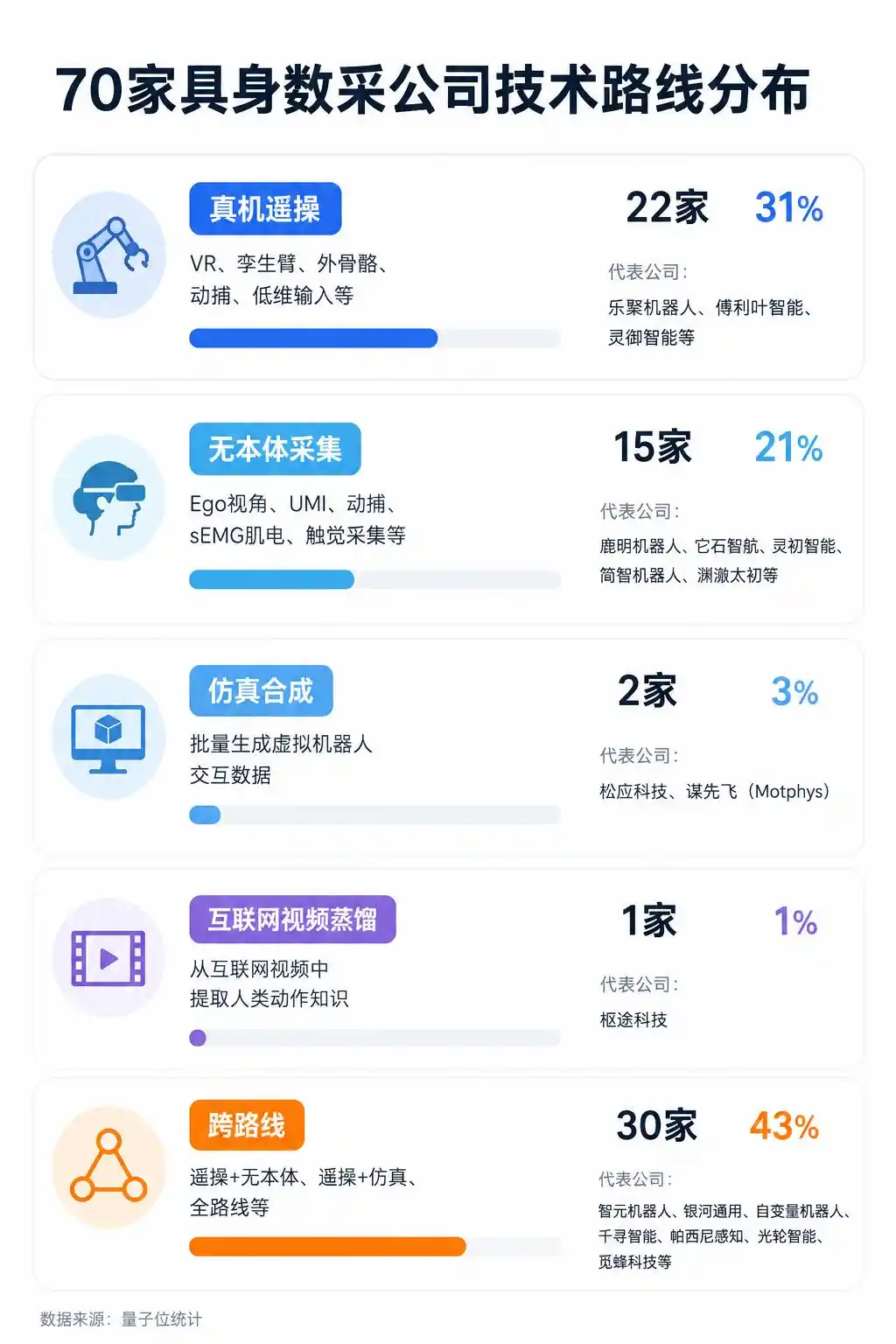
The report grouped current embodied data collection methods into four main routes: teleoperation on real robots, robot-free collection through direct human demonstrations, synthetic simulation, and internet video distillation.
- Real-robot teleoperation records actions, states, and sensor data while a human operates a physical robot.
- Robot-free collection captures human demonstrations through motion capture, gripper mapping, first-person cameras, and related tools without putting a robot in the loop.
- Simulation generates interaction data in virtual environments for model training.
- Internet video distillation extracts human action knowledge from online video and converts it into data that embodied models can learn from.
Among the 70 collection companies or platforms in Quantum Position’s count, 30 used more than one route, or 43% of the total. Examples included real-robot teleoperation combined with robot-free collection, teleoperation plus simulation, robot-free collection plus simulation, or full-route setups. That means cross-route collection is more common than betting on any single route alone.

The report said the industry often uses a “data pyramid” to describe the structure of robot training data. No single collection method can satisfy those training needs on its own.
Teleoperation has the largest single-route camp, while robot-free firms are newer
There were 22 players focused only on real-robot teleoperation, accounting for 31% of the sample. Of those, 13 were state-backed data platforms, seven were robotics companies, one came from AI data labeling, and one crossed over from industrial equipment manufacturing.
Quantum Position said the logic is straightforward. Robotics companies already have hardware and direct demand, while state-backed platforms are better positioned to mobilize the heavy assets the route requires, including robot bodies, sites, and operators.
Another 15 companies, or 21%, focused only on robot-free collection. This group was the youngest in the market, with most founded after September 2024. It also showed the widest technical spread, including ego-view capture, UMI, motion capture, sEMG, and tactile collection.
Only two players focused solely on simulation: Songying Technology and Motphys. Only one company focused solely on internet video distillation: Shutuo Technology. The report said Shutuo claims it can cut aggregate collection costs to one five-hundredth of the industry average by extracting multimodal robot training data from monocular RGB internet video.
Some companies once known for simulation have added other methods. The report said Guanglun Intelligence, previously centered on simulated data, has started collecting human data, while Galaxy General released a full-body teleoperation system in June this year and now has teleoperation collection capability.
Quantum Position gave two reasons. First, supply of real-robot and human data has risen quickly and prices have continued to fall, reducing simulation’s scale and cost edge. Second, the sim2real gap still lacks a strong solution, especially when it comes to faithfully reproducing friction, deformation, force, and tactile feedback in the physical world.
Independent service providers now form the largest group
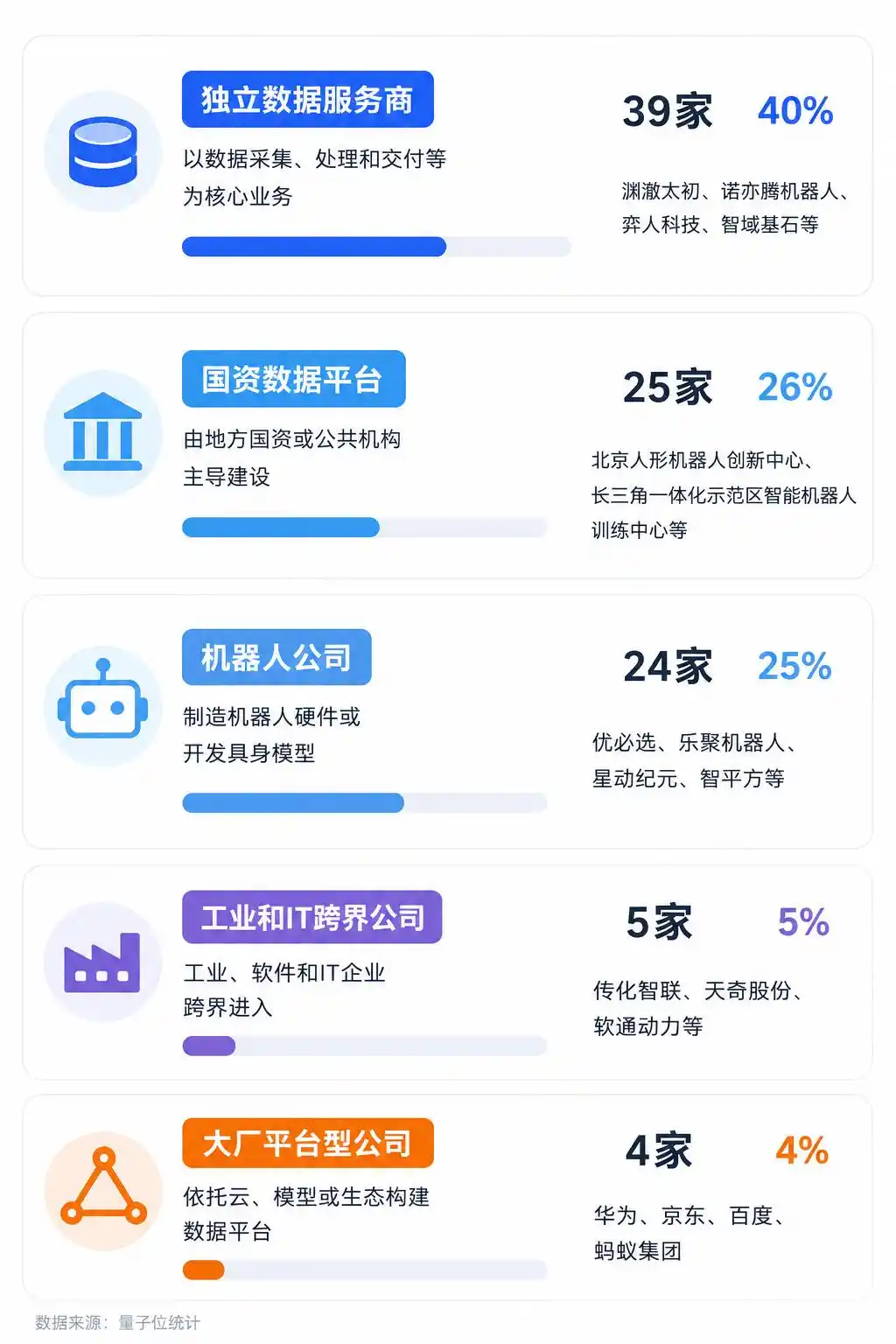
When sorted by company identity rather than technical route, the 97 players fall into five categories: 39 independent data service providers, or 40%; 25 state-backed data platforms, or 26%; 24 robotics companies, or 25%; five industrial and IT crossover firms, or 5%; and four platform companies from large tech groups, or 4%.
Independent data service providers are the largest group. In the report’s reading, that shows embodied data has become a market of its own rather than a support function attached to robotics makers.
The same sample can also be divided into “native embodied” companies and “crossover” firms. Sixty-five companies, or 67%, were native to embodied data or embodied intelligence from the start, while 32, or 33%, were transformed from other businesses such as AI data labeling, autonomous driving, motion capture, or industrial services.
The composition differs sharply between collection and infrastructure. Among the 70 collection firms, 57 were native embodied companies, roughly 80%. Among the 27 data infrastructure firms, 19 were crossover companies, roughly 70%.

The report pointed to examples such as Haitian Ruisheng, Datatang, and Testin Data. Their pipeline, quality control, and delivery experience in AI data labeling can be moved into embodied data infrastructure. Collection is different. There is no ready-made asset base, so new companies can start with less baggage.
Annual capacity is estimated at 1.6 million to 1.8 million hours, with a short-term goal 15 to 20 times larger
Quantum Position estimated current annual output at 1.6 million to 1.8 million hours, plus 70 million to 80 million records.
The short-term target for the next one to three years is 25 million to 35 million hours and data at the hundred-million-record level. On hours alone, that is 15 to 20 times current capacity.
The report noted that companies disclose output using different standards, so hours and record counts are listed side by side and cannot yet be converted under a unified industry rule. These figures cover only real-robot teleoperation and robot-free collection, not simulation. Capacity was estimated conservatively from publicly disclosed company and platform data.
Total demand for robot training data remains unknown. As a reference point, the report said total global high-quality real-world physical interaction data stood at only about 500,000 hours as of the start of this year, less than one twenty-thousandth of the volume used to train large language models. Even if the industry reaches its near-term output target, the report suggested that may only bring it to the starting line.
Collection factories span 20 provinces, with the Yangtze River Delta leading
Data collection factories have spread across 20 provinces in China, according to the report. State-backed collection factories cover 16 provinces.
The main clusters are the Yangtze River Delta, the Beijing-Tianjin-Hebei region, and the Pearl River Delta. The Yangtze River Delta leads with 30 sites. Lower-cost third- and fourth-tier cities such as Suqian, Zigong, Chenzhou, Yuncheng, and Deqing have also become locations for collection factories.
Distribution patterns vary by route. Teleoperation facilities are spread across provinces, while lighter-asset robot-free companies tend to cluster in first-tier cities.
The report highlighted Wuxi as the first city in China to propose the idea of citywide data collection. One key move there has been encouraging manufacturing and service companies to open production lines and platforms so real-world scenarios can be used as data collection sites.
Funding is concentrated, and Guanglun Intelligence stands out
Looking at capital flows, the 15 independent embodied data service providers raised about RMB 4.47 billion through 34 deals over the past year. Funding activity was heavily concentrated in April through June 2026, when more than 40% of the financing events took place.
For comparison, Quantum Position previously estimated that the entire embodied intelligence sector raised about RMB 43.8 billion in the first half of 2026. By that measure, a full year of embodied data funding still represents only a small slice of broader embodied AI financing.
The market is also splitting into tiers. Guanglun Intelligence was the clearest first-tier player. It completed six funding rounds over the past year and raised RMB 3.1 billion, about 70% of the total raised by the 15-company sample. It was also the only independent embodied data service provider in the sample to disclose a valuation, reported at more than $2 billion, or more than RMB 13.5 billion. The report described it as the world’s first embodied data unicorn.
The second tier included 11 companies such as Jianzhi Robotics, Noitom Robotics, Yuanche Taichu, and Mifeng Technology. Their cumulative fundraising over the past year ranged from tens of millions of yuan to several hundred million yuan. Most were still at Pre-A or earlier, with only a few older AI data-labeling converts moving past Series A.
The third tier included Shutuo Technology, Zhiyu Jishi, and Butianshi Technology. Their total fundraising over the past year was at the level of tens of millions of yuan, mostly at the angel stage, and their businesses remain in early validation.
Sixty-nine investment firms participated, but none has gone all in
Over the past year, 69 investment institutions backed the 15 independent service providers in the sample.
Guofang Venture Capital made three investments, five institutions invested twice, and the remaining 63 invested only once. The report’s conclusion was that the market may agree on the direction, but not yet on which companies are the ones to back heavily.
It also laid out why investors may be cautious. Compared with the much larger upside often assigned to embodied “brains,” embodied data looks more labor-intensive. Pricing could keep getting more competitive, and expected customer demand may have a clearer ceiling.

At the same time, some investors told Quantum Position that the market still has room to expand. One reason is that it can become a global business with sizable overseas demand. Another is that data collection capability can extend into model evaluation and other parts of the physical AI stack.
Most funded firms are still early, and profits remain largely undisclosed
The report closed with a simple assessment: the independent embodied data industry is still in an early phase.
More than half of the independently funded embodied data service providers were founded less than a year ago. Thirteen of the 15 companies had most recently raised at Series A or earlier. No company has disclosed profits. Only Yiren Technology said it was profitable, and it did not publish a profit figure.
Quantum Position summed up the market in three points. Embodied data has become an independent track. The track is still early, with many open questions and few settled assumptions. Capital is still casting a wide net, and few companies have proved that “selling data” alone can become a profitable business.
According to the report, the next one to two years may be the window that tests that model. Whether capacity is delivered, how far price competition goes, and who can produce a profit statement first will shape whether embodied data providers can turn into sustainable businesses.