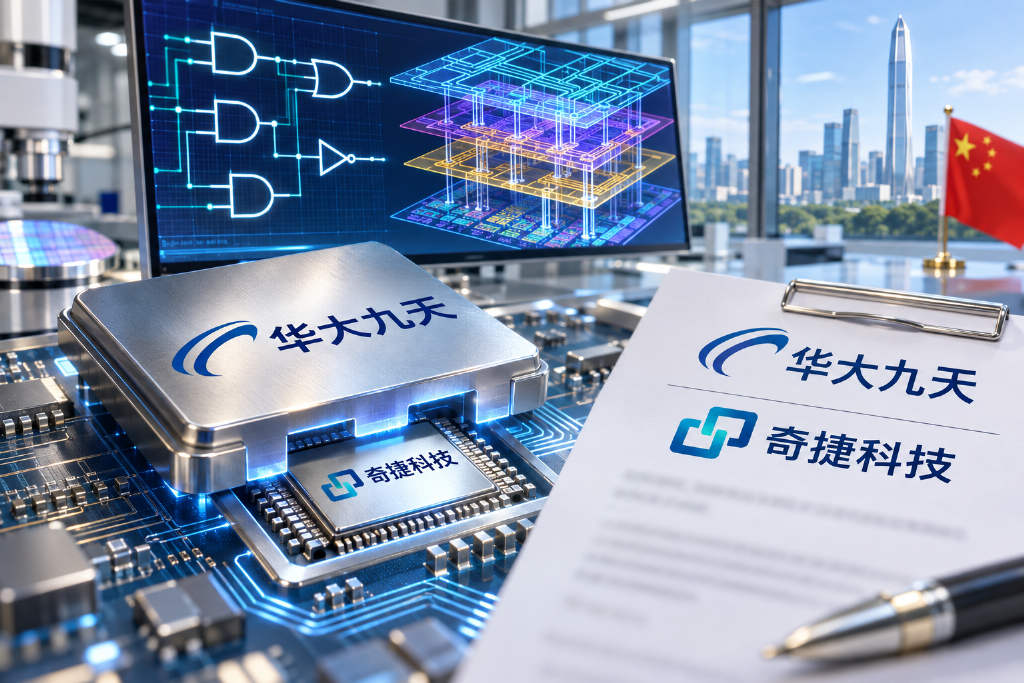
Empyrean Technology said on Nov. 1 that it intends to buy up to 51% of Qijie Technology (Shenzhen) Co., Ltd. for no more than 220 million yuan. After the deal closes, Qijie will become an Empyrean-controlled subsidiary.
Under the terms laid out in the announcement, Empyrean plans to buy a 50.3762% stake in Qijie, tied to registered capital of 1.1804 million yuan, for roughly 219 million yuan, with the payment made in installments. Once completed, Empyrean’s stake in Qijie would rise from a minority holding to 73.8651%, putting control firmly in its hands.
From minority investment to control
The deal is framed as another real move by Empyrean to patch holes in its digital EDA product line. Before this, the company had already put money into several EDA firms, including Xinxingji, Zhongke Jianxin, and Shanghai Manguang. The article says Empyrean signed strategic cooperation agreements with those portfolio companies at its partner conference in October 2026.
Qijie is the first of those investments to go from a simple equity holding to a controlling stake, and the first to be folded into Empyrean’s consolidated financial statements. That matters. In the source article’s view, it shows a shift from working through partnerships to running the business directly in an area where Empyrean had been relatively weak.
The missing piece in digital logic optimization
Empyrean’s announcement puts the reason plainly: this acquisition is meant to patch a gap in digital logic optimization EDA tools, strengthen the competitiveness of the company’s current end-to-end digital solution, and support next-generation AI/3DIC digital design logic and performance optimization solutions.
That point hits because of the way Empyrean built its product lineup. It began with full-flow tools for analog circuit design, then later built out full-process capabilities in memory, radio frequency, and flat-panel display applications. But in digital design, the gap was hard to miss.
The article breaks digital chip design into broad stages: logic synthesis, place and route, logic optimization, static timing analysis, physical verification, and DFT. Through its own R&D and outside investments, Empyrean had already covered simulation and verification, static timing analysis, physical verification, place and route, and DFT. Logic optimization was the core tool still missing.
Qijie’s Easylogic ECO and its market validation
Qijie Technology was founded in January 2021 and focuses on developing and selling logic optimization EDA tools. Its main product, Easylogic ECO, is an automated logic functional change tool used for fast logic fixes late in the chip design cycle. The article says it supports advanced nodes, including 5nm.
In chip design, logic optimization tools matter because they let teams finish design iterations with minimal time and resource costs. The source article says that has a direct effect on tape-out success rates and cost control. And as tape-out costs at advanced nodes keep climbing while design complexity grows exponentially, the value of this step keeps rising too.
On customer uptake, the article says Qijie’s products have been used by nearly 100 digital chip design companies in China and overseas. In EDA, customer stickiness is high. Very high. So that level of commercial use suggests the product has already been tested in real production settings. For a company that has existed for only five years, the article calls that a meaningful result.
The report also puts a spotlight on the team. Qijie team members have won world championships multiple times in international EDA algorithm competitions, and some key technologies have reached internationally or domestically leading levels. The article says the team’s intact organizational structure was an important reason Empyrean was willing to pay a control premium.
Part of a faster M&A cycle in China’s EDA sector
This transaction also sits inside a wider consolidation trend. The article says M&A in China’s domestic EDA industry has picked up speed since 2026. Primarius Technologies acquired Ruicheng Xinwei and Naneng Micro for more than 2.1 billion yuan as part of an effort to build a dual-engine EDA plus IP platform.
Empyrean itself has been busy since listing, the article says. It acquired Xinda Chip and invested in Akasi, Yake Hongyu, Ruijing Juyuan, and Feisilixin, while also setting up two industry funds to deepen its presence.
Set against a market where the three major overseas EDA vendors have long dominated full-flow toolchains, just collecting point tools no longer cuts it for advanced process nodes and complex SoC design. The article’s argument is blunt: platform-style full-flow capability built through acquisitions is becoming the path chosen by leading companies.
A case study in domestic EDA integration
Seen through the broader evolution of the domestic EDA industry, the article says this deal matters for more than just one company’s missing product. China’s EDA market has long been fragmented, with dozens of companies scattered across different tool stages and each covering only a narrow slice of the workflow. That makes forming a complete closed-loop process difficult.
The article argues that overseas leaders have already shown what drives commercial success in EDA: full-flow capability, advanced-node support, and ecosystem lock-in. If domestic vendors stay stuck at the point-tool stage, then even tools that hit performance targets on their own may still fail to support large-scale independent digital chip design.
Empyrean’s method is described as a three-track strategy: in-house development, cooperative development, and acquisition-led integration. In digital design, the company has already launched more than 10 commercial tools, including characterization extraction, simulation and verification, static timing analysis, and physical verification. Put together with its positions in Xinxingji, Qijie, and Zhongke Jianxin, the article says the pieces of a full digital design flow are becoming more complete.
Still, having all the pieces is not the same as having them work together. That is the hard part. The report points to differences in data models, user interfaces, and underlying architectures across tools from different sources as one of the toughest engineering problems in integration. Whether Empyrean can deeply connect Qijie’s ECO tool with its existing digital toolchain, instead of merely adding another product name to a catalog, will decide how much real substance this acquisition has.
Customer trust and the integration model
The article also says customer trust is something to watch. Among Qijie’s nearly 100 domestic and overseas customers, some may have picked the product precisely because it was neutral and independent. Once Qijie becomes an Empyrean-controlled subsidiary, some customers may rethink procurement strategy because of competitive ties or worries about supplier concentration. The article says that variable will take time to play out, especially in a domestic EDA market that is still developing and offers few alternatives.
From a more constructive view, the report says the transaction offers a reference case for smaller companies in specialized domestic EDA segments. With capital market financing slowing and competition getting fiercer, being acquired by or brought under the control of a larger platform may become a practical option for more point-tool vendors.
Empyrean’s route here is gradual: minority investment first, control later. The article says that method lowers the risk of information asymmetry and gives the target company’s founders a transition period. If later deals follow the same pattern, it could accelerate the domestic EDA industry’s shift from fragmentation toward a more consolidated structure.
Execution will decide the result
The source article ends by saying Empyrean’s 220 million yuan move to take control of Qijie is a deal with a clear strategic aim and a practical execution path. It patches the most visible gap in Empyrean’s full digital EDA flow and gives the market a visible case of ecosystem integration in China’s domestic EDA sector.
But good strategy does not mean the integration will work. The article closes on a simple, practical point: the promise of a full domestic EDA workflow still has to be proven tool by tool inside real chip design processes.
The original article was published through the WeChat public account Xinshiye and credited to Grace, under the headline: "A heavyweight 220 million yuan acquisition! Domestic EDA 'huddling together for warmth' enters the second half."