
Altcoins have started to heat up again after strong rebounds in Bitcoin and Ether, but Blockcast’s report argues that the market is still far from a full-blown altseason.
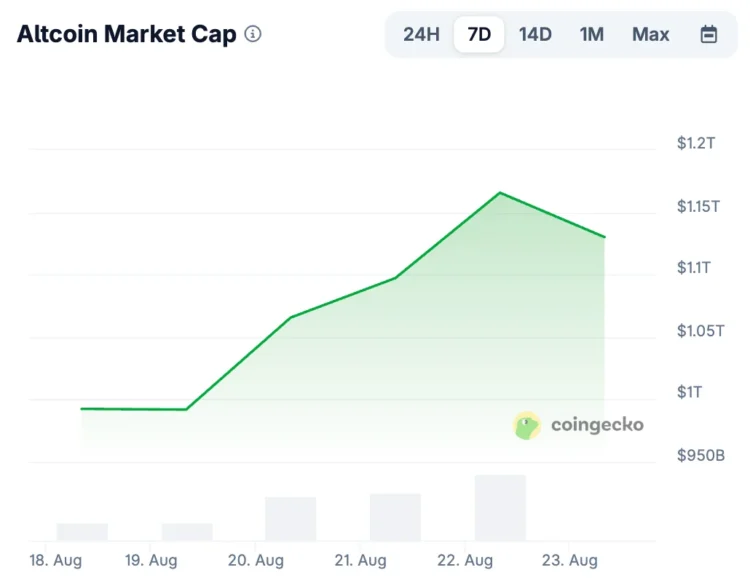
CoinGecko data cited in the report shows that since Aug. 19, total altcoin market capitalization has increased by more than $250 billion at its peak and has now recovered to about $1.13 trillion. CoinGlass data shows daily altcoin trading volume rose over the same period from roughly $86.23 billion to as high as $132.43 billion, up about 53.6%.
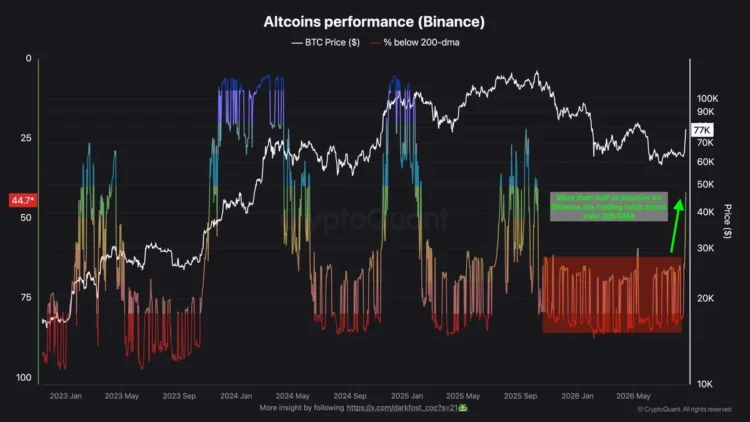
The pickup in market activity has been accompanied by improving technical conditions. CryptoQuant analyst Darkfost said 56% of altcoins listed on Binance have now climbed back above their 200-day moving average, a key indicator that may suggest the market is entering a new cycle phase.
Leadership has narrowed to a handful of tokens
Within the top 100 tokens by market capitalization, CoinGecko data shows the top 30 gainers posted an average increase of more than 34.9% over the past seven days, outperforming both Bitcoin and Ether during the same period. ENA, PUMP, ZEC and AAVE led the group, rising 98%, 80.5%, 69.7% and 60.7%, respectively.
The report says those gains have been driven by two forces at once: a broader recovery in market sentiment and project-specific improvements in fundamentals or near-term catalysts.
For ENA, the article points to Ethena securing a $1 billion financing arrangement from FalconX, along with public bullish comments and purchases from BitMEX co-founder Arthur Hayes. For PUMP, the cited drivers include stronger protocol revenue, an improved token burn ratio, product updates such as BOOST mode and Allout Rewards, and other supportive factors mentioned in the report.
Only ZEC and HYPE were described as having recently reached fresh highs and therefore capturing higher market premiums. The report says ZEC’s rise was supported by Grayscale’s amended filing for a Zcash ETF, DCG’s discussion of injecting about 200,000 ZEC into a related fund, and the return of a privacy narrative. HYPE, meanwhile, was linked to continued protocol revenue and buyback mechanisms, remarks by Trump at a White House crypto meeting, and expectations surrounding the AQAv2 upgrade.
Strength is concentrated in privacy, DeFi and meme names
By sector, the leading gainers were mainly found in privacy, DeFi, meme, payments and trading, while the number of standout assets remained limited. Public chain, RWA and oracle segments posted more moderate gains.
The privacy segment recorded the highest average increase, though the report says that performance was largely driven by ZEC alone rather than a broad move across the category. DeFi has also been repriced by the market. ENA, AAVE, UNI, MORPHO and SKY gained an average of about 51.5% over the past seven days. Even excluding ENA’s 98% jump, the other four DeFi tokens still averaged about 39.9%.
Meme tokens also turned in strong performance. Four related tokens posted an average 7-day gain of 46.75%, with PUMP up 80.5%, PEPE rising 53.9%, DOGE gaining 30.9% and SHIB adding 21.7%. The article says coordinated gains in meme tokens are often viewed as a sign that risk appetite is improving, but whether that strength can continue will depend largely on whether fresh capital keeps entering the market and whether overall risk appetite improves further.
Overall, the report describes the current altcoin rally as a mix of technical repair after deep drawdowns and a shift in sentiment from defense toward offense. Even so, capital is moving more selectively into high-beta assets, strong narratives and tokens with clear catalysts, rather than spreading across the market.
Altcoin season indicators have improved, but not enough
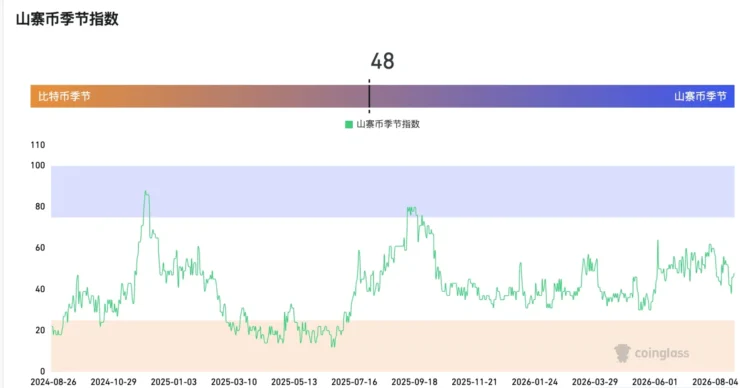
Despite the rebound, the article says the market still remains some distance from a true altseason. CoinGlass data shows the Altcoin Season Index has recovered to 48 from its low point over the past two months, but it is still well below 75, the threshold commonly viewed as confirmation of altseason.
The index tracks the relative performance of altcoins versus Bitcoin. Only when most of the top 100 altcoins by market capitalization outperform BTC over the previous 90 days does the market start to resemble a classic altseason. With the reading still hovering near 50, the report says the market remains in a transitional and choppy phase, and capital has not yet spilled over into altcoins on a broad basis.
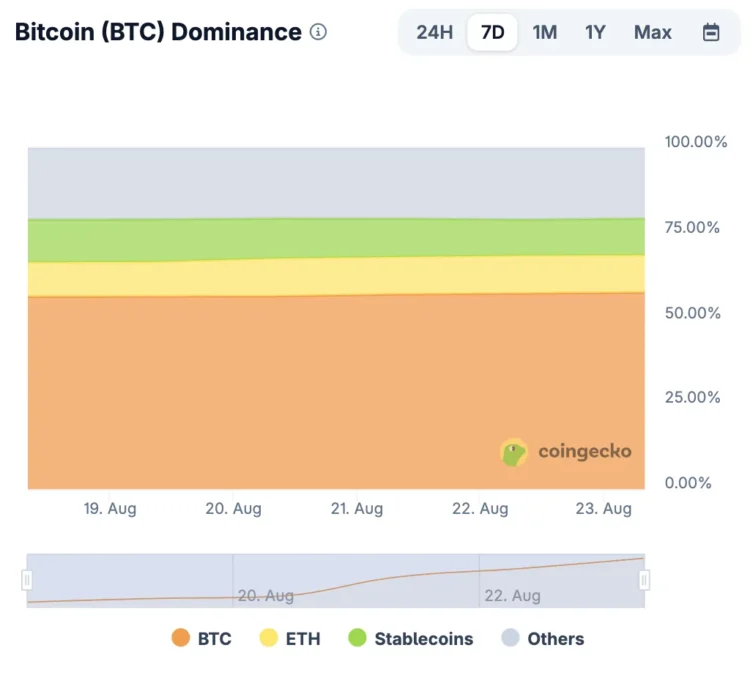
Bitcoin dominance remains elevated as well. CoinGecko data puts BTC dominance at 57.6%, while the rest of the altcoin market excluding Ether and stablecoins accounts for only 20.64%, with little recent change. That, the report says, supports the view that recent gains have been concentrated in selected tokens rather than fueled by a market-wide release of liquidity.
The piece also revisits the traditional cycle pattern. Historically, classic altseasons tended to appear after Bitcoin had already posted a major rally and then entered a period of consolidation near higher levels. As Bitcoin momentum cooled, some capital would rotate into Ether, large-cap altcoins and then smaller tokens. Right now, the report says Bitcoin’s next trend still needs more confirmation. In the early stage of a market move, capital usually stays concentrated in Bitcoin first, often producing a siphoning effect that makes it difficult for most altcoins to attract sustained support.
Why the old “everything pumps” playbook may no longer work
The report argues that this cycle’s capital structure has changed. As Wall Street institutions enter through spot Bitcoin and Ether ETFs as well as crypto treasury channels, the old pattern in which money cascaded from Bitcoin into progressively smaller altcoins is facing pressure. Institutional capital, compared with speculative retail flows, tends to prefer the deepest and most liquid assets with clearer certainty.
At the same time, the number of altcoins has expanded sharply in recent years. New tokens continue to enter the market, spreading limited liquidity across a much wider field. Without a matching expansion in net new capital, even if money starts flowing into altcoins, the market may struggle to recreate the kind of across-the-board rally seen in earlier cycles.
CryptoQuant founder Ki Young Ju previously made a similar point, saying the traditional altcoin rotation effect has largely disappeared and that trading volume in altcoins against BTC pairs has shrunk sharply since 2021.
In his view, the period when narrative-driven token issuance alone could make money is over. Altcoins are not dead, but only projects with real business activity and actual revenue are worth holding for the long term. He highlighted three types of projects: global internet companies with tokenized market layers such as Binance’s BNB and Telegram’s TON; DeFi protocols with real revenue, including high-quality decentralized exchanges such as Hyperliquid, assuming founders are credible and governance respects token holders; and projects aligned with global financial trends, including stablecoins, RWA and tokenized stocks.
Blockcast’s report concludes that another altseason may still arrive, but the era in which nearly every token rises together may already be over. What comes next, based on the article, is likely to be a more selective rotation in which fundamentals, real revenue and the durability of a project’s narrative matter more than simple beta exposure.