

A research team from Virginia Tech, the University of Maryland, MBZUAI, and the University of Pittsburgh has proposed Epi2Diff, a framework that uses large language model reasoning traces to predict how difficult a test item will be for human examinees. The paper has been accepted by Transactions on Machine Learning Research (TMLR).
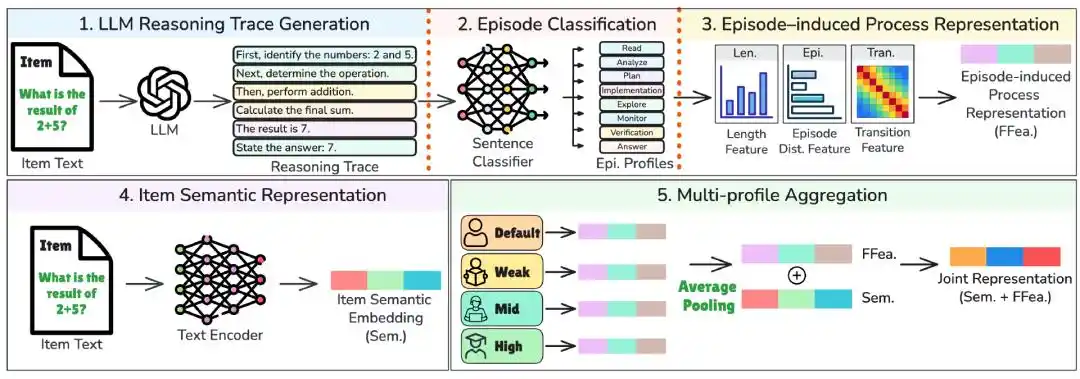
The core idea is to look beyond item wording. Instead of estimating difficulty from question semantics alone, Epi2Diff analyzes the model’s problem-solving process: how long it reasons, whether it spends more effort on analysis or execution, and how often it shifts strategies. The study frames those signals as scalable proxy evidence, while keeping human difficulty labels as the supervision target.
From raw reasoning traces to structured process features
The method breaks each reasoning trace into eight cognitive episode types: reading, analysis, planning, execution, exploration, verification, monitoring, and answering. These are sentence-level functional labels rather than a fixed eight-step workflow.
Using a RoBERTa-based classifier, the team reports 79.9% accuracy and a macro-F1 score of 0.761 on ThinkARM’s 7,067-sentence manually labeled math reasoning test set. In additional labeled evaluations from target domains, accuracy ranged from 62.9% to 74.2%, which the paper says shows that cross-domain automatic classification still carries error.
Epi2Diff then extracts 83 process features from the traces: three length statistics, token counts for the eight episode types, token ratios for the same eight types, and 64 adjacent episode transition counts. Those features are meant to capture how much effort is spent, where that effort is allocated, and how the reasoning process unfolds over time.
The paper gives a simple contrast. Two traces may have similar length and similar analysis-versus-execution ratios, yet one may cluster analysis first and then move into sustained execution, while the other may switch back and forth repeatedly. Transition features preserve that ordering information.

To generate traces, the experiments used QwQ-32B and Qwen3-32B under direct answering and prompt conditions labeled “weak,” “medium,” and “strong,” then averaged the resulting features. The authors note that these prompts were used to induce different solution paths and do not represent validated student ability levels.
Process features were concatenated with Sentence-BERT semantic vectors of the item text, and a supervised model was trained to predict difficulty. After validation-set selection, XGBoost was used as the final predictor for all four datasets.
Main results across four real-world assessment datasets
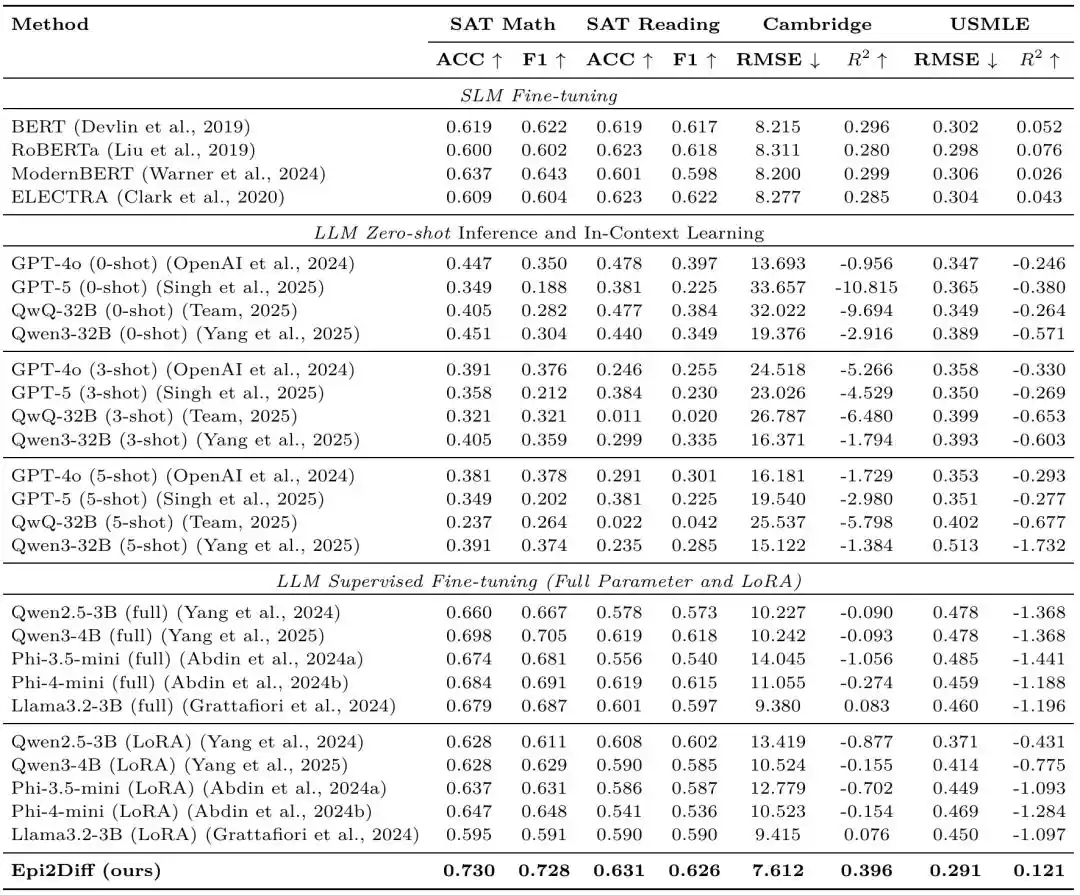
The evaluation covered 1,075 SAT Math items, 1,338 SAT Reading and Writing items, 793 Cambridge English reading items, and 667 USMLE medical items. The two SAT tasks used three-way classification with “easy,” “medium,” and “hard,” while Cambridge and USMLE were treated as continuous difficulty prediction tasks. Baselines included fine-tuned smaller models such as BERT, zero-shot and few-shot LLM prompting, and both full-parameter and LoRA fine-tuning.
In the main single-run experiment, Epi2Diff ranked first on all reported metrics.
- SAT Math: accuracy improved from 69.8% for the strongest baseline to 73.0%, while macro-F1 rose from 0.705 to 0.728.
- SAT Reading and Writing: accuracy increased from 62.3% to 63.1%, and macro-F1 moved from 0.622 to 0.626.
- Cambridge: RMSE fell from 8.200 to 7.612, and R² increased from 0.299 to 0.396.
- USMLE: RMSE declined from 0.298 to 0.291, and R² rose from 0.076 to 0.121.
Repeated runs and limits of the findings
In five additional runs, Epi2Diff still posted the highest average accuracy and macro-F1 on the two SAT tasks. The paper adds a caution, though: on SAT Reading and Writing, the lead was smaller than the run-to-run variation, so that advantage should be interpreted carefully.
Those repeated experiments kept the traces and episode features fixed and changed only the random seed of the downstream predictor.
Ablation results show gains are not just about longer reasoning
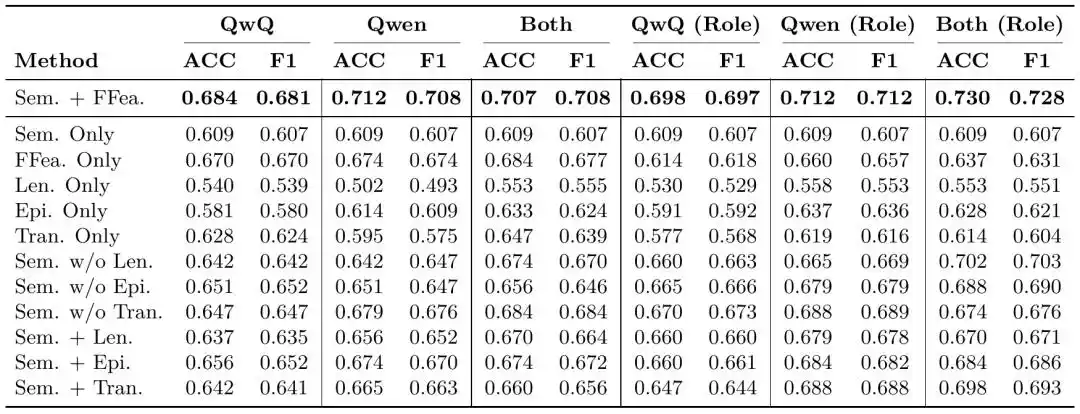
On SAT Math, the ablation study suggests that the improvement does not come from trace length alone. Using only item semantics produced a macro-F1 score of 0.607. Adding length features raised it to 0.671. The full representation reached 0.728. When transition information was removed while other features were kept, macro-F1 dropped to 0.676.
The team also ran an order-shuffling test that preserved trace length and episode frequency but changed the order of intermediate reasoning sentences and labels. The original order performed better, supporting the claim that local transition order contains predictive information.
For SAT Math, harder items were also associated with more intermediate reasoning, heavier execution effort, and stronger “analysis→execution,” “execution→execution,” and “execution→analysis” transition signals. The paper says these patterns were only limitedly reproduced in other domains and should be treated as process correlations rather than direct observations of human cognition or causal proof.
Intended use and publication details
The study presents Epi2Diff as a tool for early difficulty assessment of new items and as an aid for human review in item bank construction. The authors say practical deployment would still require labeled training data, validation on the target population, and expert review. The framework is not positioned as a replacement for educational measurement, but as an added source of evidence drawn from the reasoning process.
The paper is titled Cognitive Episodes in LLM Reasoning Traces Enable Interpretable Human Item Difficulty Prediction.
The authors are Chenguang Wang*, Ming Li*, Xinyue Zeng, Zhuochun Li, Hong Jiao, Tianyi Zhou, and Dawei Zhou, with Chenguang Wang and Ming Li listed as co-first authors.
Paper: https://arxiv.org/abs/2606.28186
Code: https://github.com/c-steve-wang/Epi2Diff
The original Chinese article was published via the WeChat account Quantum Bit and credited to the Epi2Diff team.



