
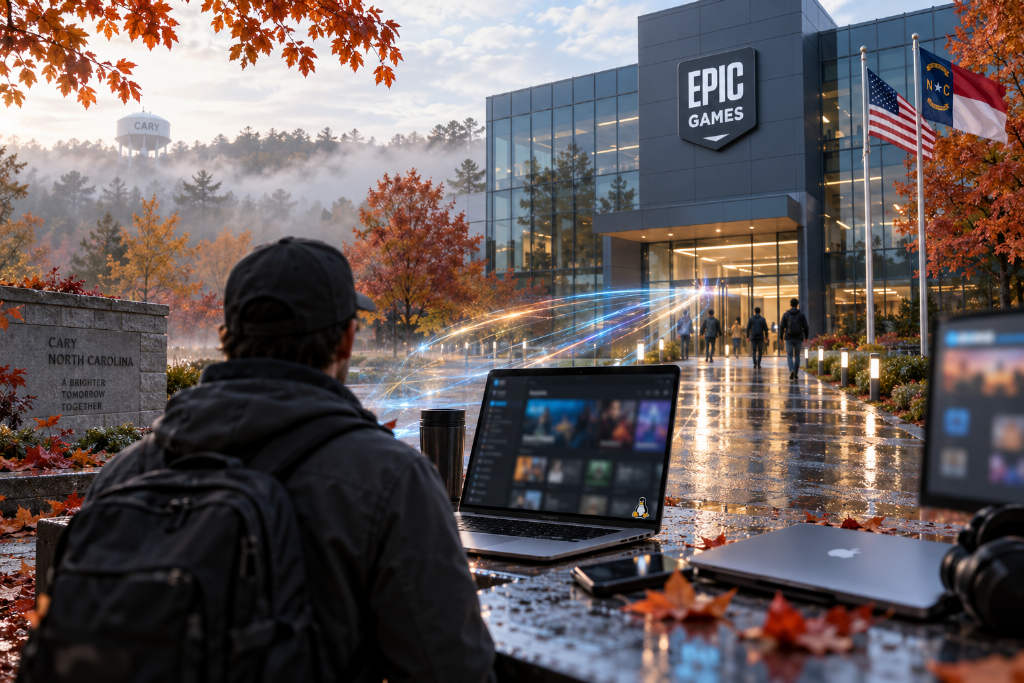
Epic Games on Oct. 14 released a preview build of a redesigned Epic Games Launcher, opening its announcement with a blunt line: coding is hard. So, the company said, it used vibe coding to build a new launcher that is much faster than the current version, more responsive, and visually refreshed.
In this context, vibe coding refers to a development approach where natural-language prompts are used to have AI generate code.
Preview is live on Windows and macOS, with first-time Linux support
The preview release is available for download on Windows and macOS. Linux support has been added for the first time. On macOS, the new launcher supports Apple Silicon machines only.
Epic said users’ purchased games, cloud saves, and progress will carry over to the new version. At the same time, the company acknowledged that this preview is still light on features, with some social tools and account-management options not yet moved over from the older launcher.
Ars Technica reported that the update adds a long-requested “recently played” list. It also groups download progress and read/write speeds onto the same page. PC Gamer noted that the game library can now link titles installed through other PC platforms, including shortcuts for games installed through clients such as Steam.
Epic openly compares the new launcher with Steam
Epic’s marketing on X was even more direct. The company wrote: “We vibe coded the Epic Games Launcher to be faster than the other guy.”
According to figures published on Epic’s website, the new launcher takes 5.47 seconds to cold start from a fully closed state. Steam, by comparison, took 10.07 seconds. That leaves a gap of about 4.6 seconds, which Epic translated into a 1.8x speed advantage.
For reopening the game library from the system tray, the new launcher recorded 0.36 seconds, versus 0.42 seconds for Steam. The difference there was just 0.06 seconds. Ars Technica said it could not meaningfully feel a difference in that part of the test.
Epic said the benchmark came from third-party testing carried out by Keywords Studios. The firm tested 13 PCs in October, ran five trials on each machine, averaged the results, and excluded the three lowest-end systems from the sample. Epic added that actual results may vary by device.
Martin Keely says AI was used to write and review new features
PC Gamer said Epic’s “coding is hard” line was delivered as a joke, but the company was serious about using AI to build software. Martin Keely, who became general manager of Epic Games Store in August this year, told PC Gamer that the team started from scratch and rebuilt both the storefront and the launcher shell on a new architecture.
When asked whether AI was used mainly to analyze old code or to create new code, Keely said it was the latter. He said the team reviewed the functionality of the previous launcher and aimed to reproduce those features, “but not reproduce the code itself.” In his description, AI was used as a tool to “write and review new features, new capabilities,” with the system rebuilt from the ground up on a different technical foundation.
Keely also told IGN that AI improved efficiency and “enabled a small team to rewrite the whole codebase,” while helping the company ship cross-platform versions more quickly. Asked how far AI was involved, he said the focus was on code efficiency and architecture so features could be built faster. He added that AI was not used for art or visual style. Interface updates and design adjustments remained with Epic’s existing design team.
Tim Sweeney points to a broader AI shift inside Epic
Two days before the launcher preview went live, PC Gamer, citing Bloomberg, reported that Epic had instructed the team behind an unannounced shooter to adopt an “AI-first” development approach. The game was described as combining Star Wars and Marvel themes.
Epic chief executive Tim Sweeney then wrote on X that a “major shift” was underway inside the company. He said Epic was moving developers around and “retooling for maximum AI acceleration,” with a goal “not to do the same things with fewer people, but for everyone here to create more and better things.”
What the published numbers and current limits show
- The Epic Games Launcher preview went live on Oct. 14.
- It supports Windows, macOS, and Linux, with Linux included for the first time.
- The macOS version works only on Apple Silicon devices.
- Epic’s third-party benchmark put cold start at 5.47 seconds, versus 10.07 seconds for Steam.
- Reopening the library from the system tray came in at 0.36 seconds, compared with 0.42 seconds for Steam.
- Purchased games, cloud saves, and progress carry over to the new launcher.
- Some social and account-management features are still missing from the preview.
How Epic answered the central questions around the release
On whether the launcher was really built through vibe coding, Keely’s answer was that the preview is part of a ground-up rewrite and that AI was used to write and review new features. The art direction and interface design, however, stayed with Epic’s existing design team.
On whether the new launcher is materially faster than Steam, Epic’s commissioned testing showed a large gap in cold start time, 5.47 seconds against 10.07 seconds, but only a narrow difference when calling the library back to the screen, 0.36 seconds versus 0.42 seconds. Ars Technica’s hands-on impression matched that split: a few seconds faster to open, not much noticeable difference in the tray-to-library action.



