
Europe’s crypto registry expanded again, while treasury companies, exchanges, protocol teams and AI firms released a dense stream of updates between Oct. 19 and Oct. 20.
ESMA adds nine crypto-asset service providers under MiCA
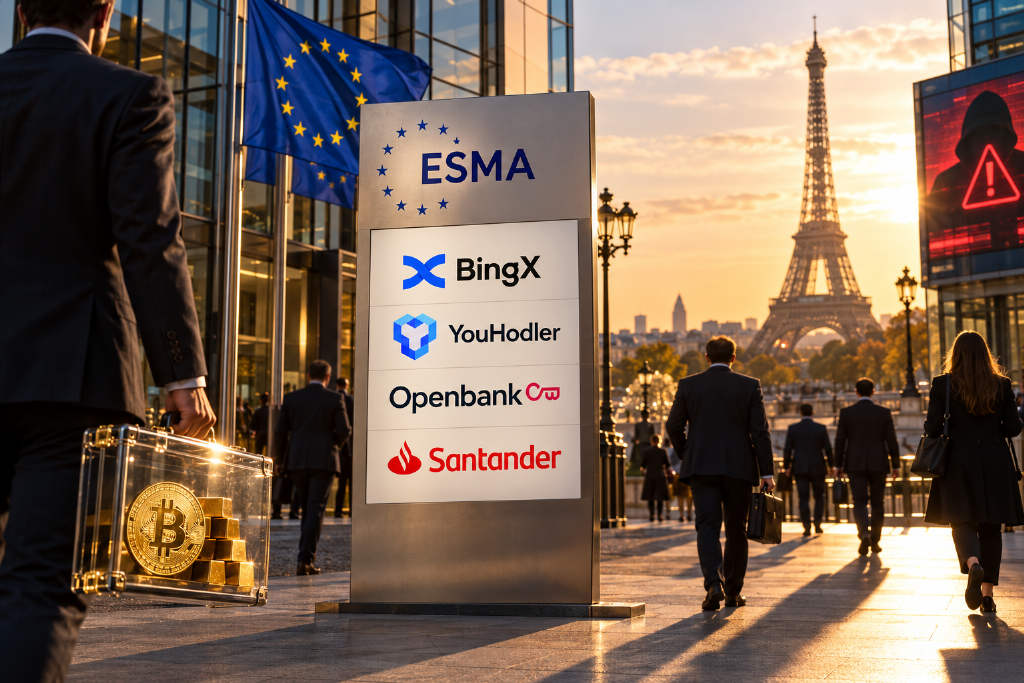
The European Securities and Markets Authority, or ESMA, added nine crypto-asset service providers, or CASPs, to its register under the Markets in Crypto-Assets regulation, known as MiCA. The additions include MEGE zweite, BingX’s Austrian entity, YouHodler’s Italian subsidiary, and Openbank Deutschland, which is part of Santander. The latest update brings the total number of registered CASPs to 375.
Shenzhen police warn against scams using RWA and blockchain language
Shenzhen’s Economic Crime Investigation Bureau issued a public warning about new scams packaged as "RWA real estate tokenization" and "blockchain notarization."
The bureau said technical terminology should not be treated as a trust endorsement. It added that people working in technology can mistake something that is technically verifiable for something that is legally compliant. According to the notice, bad actors have entered technical communities while posing as experienced industry figures and have used trust within those circles to lower other people’s guard.
The bureau also said that a contract address or a company registration number can only show that code exists or that an entity has been registered. It does not prove that the underlying asset exists, nor does it show that the project has the qualifications required to conduct financial business.
Binance Alpha sets 255-point threshold for airdrop trading and CT claims
Binance Alpha said its airdrop claim and trading event will begin at 21:00 UTC+8 today. Users holding at least 255 Binance Alpha points can claim tokens on a first-come, first-served basis until the airdrop pool is exhausted or the event ends.
Binance Alpha also opened the second wave of its Concrete (CT) airdrop. Users with at least 255 Binance Alpha points can claim an airdrop of 87 CT tokens on the Alpha event page. If rewards are not fully distributed, the points threshold will automatically drop by 5 points every five minutes.
Claiming the airdrop consumes 15 Binance Alpha points. Users must confirm the claim on the Alpha event page within 24 hours, or the reward will be treated as forfeited.
Strategy repurchases $193 million of STRC and buys 267 BTC
Strategy said it repurchased $193 million worth of STRC over the past week and bought 267 BTC.
As of Oct. 18, 2026, the company held 848,517 BTC and $5.3 billion in dollar-denominated assets. It also expanded the size of its Digital Credit Securities Repurchase Program from $2 billion to $3 billion.
Strive and BitMine disclose updated holdings
Strive added 1,223 BTC last week, bringing its total bitcoin holdings to 36,818 BTC. The company said its bitcoin position has grown by more than 380% this year.
BitMine added 12,535 ETH last week. As of Oct. 18, its total ETH holdings stood at 6,041,481 ETH, equal to about 4.9% of ETH’s total supply.
BitMine said the total value of its crypto, cash and other investment assets is about $15.1 billion. That figure includes $582 million in cash and marketable securities, 215 BTC, $180 million in equity assets tied to Beast Industries, and a $74 million investment in Eightco Holdings (ORBS).
The company also said it has staked 5,067,309 ETH. At an ETH price of $2,365, that stake is worth $12 billion.
De¹ launches Tokenized Asset World on BNB Chain
De¹ said it has launched Tokenized Asset World, the first vertical domain of its Financial World Model, or FWM, on BNB Chain. The project is focused on tokenized equities and real-world assets, or RWAs, and is designed to combine asset trading, liquidity execution, collateralized lending, structured credit and AI agent interaction in one financial intelligence environment.
According to the announcement, De¹ will build around infrastructure including PancakeSwap, ListaDAO, Venus and the BNB Agent SDK. It plans to convert onchain activity such as real trades, lending and liquidations into verifiable training signals, creating a feedback loop that runs from market interaction to model updates, trade routing and agent strategy optimization.
De¹ said the setup is intended to turn fragmented financial activity on BNB Chain into a system that AI agents can understand and operate in a unified way, allowing the model to keep learning from live market behavior.
Machi records a net loss of $382,000 on PaperTrade
Machi, identified in the report as Jeffrey Huang, has continued to lose money on PaperTrade. Of the $261,000 deposited yesterday, almost all has been lost, leaving just $5,682 in the account.
The report said Machi lost $779,000 in trading, while earning $394,000 in rewards through USDC staking, resulting in a net loss of $382,000.
SkyAI exits SOL and holds $223.8 million in cash
SkyAI, a Solana treasury company formerly known as Sharps Technology, has sold all of its Solana holdings. Its position fell from more than 2 million SOL in September to zero on Oct. 16.
The company now holds $223.8 million in cash and has launched a buyback program with a total size of up to $201.3 million. The repurchase price is set at $3 per share or per warrant.
US federal agencies may be barred from using DeepSeek products
The Trump administration is planning to prohibit US federal agencies from using DeepSeek products or services.
According to a notice posted Monday by the Department of Homeland Security on the Federal Register website, federal agencies must remove all DeepSeek products from their systems. The order cites US cybersecurity laws and also bars DeepSeek from participating in federal government contracts.
Storage chip stocks rise in the US while Korea’s KOSPI drops further
According to Binance market data, US-listed storage chip stocks moved higher. Micron Technology rose 4.18%, SK Hynix gained 5.07%, SanDisk climbed 7.23%, and Western Digital added 5.96%.
In South Korea, the KOSPI index extended its decline to 3%. SK Hynix fell 4.6% and Samsung Electronics lost 2%.
Echo Protocol begins wind-down and sets shutdown deadlines
Bitcoin infrastructure protocol Echo Protocol said it will gradually shut down the protocol and end related business after nearly two years of operation.
The team said the lending business has stopped accepting new deposits and new borrowing requests and has also stopped accruing interest. Strategy has stopped taking new deposits, and LSD has stopped taking new staking. Repayments, withdrawals and necessary asset liquidations remain available. Echo said it will formally cease operations after Nov. 14.
Users can withdraw, repay and unstake starting at 08:00 on Oct. 19, with a deadline of 07:59 on Nov. 20. Loans that remain unpaid after the deadline will have their collateral liquidated, with proceeds used to repay lenders. After the cutoff, remaining positions will enter liquidation or settlement procedures, with the exact timing still to be announced.
After the protocol shuts down, the redemption service for the Aptos-to-B² Network cross-chain bridge will remain available. The team also warned users not to respond to any request asking them to transfer funds or privately sign for a specific wallet address.
Tenstorrent closes $1.5 billion Series E with Tether among participants
AI startup Tenstorrent completed a $1.5 billion Series E round at a post-money valuation of $6.2 billion.
The round was led by Trace Capital and Innovation X. Participants included Agostinelli Group, ARK Invest, Brett Barna, Cadence Ventures, Eclipse, Fidelity Management & Research Company, Maverick Silicon, Morgan Stanley, Protagonist, SanDisk, T. Rowe Price*, Tether Investments, Troluce Capital, Virtu Financial and XTX Markets, among other new and existing investors.
MiniMax launches M3.1 Flash
According to MiniMax’s official blog, the company has launched its new M3.1 Flash model. It said the cost of agent tasks is down 70% from the previous generation, online inference speed is nearly three times faster, and output speed exceeds 200 tokens per second.
MiniMax priced the API at $0.15 per million input tokens and $0.6 per million output tokens. On the OSWorld V2 benchmark, the model scored 61.7, which the company said ranks first among domestic models.
MiniMax also said the anonymous model "Space Bunny," which previously processed more than 200 trillion tokens, was an early version of M3.1 Flash. The model is now available through MiniMax API, M Plan and MiniMax Code, and the model weights will be open-sourced later. MiniMax had released M3.1-Flash-Preview in September.
Pump.fun lists Pre-IPO tokens backed by PreStocks
Pump.fun said on X that Pre-IPO tokens supported by PreStocks are now live on the platform. Users can trade Pre-IPO tokens tied to private companies including OpenAI, Anthropic, Anduril, Neuralink, Figure AI, Kalshi, Polymarket and Oura, and can also issue new tokens paired with those assets.
PreStocks is a Solana-based Pre-IPO tokenization platform. Pump.fun had previously launched custom trading pairs on Oct. 9, allowing new tokens to be paired with assets already issued on the platform.
Coinbase adds AXIS, PEARL and STABLE to listing roadmap
Coinbase Assets said on X that Coinbase has added Axis Labs (AXIS), Pearl (PEARL) and Stable (STABLE) to its listing roadmap. AXIS is a token on Base.
The company said trading for those assets will depend on market-making support and technical infrastructure. A launch date will be announced once the required conditions are met.
Anthropic discusses roughly $45 billion compute deal with Nscale
Nscale, an Nvidia-backed AI cloud computing company, is in talks with Anthropic over a compute sale that could be worth about $45 billion.
Under the plan, Nscale would build a second facility at its Monarch data center campus in West Virginia, providing 460 megawatts of compute capacity using Nvidia Vera Rubin chips. Anthropic would also hold a right of first refusal on a third facility.
People familiar with the matter said the deal could be finalized in the coming days, though details may still change. Nscale’s IPO filing shows that Anthropic had previously signed an infrastructure agreement with the company worth about $44.6 billion.
BlackRock files for bitcoin managed protection ETF tied to IBIT
According to a filing with the US Securities and Exchange Commission, BlackRock’s iShares trust submitted a registration statement on Oct. 19 for the iShares Bitcoin Managed Protection ETF, with the ticker PBIT.
The fund is designed to provide upside linked to the iShares Bitcoin Trust ETF (IBIT) and similar bitcoin exposure, while placing an approximate cap on gains and offering a degree of downside protection.
Its strategy typically includes buying bitcoin options in three tranches, while also selling options to offset purchase costs, which limits upside. The fund would also invest in fixed-income products to earn interest income used to hedge option costs and support downside protection.
Eric Schmidt reportedly holds about 1% of Anthropic
Former Google CEO Eric Schmidt reportedly owns about 1% of Anthropic, stemming from tens of millions of dollars invested in the company’s Series A round. That could make him one of the biggest individual beneficiaries of Anthropic’s expected IPO.
It is not clear whether he has sold any shares. Schmidt and Anthropic both declined to comment. PitchBook data shows Anthropic was valued at $461 million when Schmidt first invested in 2021.
Investors said last week that a reasonable valuation for Anthropic is between $1.8 trillion and $2 trillion. At the top end of that range, Schmidt’s net worth would rise to nearly $80 billion.
OpenAI seeks to finish roughly $30 billion fundraising before Anthropic IPO
People familiar with the matter said OpenAI is trying to complete a new fundraising round of about $30 billion at unusual speed, hoping to lock it in before Anthropic’s expected mid-November listing.
SoftBank, MGX and other existing investors are in talks to participate. The round could value OpenAI at more than $1.4 trillion. OpenAI has told investors that its annualized revenue has reached $50 billion and could hit $70 billion by year-end.
In March this year, OpenAI completed a $122 billion financing round at a valuation of $852 billion.
CFTC says CME has not shown harm from perpetual futures policy
The US Commodity Futures Trading Commission told a court in a filing last Friday that CME has failed to show it was harmed by the CFTC’s new policy on perpetual contracts and therefore lacks standing to sue.
The CFTC said CME’s crypto futures volume rose rather than fell after the policy change. It also said CME had told investors on an earnings call that it had not seen demand for perpetual contracts and did not view the two products as substitutes.
The CFTC approved Kalshi in May to launch the first bitcoin perpetual contract in the United States and said such products would be regulated case by case as futures. CME argues that perpetual contracts have no expiry and should be regulated as swaps. The CFTC asked a judge last month to dismiss the case.
TD Cowen analyst Jaret Seiberg said the perpetual market has continued to expand during the litigation, and a CME win would make any market unwind more complicated.
Charles Hoskinson says he is building a new programming language for Cardano
Cardano founder Charles Hoskinson said on X on Sunday that he is personally developing a new programming language for Cardano.
His collaborator is Lucas Rosa, a software engineer at Input Output Global and a co-creator of Cardano smart contract language Aiken. Hoskinson said the language will be the first to combine transaction intents with cryptographic proof that "the rules have been followed." It will support transaction intents, proof-carrying data and Groth16 proofs.
He said developers will be able to use it to build applications that coordinate transactions and verify complex conditions, with Cardano validating a small proof onchain at the end. Cardano’s current smart contract languages are Plutus and Aiken. Hoskinson has not disclosed the language’s name, public code or launch date.
Ramp applies to the OCC for a national trust bank charter
Fintech company Ramp has applied to the Office of the Comptroller of the Currency, or OCC, to establish Ramp National Trust Bank.
Ramp said on X that, if approved, the trust bank would provide fiduciary investment management and digital asset custody services. It would not take deposits or issue commercial loans. This year, companies including Revolut and Crypto.com have received conditional approval for different types of OCC licenses.
Bloomberg had previously reported that Ramp was valued at $60 billion in a new financing round and that its annualized revenue had risen to $2 billion.
Whale sells 12,468 ETH, then moves $20 million USDC to Hyperliquid to long oil
A whale sold 12,468 ETH at an average price of $2,368, receiving 29.52 million USDC and realizing a profit of about $8.99 million.
The same trader then transferred $20 million USDC to Hyperliquid to take a long position in oil. The position is now worth about $22.4 million and includes CL (WTI crude oil) and BRENTOIL (Brent crude) contracts. The trader is still adding to the position.
The report said the whale had used a looping strategy on Spark in early June to borrow 30 million USDS and buy 18,212 ETH with leverage at an average price of $1,647.
Ethereum’s Glamsterdam upgrade set for Hoodi testnet activation on Oct. 27 Beijing time
The Glamsterdam upgrade is scheduled to activate on the Hoodi testnet at 17:42:48 UTC on Oct. 26, which is 01:42:48 Beijing time on Oct. 27. Hoodi’s block gas limit will also be raised to 200 million at that time.
The upgrade includes in-protocol proposer-builder separation, block-level access lists and gas accounting adjustments. The Sepolia testnet completed activation on Oct. 6. A date for Ethereum mainnet activation has not yet been set. Node operators need to update both execution-layer and consensus-layer clients before Hoodi activates.
Sophon mainnet to shut down on Nov. 30
Sophon said it plans to permanently shut down the Sophon mainnet on Nov. 30, 2026. The deadline for asset withdrawals is Nov. 25.
After that, key infrastructure and related websites will be shut down in stages, and assets left onchain may become permanently inaccessible. Users can withdraw liquid assets including SOPH, ETH and USDC through claim.sophon.com and can also claim outstanding staking rewards and Guardian rewards. Unwithdrawn Sophon farm assets must be claimed through farm.sophon.xyz.
The team urged users to use only official links and stay alert to fake migration websites.
BNB Chain opens community forum for NewL1
BNB Chain has opened a dedicated community forum section for its new Layer 1 network, NewL1. The section first went live in July 2026 and was promoted again on Oct. 17 and Oct. 19.
NewL1 is EVM-compatible and is aimed at trading, payments and AI use cases, including autonomous trading by AI agents. Its target performance includes sub-50 millisecond pre-confirmation, more than 100,000 TPS and sub-second finality.
NewL1 will not issue a new token. BNB will be the only gas token. The network plans to introduce a TxStream structure to reduce front-running risk, add privacy-enhancing features and build a native bridge connecting to BSC.
The forum is intended for discussion of tokenomics, consensus, privacy and other technical topics, while price speculation is prohibited. Testnet launch is expected by the end of 2026, with mainnet expected in early 2027.
Hyperliquid ecosystem L2 Elysium to launch mainnet on Nov. 9
Elysium, the first Layer 2 network in the Hyperliquid ecosystem, said it will launch its mainnet on Nov. 9.
Elysium is a general-purpose high-performance L2 built for Hyperliquid. Its settlement layer is HyperEVM, the project’s smart contract environment, and it is deployed alongside HyperCore, which handles trading. Its native gas token is HYPE.
The network currently runs Conduit’s G2 sequencer, and its underlying architecture meets SOC II Type 2 security standards. After mainnet launch, Elysium will move out of the testing phase and open for applications and trading.
AI watchlist: Skyfall AI, MiniMax and Mistral
PANews AI Watch selected several AI developments from the past 24 hours.
Skyfall AI released SKY-001, described as its first engineering design world model. The company said the model is a hierarchical compositional visual world model for complex physical product design and is currently in research preview. It said the system supports long-horizon spatial planning and recursive 3D reasoning, with reasoning efficiency and compute cost in engineering workflows at least 100 times better than frontier models such as GPT Astra.
MiniMax released M3.1 Flash on Oct. 19. The company said online inference is nearly three times faster than the previous generation and usage cost is down 70%, with improvements focused on agentic tasks, coding, computer use and cybersecurity.
Mistral released Timestral, its first family of time-series foundation models. The largest model has 209 million parameters and ranked first on the public GIFT-Eval, TIME and fev-bench benchmarks. It supports probabilistic multivariate forecasting as well as past and future covariates.



