
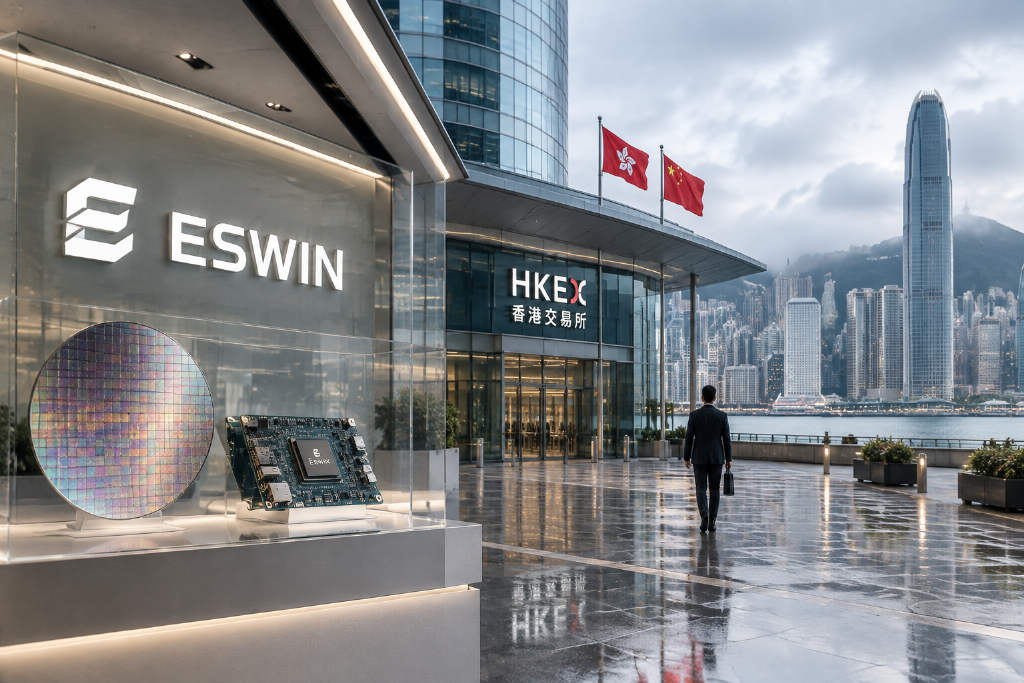
ESWIN Computing cleared its Hong Kong listing hearing on Sept. 21, according to Hong Kong Stock Exchange documents. CITIC Securities (Hong Kong) and CSC International are the joint sponsors. After three tries at filing, the chipmaker backed by BOE founder Wang Dongsheng is now on the last leg before a possible IPO.

If it goes public, ESWIN Computing would become what the filing calls Hong Kong’s first RISC-V-focused stock. One question is now settled. The tougher one is still hanging there: can this RISC-V bet become commercial at scale, and will investors keep backing a business with a long payback cycle that is still losing heavily?
Wang Dongsheng’s second industry wager
Wang placed his first big bet in 1993. He was 36. He pushed through a shareholding reform at the money-losing Beijing Electron Tube Factory and used RMB 6.5 million raised by employees to found Beijing Oriental Electronics Group, the predecessor of BOE.
Back then, China did not have its own LCD panel industry. Core displays for TVs and mobile phones had to be imported. In 1994, BOE formed a TFT-LCD pre-research team and officially stepped into the display business. In 2003, it bought HYDIS’s TFT-LCD business from South Korea for $380 million and built a fifth-generation production line in Beijing. BOE kept adding capacity and improving its technology. By 2017, its LCD panel shipments ranked first in the world.
Wang once said, “South Korea has Samsung, and Japan has Panasonic and Sony. There is no reason we cannot build a world-class company as well.”
He stepped down as BOE chairman in June 2019 at age 62. Hardly anyone thought he would really retire. Then sanctions hit ZTE and Huawei, and “chip shortage” started to feel like a more urgent industrial problem than the earlier “lack of screens.” So Wang moved quickly into his second bet.
He joined ESWIN in July 2019. Explaining why, Wang said he had been thinking about the integrated circuit sector for a long time and wanted to focus on foundational materials and core chip technologies to help break bottlenecks in manufacturing and product development.

From materials to chip products
Inside the broader ESWIN system, the materials unit is focused on 12-inch silicon wafers and was listed on Shanghai’s STAR Market in 2025. ESWIN Computing is the business handling chip design and product commercialization.
The company submitted its third Hong Kong prospectus in July 2026. At the heart of that document is a simple pitch: chip products built on the RISC-V architecture.
Why RISC-V matters to the story
In chip development, the instruction set architecture is the language that lets software communicate with hardware. For decades, general-purpose computing has been dominated by two commercial camps. x86 has ruled PCs and servers. Arm built a strong position in mobile and embedded devices.
RISC-V, created in 2010 in a University of California, Berkeley lab, works differently. It is an open, royalty-free instruction set standard. That means companies can design processors without paying for ISA licenses from a single architecture owner.
Wang has said more than once in public interviews that RISC-V could become a native computing architecture in the AI era. His argument is that the architecture is open, still evolving, and a better fit for a time when software and algorithm models are changing fast. He has also said it can connect to existing ecosystems through porting and compatibility, while also acting as a native base for new applications and scenarios.
Still, being open does not make the job easy. The hard part is not just taping out a chip. It is building software and hardware around it that can last: compilers and toolchains, operating system support, application adaptation, developer migration, and coordination across chips, system software, and end devices.

ESWIN says this plainly in its own prospectus. It says Arm and x86 already have mature ecosystems and wide software-hardware compatibility, while RISC-V is still in development and integration across software platforms is still hard.
That makes Wang’s second bet much more specific than just “making chips.” He is betting RISC-V can go from an open instruction set to broad commercial use.
The business is still supported by display-related chips
ESWIN Computing splits its products into two main groups by use case.
The first is smart terminal chips, aimed at home, office, and portable devices. These chips manage screen-based input and output and process multimedia signals. According to the prospectus, human-machine interaction chips in this segment remained the company’s core business, bringing in RMB 1.856 billion in 2025, or 76.3% of total revenue.
Put simply, the company still gets most of its revenue from display-related chips, the same industrial field where Wang first built his reputation.
And that core segment is feeling pressure on pricing and margins. The average selling price of human-machine interaction chips dropped from RMB 20.9 in 2023 to RMB 12.1 in 2025, then fell again to RMB 11.6 in the first quarter of 2026. Gross margin went from 18.8% in 2023 to 16.2% in 2025 and then down to 7.3% in the first quarter of 2026.

The source article says chip design gross margins usually sit in the 40% to 60% range, with Nvidia and some others above 70%. Against that standard, 16.2% is low. Very low.
The second group is interconnect and computing chips for cars, robots, and industrial equipment. These products are meant to provide the hardware base for sensing, connectivity, and decision-making in those systems. Revenue from interconnect and computing chips reached RMB 383 million in 2025, up 103% year over year and equal to 15.8% of total revenue, making it the fastest-growing business line.
Margins were better there. Computing chips posted a 26.2% gross margin in 2025, while interconnect chips reached 32.5% in the first quarter of 2026. Even so, this part of the business is still too small to push the company into profitability.
Customer concentration remains high
The prospectus names the company’s biggest customer only as “Customer A.” It describes that customer as a leading IoT supplier incorporated in China, listed on the Shenzhen Stock Exchange, and involved in smart interaction products and professional services. The source article says the market widely assumes this customer is BOE, Wang’s former company.
According to the filing, revenue from the largest customer made up 82.1%, 76.8%, and 64.6% of total revenue from 2023 to 2025. That tells you how dependent ESWIN Computing has been on one major account.
In the first quarter of 2026, “Customer I,” a subsidiary of a computing power operator, contributed RMB 194 million in a single quarter and briefly became the top customer. But that revenue came from a project-based delivery. It did not mean the customer base had truly diversified. During the same period, the top five customers still accounted for 83.1% of total revenue.

To speed up ecosystem development, ESWIN launched the RISAA platform in 2024. The idea was to package RISC-V cores, dedicated IP, and open software so developers would not need to build chips from scratch. Wang also proposed a broader concept called RDI, short for RISC-V Digital Infrastructure, in an attempt to bring more upstream and downstream industry participants into one framework.
But that is the hard truth: a platform is not the same as a functioning ecosystem. Adoption still comes down to whether developers show up and whether real use cases scale.
Rising revenue, but losses are still the defining number
Financially, losses are still the clearest pressure point. ESWIN Computing recorded revenue of RMB 1.752 billion, RMB 2.025 billion, and RMB 2.431 billion in 2023, 2024, and 2025. Net losses in those same years were RMB 1.837 billion, RMB 1.547 billion, and RMB 1.516 billion, bringing the three-year total to RMB 4.9 billion.
In the first quarter of 2026, the company posted revenue of RMB 494 million and still lost RMB 375 million.
Before the IPO, ESWIN completed financing rounds from Series A through Series D and raised more than RMB 9.2 billion in total. Investors named in the prospectus include IDG Capital, Legend Capital, and CITIC Securities.
Research and development spending stayed heavy, even though the absolute figure narrowed year by year. R&D expenses were RMB 1.445 billion, RMB 1.337 billion, and RMB 1.042 billion from 2023 to 2025, equal to 82.5%, 66.0%, and 42.8% of revenue in those years.

Operating cash flow shows what that long buildout costs. Net cash flow from operating activities was negative RMB 1.251 billion, negative RMB 781 million, and negative RMB 1.171 billion from 2023 to 2025, adding up to a cumulative net outflow of RMB 3.203 billion.
Three filings later, the door is finally open
ESWIN Computing first applied for a Hong Kong listing on May 30, 2025. It filed again on Jan. 30, 2026, and then submitted a third application on July 31, 2026. The company passed its listing hearing on Sept. 21, 2026.
For a chip company that is still losing money and still spending heavily on research, the point of listing is not only fresh capital. It is also time. Time to keep building products and an ecosystem before commercialization is fully proven.
Even if the listing happens, the big questions do not go away. Can RISC-V bridge the gap between an open architecture and real commercial scale? Can ESWIN cut its reliance on display-related chips and a small circle of major customers? And can commercialization move quickly enough to keep pace with investor patience?
Wang Dongsheng’s second wager has reached another milestone. But the final outcome is still unsettled.