
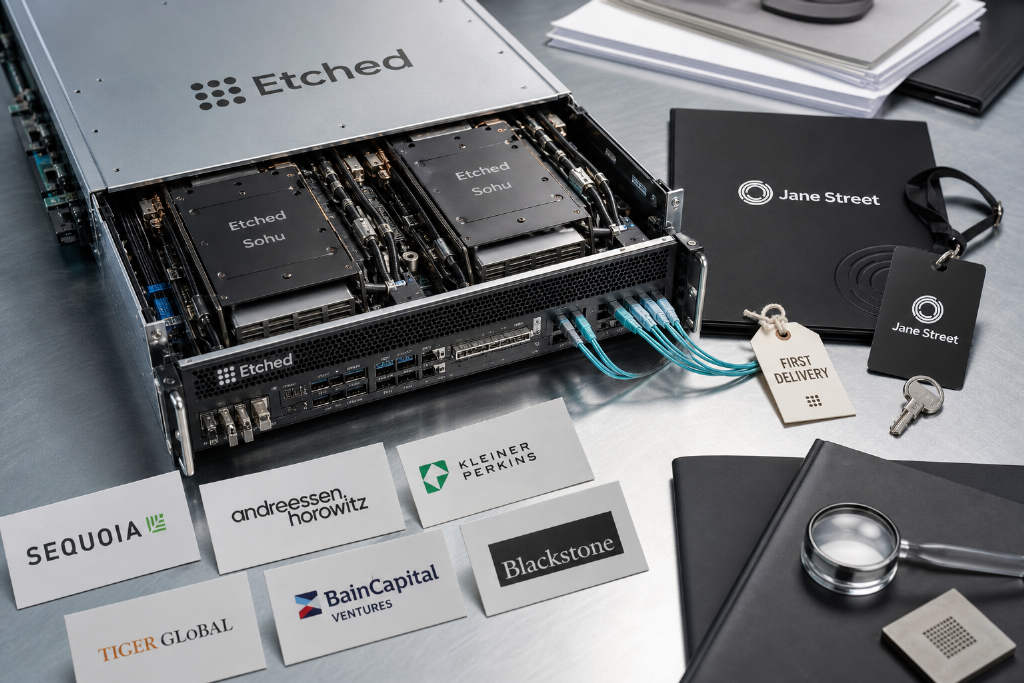
AI chip startup Etched said on August 18 that it raised $700 million at a $21 billion post-money valuation, with Jane Street leading the round. Other participants named by the company were Sequoia, Andreessen Horowitz, Kleiner Perkins, Tiger Global, Bain Capital Ventures, Blackstone, and Peter Thiel.
On the same day, Etched said it delivered the first inference rack in the company’s history to Jane Street. The quantitative trading firm is also the only customer that has publicly confirmed receiving Etched hardware.
Etched was valued at about $5 billion in December 2025. In July 2026, it raised $300 million at a $10.3 billion valuation. One month later, that figure doubled to $21 billion. In less than a year, its paper valuation rose roughly fourfold.
Founded in 2022, Etched is building an ASIC for Transformer inference
Etched was founded in 2022 by Gavin Uberti, Chris Zhu, and Robert Wachen, who dropped out of Harvard and received support from the Peter Thiel Fellowship.
The company’s core product is Sohu, an ASIC built specifically for Transformer inference and manufactured using TSMC’s 4 nm process.
Etched frames the difference from Nvidia GPUs in simple terms. GPUs are general-purpose compute chips that run many kinds of AI workloads through CUDA software. Sohu hardwires Transformer attention into silicon, giving up generality in exchange for efficiency on a narrower task.
According to Etched, a server with eight Sohu chips can produce more than 500,000 tokens per second on Llama 70B. It said an eight-H100 system at a comparable configuration runs at about 23,000 tokens per second.
The company changed its pitch in 2026
Etched made a major shift in 2026. Early on, it positioned itself as a maker of custom chips for specific large models. It later said its system could run any frontier model.
Its technical approach also evolved from a pure Transformer ASIC to a two-stage optimization model. A low-voltage chip handles the Prefill stage, which processes prompts and context. Etched’s in-house shared memory and chip-to-chip interconnect handle the Decode stage, where responses are generated token by token.
Co-founder Robert Wachen described that second piece as “cluster-scale memory,” with multiple chips connected to one shared memory pool to reduce latency.
According to SiliconANGLE, Etched’s interconnect reduced some communication tasks from 4,000 milliseconds on competing chips to 700 milliseconds. The company also built its own cooling plate and voltage regulator module, or VRM.
Etched said it has signed more than $1 billion in customer contracts.
Technical criticism has focused on marketing and outside validation
Even with a high-profile investor list, Etched has faced skepticism from parts of the technical community.
tinygrad founder George Hotz, known online as geohot, posted what he called a “public service announcement” on X, naming Etched directly: “They might have a great chip with annoying marketing. They might also have no chip or a bad chip and it’s all smoke and mirrors.”
Hotz then broke down what he saw as Etched’s external messaging strategy. He said the company’s marketing centered on dramatic hardware photography, founder mythology, employee academic pedigrees, investor logo walls, and fundraising milestones rather than the materials a traditional chip company would usually publish, such as technical documentation, benchmarking methodology, architecture diagrams, power figures, and analyst testing. His conclusion was that this style of marketing is harmful to the technology industry.
Tech blogger Zach made a more detailed argument. He said the striking tokens-per-second figures shown on Etched’s old website “were never delivered,” and that the low-voltage technology promoted on the new site may offer an advantage in performance per watt, but represents a move away from raw speed toward power efficiency. In his view, Etched’s central pitch changed quietly over two years.
Zach wrote: “The early skeptics were completely justified in being skeptical, even if they ultimately built a chip with a real advantage.” He also pointed to a familiar semiconductor pattern: founders raise money on an aggressive initial concept, use that money to hire real silicon engineers, and those engineers develop a different and better technical plan. The concept changes, but the capital does not get returned.
Another point raised repeatedly is that, as of mid-2026, no independent third-party benchmarking organization had published throughput test results for Sohu hardware under production conditions. All performance numbers available publicly came from Etched’s own materials.
Jane Street is both lead investor and the only publicly confirmed customer
Jane Street occupies an unusual place in the story. It led the financing round and is also the only publicly confirmed customer to have received Etched hardware.
Jane Street is one of the world’s largest quantitative trading firms. The article said it generated more than $2 billion in net trading revenue in 2024. In a statement, the firm said: “We tested the chips and are pleased with the early results. Etched’s unique approach to inference gives us the precision we need to support the most demanding workloads. We’re excited to now have a dedicated rack running in our data center.”
That said, a single delivered rack is still far from broad commercial proof. It shows the hardware can run. It does not, by itself, show that the chips can be manufactured at scale, operate reliably over time, or win acceptance from a wider base of AI infrastructure customers. Jane Street’s overlapping roles as customer and lead investor also make the signal harder to interpret.
The next test is whether Etched can deliver faster than it did the first time
The debate around Etched also reflects the current state of AI hardware investing. The article argues that Nvidia’s moat is not just chip performance. It also includes the CUDA ecosystem, networking such as InfiniBand and NVLink, supply chain relationships, and the developer community. Any new entrant has to break through more than one layer.
Etched’s answer is to avoid that stack and sell full racks instead of chips. It packages its own silicon, interconnect, cooling, and power regulation into one delivered system, so customers do not need CUDA and do not have to build clusters themselves. That strategy depends on one question: whether Sohu’s performance edge is large enough to persuade customers to adopt an entirely new stack.
The market has assigned Etched a $21 billion valuation without independent third-party testing, without public revenue disclosure, and with the first rack only just delivered. Etched COO Robert Wachen said Andrej Karpathy, OpenAI’s Noam Brown, Geoffrey Hinton, and investors from every round had all personally tried the hardware and were “very excited” by the results.
But there is still a long gap between trials and mass production, including yield, thermal management, system stability, and customer support. CEO Gavin Uberti acknowledged that directly: “It took us three years to deliver the first rack. The next one will be much faster.”
That line captures the company’s position. After three years to ship one rack, the pace of the next deliveries may do more than anything else to determine whether Etched can support a $21 billion valuation.
