By KarenZ, Foresight News
Ethereum co-founder Vitalik Buterin argued in a Nov. 8 post on X that the market should pay more attention to ETH’s role as a store of value rather than focus mainly on the token-burning mechanism tied to transaction fees. In his view, ETH’s long-term value should rest more heavily on Ethereum’s decentralization, censorship resistance and security.
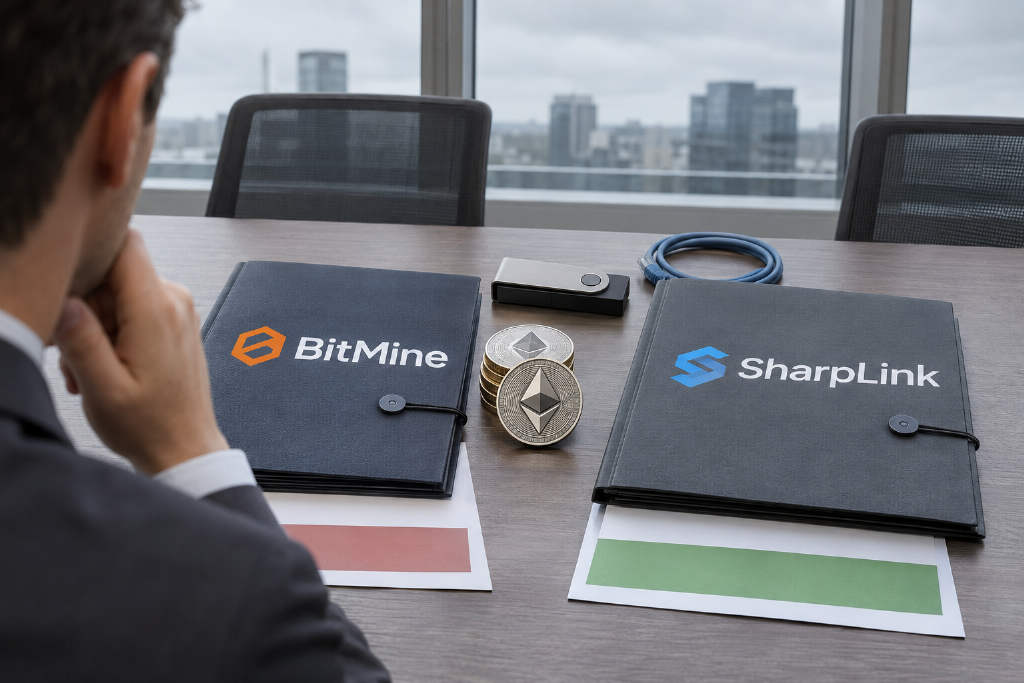
Two public companies built around Ethereum treasury strategies released financial results as that debate continued. BitMine reported a net loss of about $6.3 billion for fiscal 2026, even as its ETH holdings continued to expand. Its latest disclosure showed more than 6.07 million ETH, putting the company close to its target of holding 5% of the total ETH supply. SharpLink reported third-quarter net income of about $751.4 million, including roughly $676.7 million in unrealized digital-asset gains and about $13 million in staking revenue.
The reporting periods are different, so the companies’ profits and losses cannot be compared directly. Their filings do show a shared model, though: raise capital in public markets, acquire ETH, generate staking income and accept significant exposure to ETH price movements through accounting gains and losses.
For BitMine and SharpLink, the question is no longer only how much ETH they can hold. They also need to show how those assets can create additional value for shareholders.
BitMine’s loss reached $6.313 billion as its ETH position neared the 5% target
BitMine’s latest filing largely reflects the effect of digital-asset prices on its financial statements.
In the 10-K for the fiscal year ended Aug. 31, the company reported revenue of about $125 million, up sharply from $6.095 million in the prior fiscal year. It nevertheless posted a net loss of $6.313 billion, compared with net income of about $349 million in the previous year.
BitMine’s fiscal year is not a calendar year. The reported period ran from Sept. 1, 2025, through Aug. 31, 2026. The company had been using Aug. 31 as its fiscal year-end, but plans to shift to a calendar-year reporting cycle beginning in 2027. The period from September through December 2026 will be reported as a transition period. As a result, the $6.3 billion loss does not include the company’s financial performance since September and should not be compared directly with SharpLink’s third-quarter profit.
The main source of the loss was the change in the fair value of digital assets. BitMine recorded an unrealized digital-asset loss of about $6.229 billion for fiscal 2026. Under the applicable U.S. accounting rules, qualifying crypto assets such as ETH are measured at fair value, sending price changes directly through the income statement.
As of Aug. 31, BitMine held 5,901,837 ETH. The aggregate carrying cost was about $19.948 billion, while the fair value at the end of the period was about $14.559 billion. Based on the number of tokens held, the average cost was roughly $3,380 per ETH, compared with an end-period implied price of about $2,467. The difference was approximately $5.389 billion, representing the gap between the cumulative cost and fair value of the holdings at the reporting date.
The loss did not stop BitMine from adding to its ETH position. In a holdings update published Nov. 9, the company said it held 6,070,092 ETH as of Nov. 8. Using the approximately 122.2 million ETH total-supply figure cited by the company, the position represented 4.97% of supply.
That puts Tom Lee’s “Alchemy of 5%” target close to completion. BitMine said its holdings had reached about 99% of the target after roughly 15 months of accumulation.
The company also held 216 BTC, about $475 million in cash and marketable securities, and equity investments in Beast Industries and Eightco. Based on the asset prices used in its announcement, its crypto assets, cash, marketable securities and related investments totaled about $14.3 billion.
Staking is BitMine’s main operating revenue source
BitMine’s answer to the question of how to make the large ETH position productive is staking.
As of Nov. 8, the company had staked about 5.227 million ETH, or roughly 86% of its total ETH holdings. Using the seven-day average staking yield of 2.65% disclosed by BitMine and the ETH price at that time, the position would correspond to an annualized reward value of about $309 million.
That is an annualized estimate based on the data available at the time, not revenue already realized over a full year.
BitMine has also expanded into validator infrastructure. It acquired blockchain infrastructure and staking-services provider Pier Two and is building the MAVAN staking platform. The stated direction is to earn staking rewards not only on its own assets, but also to offer related services to other institutions.
Staking and validator-services revenue reached about $121.4 million in fiscal 2026, representing 97% of total revenue. General and administrative expenses were $377 million during the same period. BitMine has established staking as its core revenue stream, but its current operating scale has not been enough to cover its overall cost base.
As the 5% target comes into view, the simple story of accumulating more ETH faces a new test. BitMine will need to show how a very large ETH reserve can translate into sustained value on a per-share basis.
SharpLink’s $751.4 million profit was dominated by valuation changes
SharpLink has taken a different route from BitMine’s emphasis on building the largest possible position. Its strategy focuses on improving the earning capacity of the ETH it already holds.
In its third-quarter results released Nov. 9, SharpLink reported revenue of about $13.456 million, up 24% year over year. Net income reached $751.4 million, and diluted earnings per share were $3.45.
The composition of that profit tells a different story. SharpLink recognized about $676.7 million in unrealized digital-asset gains and roughly $75.22 million in realized net gains during the quarter. Together, the two figures totaled about $752 million, slightly more than reported net income.
The unrealized gain accounted for about 90% of net income. It does not mean SharpLink sold ETH and converted the gain into cash.
The realized gain also does not mean the company received an equivalent amount of cash by selling ETH. According to the filing, the approximately $75.22 million realized net gain primarily came from the redemption of liquid-staking tokens, conversions between ETH and staking tokens, and asset contributions to an on-chain yield fund. Part of the gain was accounting profit recognized during asset conversions.
The year-to-date figures present another view. Although SharpLink earned more than $750 million in the third quarter, it still recorded a cumulative net loss of about $328.4 million for the first three quarters of the year. Losses caused by earlier declines in crypto-asset prices had not been fully offset by the third-quarter profit.
Operating revenue was much smaller than the accounting profit. SharpLink generated about $13.06 million from staking in the third quarter, up 27% year over year and equal to about 97% of total revenue. Sales, general and administrative expenses were approximately $11.01 million.
As of Sept. 30, SharpLink held about 892,700 ETH and equivalent staked assets, with a carrying value of about $2.1 billion. By Nov. 2, the position had increased to approximately 895,100 ETH.
SharpLink moves into liquid staking and active asset management
During the third quarter, SharpLink completed a $200 million Lido staking allocation in ETH and held the corresponding liquid-staking asset, wstETH. Unlike traditional native staking, liquid staking allows ETH to participate in staking while retaining a degree of tradability through a tokenized position.
SharpLink also partnered with Galaxy Digital to launch the Galaxy SharpLink Onchain Yield Fund. The fund has an initial committed capital base of $125 million. SharpLink committed $100 million and Galaxy Digital committed $25 million. The fund began deploying capital during the third quarter.
SharpLink CEO Joseph Chalom said in the filing that the company wants to manage ETH as an asset capable of generating returns rather than passively holding it and waiting for the price to rise.
The difference between the two companies is clear. BitMine is building scale through a larger ETH position, infrastructure acquisitions and the MAVAN platform. SharpLink is placing more emphasis on improving the efficiency of its existing ETH through staking and other on-chain strategies.
Active management brings its own costs and risks. Liquid staking and other on-chain approaches can introduce smart-contract, liquidity and treasury-management risks. How the eventual returns compare with those risks and costs will require a longer record.
Issuance, accumulation and buybacks shape the treasury model
Looking only at reported profit does not fully explain how ETH treasury companies operate. Their ability to keep raising money in capital markets, and the way they deploy that money, can directly determine how quickly their asset bases grow.
BitMine provides a clear example. During fiscal 2026, it sold about 395.1 million shares of common stock through an ATM, or at-the-market, program. Gross proceeds were about $13.2 billion, while net proceeds after issuance costs were approximately $12.941 billion. Those funds became a major source for the company’s continued ETH purchases.
The model creates a cycle: raise equity capital, use the proceeds to buy ETH, expand the asset base, and then seek to improve shareholder returns through staking and capital transactions. Issuing new shares can also dilute the ownership percentage of existing shareholders.
At the end of August 2026, about 613 million BitMine common shares were outstanding, compared with approximately 232 million at the end of the prior fiscal year. That makes ETH per share and net asset value per share important measures alongside the company’s total ETH holdings.
For example, a company holding 1 million ETH against 100 million common shares would have 0.01 ETH per share. If its holdings increased to 1.5 million ETH after an issuance but its share count doubled to 200 million, ETH per share would fall to 0.0075.
BitMine was also buying back stock while conducting large equity offerings. During fiscal 2026, it repurchased about 20.82 million common shares for a total of roughly $354 million. At the end of August, about $3.6 billion remained under its share-repurchase authorization.
Issuance and buybacks are not necessarily contradictory. The outcome depends on how the stock is priced relative to adjusted net asset value. If shares are issued above adjusted net asset value per share and the premium is sufficient to cover the related costs, an offering may increase the net asset value attributable to existing shareholders. If the stock trades below that value, repurchasing and retiring shares at an appropriate price may increase the asset value attributable to the remaining shares.
Preferred-stock financing adds a separate capital cost
BitMine has also explored financing outside common equity. In June 2026, it issued 3.5 million shares of Series A redeemable preferred stock at $80 per share, raising $280 million. The preferred shares have a $100 stated value and a cumulative annual dividend rate of 9.5%.
The transaction created another source of capital, but it also created a dividend obligation. The annual dividend requirement associated with the current issue is about $33.3 million, according to the annual report.
The yield generated by staking ETH is not necessarily higher than the cost of preferred-stock financing. The two figures are not directly comparable as a like-for-like spread, but the relationship shows why financing ETH accumulation does not automatically produce enough staking income to cover the cost of capital.
SharpLink is also focused on capital efficiency and uses ETH per share as a key measure of its treasury strategy. As these companies grow, the relevant question is not only who has bought more ETH. It is also who can raise capital on better terms and who can increase the asset value represented by each share.
Three possible sources of value for ETH treasury companies
The latest filings from BitMine and SharpLink point to three potential sources of value for ETH treasury companies.
The first is appreciation in the price of ETH. This is the most direct source, but also the most uncertain. Because the companies hold large ETH positions, both their net asset values and reported profits are highly sensitive to market prices. A rising ETH price can create large accounting gains, while a decline can quickly erode asset value.
The second is staking income. Treasury companies can participate in Ethereum’s validator network and receive rewards denominated in ETH. Staking yields are not fixed, however, and rewards denominated in ETH are not the same as stable dollar profits. The ETH price, validator operating costs and related risks all affect the final return.
The third is capital allocation and asset-management skill. Equity issuance, buybacks, staking and other strategies may improve the asset value or earning capacity represented by each share. Financing is not free: new issuance may dilute existing holders, while more complex on-chain yield strategies can introduce additional risks.
Those sources of return must also cover operating, personnel, technology, financing and other management costs. The central test for both companies is whether they can use operations and capital allocation to create sustained value per share in addition to taking on ETH price exposure.
Disclaimer: Crypto markets involve risk. This article is not investment advice. Readers should consider whether any opinions, views or conclusions in the article fit their own circumstances. Anyone investing on that basis is responsible for the consequences.