


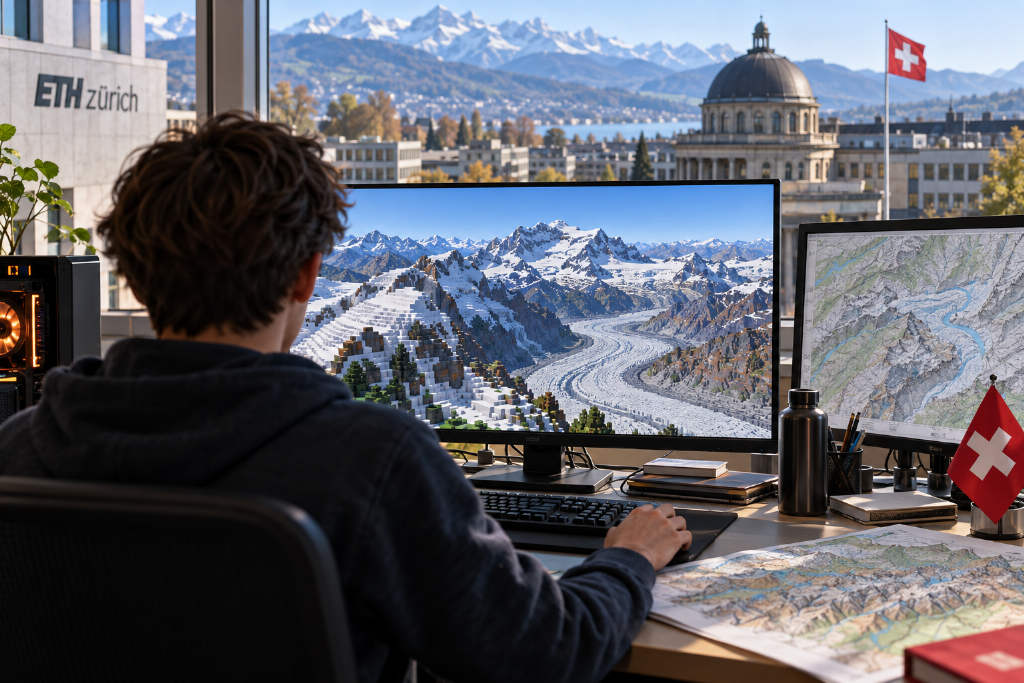
A 22-year-old student at ETH Zurich has rebuilt Switzerland inside Minecraft at a 1:1 scale using open geospatial data from swisstopo and other institutions. In the project, one in-game block equals one meter in the real world. According to German tech outlet heise online on Oct. 26, the project, called Blocks, spans Switzerland’s full 41,285 square kilometers.
The report said the area is slightly larger than Taiwan’s roughly 36,000 square kilometers, with terrain generated automatically from public geographic datasets released by government and research bodies.
Free area covers Jungfrau-Aletsch, full version starts at 15 Swiss francs
The free download includes the entire Jungfrau-Aletsch UNESCO World Heritage region, covering about 2,400 square kilometers and requiring no registration. The area includes the Eiger, Monch, Jungfrau, and the Aletsch Glacier.
The full Switzerland map starts at 15 Swiss francs, or about NT$590 based on an Oct. 27 exchange rate of roughly NT$39.4 per franc. It is sold only to people living in Switzerland.
Creator says open geodata made the project possible
Beda Good, who uses the online name Manifold, is in his seventh semester at ETH. He taught himself geodata processing and 3D modeling outside class. His main project, manifold3d.ch, uses the same datasets to create 3D-printed terrain models. After building that workflow, he converted the same data into Minecraft.
In an interview with Swiss outlet 20 Minuten, he said: 「This project was only possible because Switzerland made its geodata freely available.」
Terrain, lakebeds, glaciers, and buildings all come from public datasets
According to the data sources listed on the Blocks website, terrain is based on swisstopo’s swissALTI3D elevation model, while lakebeds come from swissBATHY3D. Forests and tree heights use swissSURFACE3D, and buildings come from swissBUILDINGS3D. Rivers, roads, railways, bridges, dams, and avalanche protection structures are taken from the swissTLM3D topographic landscape model.
Debris and snow on glaciers are identified by software from SWISSIMAGE aerial photography. Glacier extent and ice thickness also use data from the Swiss Glacier Monitoring Network, GLAMOS, and an ETH glacier thickness model. Surface categories such as grassland, vineyards, and farmland come from habitat maps produced by the Swiss Federal Institute for Forest, Snow and Landscape Research, or WSL.
The website states that swisstopo data has been open for free use since 2021 and can also be used commercially.
1:1 scale does not mean a perfect copy
Switzerland’s highest point, Dufourspitze, reaches 4,634 blocks in the game, while the country’s lowest point, Lago Maggiore, sits at 193 blocks. The Matterhorn’s height and steepness also match reality.
Still, Good notes on the website that this is 「1:1 scale, not a 1:1 copy.」 Buildings were simplified, and bridges, roads, trees, or bodies of water may contain errors or omissions. He said he carried out only spot checks.
While 41,285 square kilometers is Switzerland’s land area, the in-game map fills the full rectangle around the country, which means it also includes parts of neighboring states. Outside the border, and along some border sections, terrain uses the European Union’s Copernicus elevation model, which has one measurement point every 30 meters. That makes those areas rougher and less complete. Near Geneva, some places are missing building data, so trees appear where houses should be.
The Alps pushed the project onto a 2017 version of Minecraft
Standard Minecraft has a height limit of 384 blocks. Dufourspitze at 4,634 meters is about 12 times that ceiling. Blocks therefore uses the Cubic Chunks mod, which lets the world load in vertical sections and removes the height cap.
Good said the mod runs most reliably on Java Edition 1.12.2, released in 2017, so the map cannot be moved directly into the latest version.
Players also need to install Forge and Java 8. The website recommends importing the setup through Prism Launcher. It supports Windows, macOS, and Linux. Cubic Chunks is available only on Java Edition, which means Bedrock, consoles, and phones are not supported.
Hardware requirements and file size
The site recommends at least 16 GB of memory, with 8 GB allocated to the game. The full version has been tested on two machines: a Windows PC with an AMD Ryzen 7 7800X3D, NVIDIA RTX 4070, and 32 GB of RAM, and a MacBook Pro with an M1 Max and 64 GB of memory.
The world generates as players move through it. The first time someone reaches a new area, the game may need several minutes to build blocks from the data pack. Slower machines will take longer.
The free area download is 1.1 GB and takes about 2 GB after installation. The full-country version is a 24 GB download and needs roughly 60 GB of disk space, about 30 times the size of the free area.
Sales limited to Swiss residents, with the site citing only “legal reasons”
The paid full version comes in three pricing options. The base license costs 15 Swiss francs. A 48-franc option, about NT$1,890, corresponds to Switzerland’s 48 peaks above 4,000 meters, or 1 franc per mountain. Buyers at that level can add their names to the site’s “summit guestbook.” A third option lets buyers choose a custom amount, with the same 15-franc minimum. As of Oct. 27, the guestbook listed seven names.
Under the sales terms, all tiers include the same content and differ only in price. Future updates are free. The only paid item is the world data pack; the mod, texture pack, and shaders are included just as they are in the free area.
The full version is non-refundable after payment, even if it does not run on a buyer’s computer, so the site recommends testing the free area first. Blocks also states that it is not an official Minecraft product and has no affiliation with Mojang or Microsoft.
Payments are processed through Stripe and support TWINT, credit cards, Apple Pay, and Google Pay. Buyers must enter a Swiss address at checkout and confirm that they live in Switzerland, though their physical location at the time of purchase does not matter. The site gives only “legal reasons” for the resident-only restriction. Its terms also state that if a buyer does not live in Switzerland, Beda Good may cancel the contract and issue a refund.