
Author: 0xWizard
Translated by: TechFlow
Ethena has generated $1.04 billion in cumulative revenue since launch, with $284 million of that coming in the past 12 months. ENA holders, however, have received none of it so far.
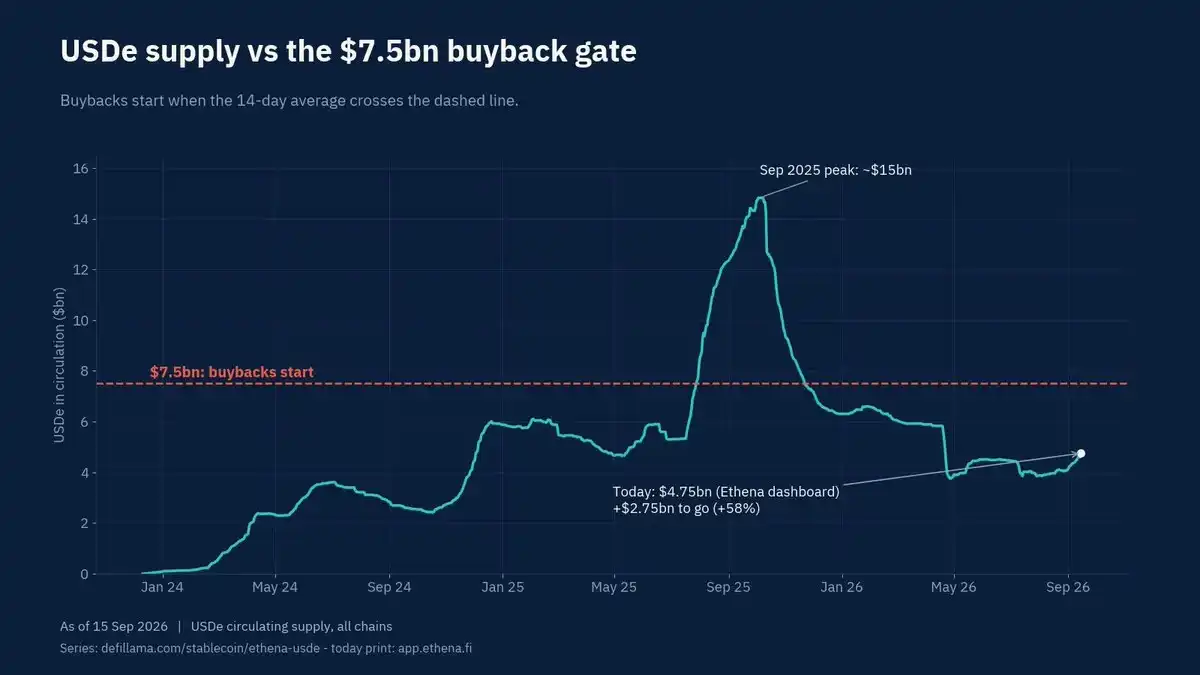
That changed in structure, though not yet in cash flow, on Sept. 2, when a governance vote approved a fee switch. Once the 14-day average supply of USDe rises above $7.5 billion, 95% of the revenue routed through that switch will be used to buy ENA on the open market.
USDe currently stands at $4.75 billion, still 58% below the threshold. The original article argues that the protocol could cross that line within three to six months, driven by three catalysts: stock perpetuals, a rebound in crypto funding rates, and wider distribution.
Valuation and what the fee switch would change
At a current valuation of $1.43 billion, ENA is priced at roughly 5x the fees the protocol collected in its weakest year, according to the article. The core argument is that once the fee switch is triggered, the revenue engine Ethena has spent two years building would begin sending value directly to ENA holders.
Three catalysts highlighted in the article
1. Stock perpetuals
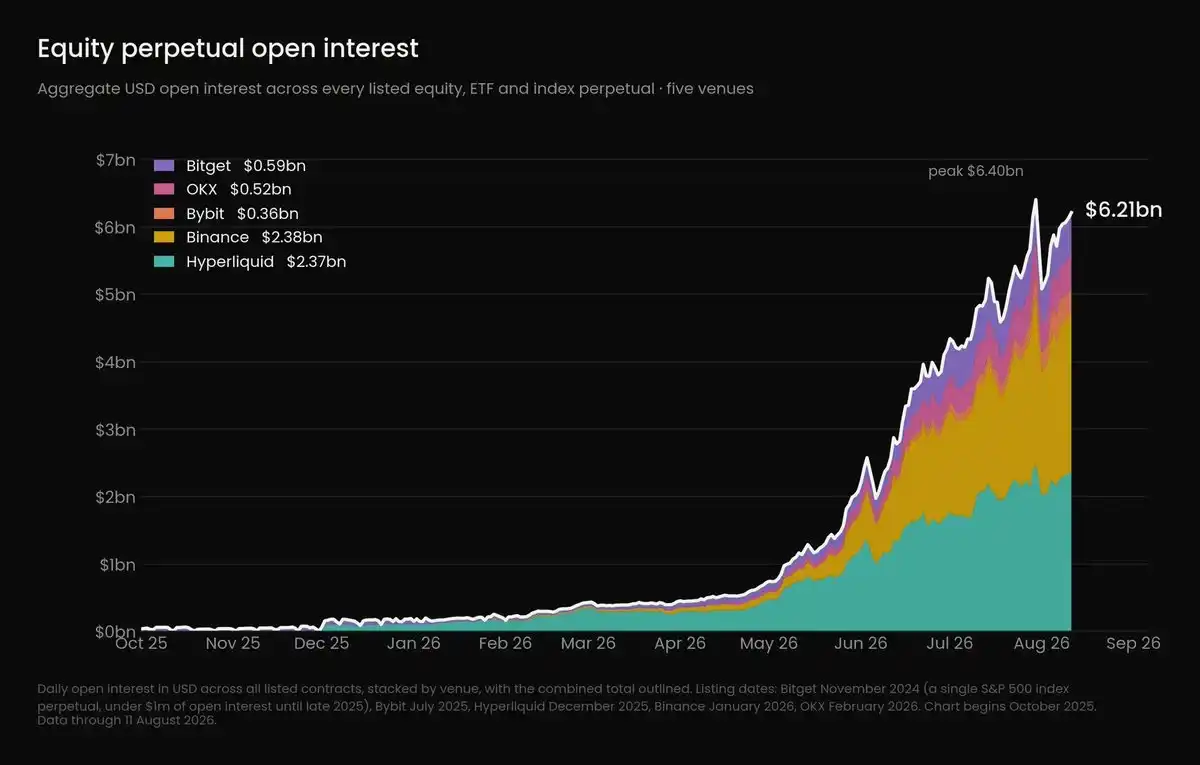
By late August, open interest in stock perpetuals across major trading venues had reached about $6.2 billion, roughly 10x the level seen in March. Over recent months, funding rates on those positions were running at about 14% annualized on Hyperliquid and about 17.5% on Binance, versus 4% to 7% for ETH and BTC.
The article’s point is that stock funding rates are not correlated with crypto funding rates. That makes them a separate yield source that can keep paying whether crypto markets are strong or weak.
On Aug. 28, Ethena said it would expand USDe backing into stock perpetual basis trades, with the first exchange deployments expected in the coming weeks. Ethena expects RWA perpetuals to overtake crypto allocations within 12 to 24 months. They currently account for 13% of backing.
If RWA perpetuals outperform the crypto book with 15% to 20% funding rates, blended yield could rise by 2% to 3%. If that segment eventually grows to half of the backing base, stocks alone could contribute 8% to 10% in sustainable yield.
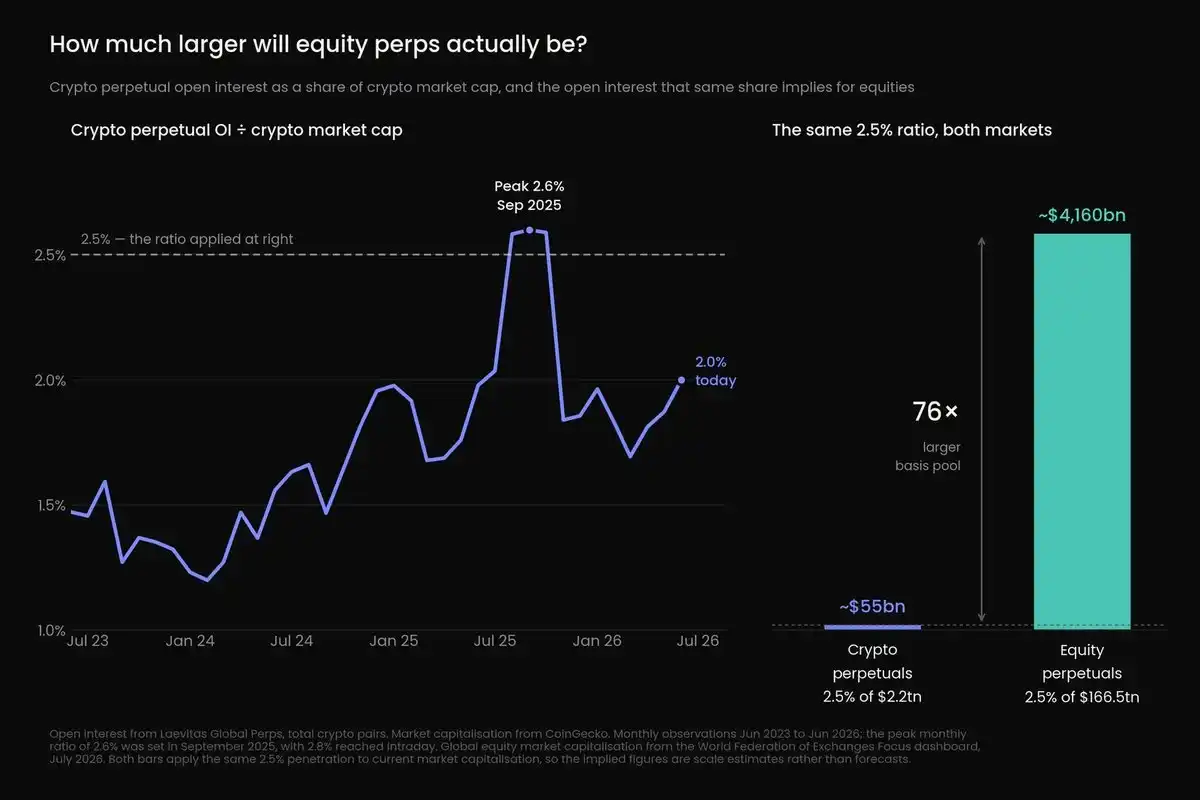
The article also compares the addressable markets. In July 2026, global equity market capitalization reached $166.5 trillion, while crypto stood at about $2.2 trillion. Based on Ethena’s own projection, open interest in stock perpetuals could grow to $4 trillion, around 40x the $110 billion peak crypto perpetual book. The article notes that a $4 trillion market would not keep paying 15% to 20% forever because funding rates would compress as more capital enters, but argues that depth matters more: a larger and uncorrelated yield engine could help push USDe supply toward the $7.5 billion threshold.
2. Crypto funding rates have recovered
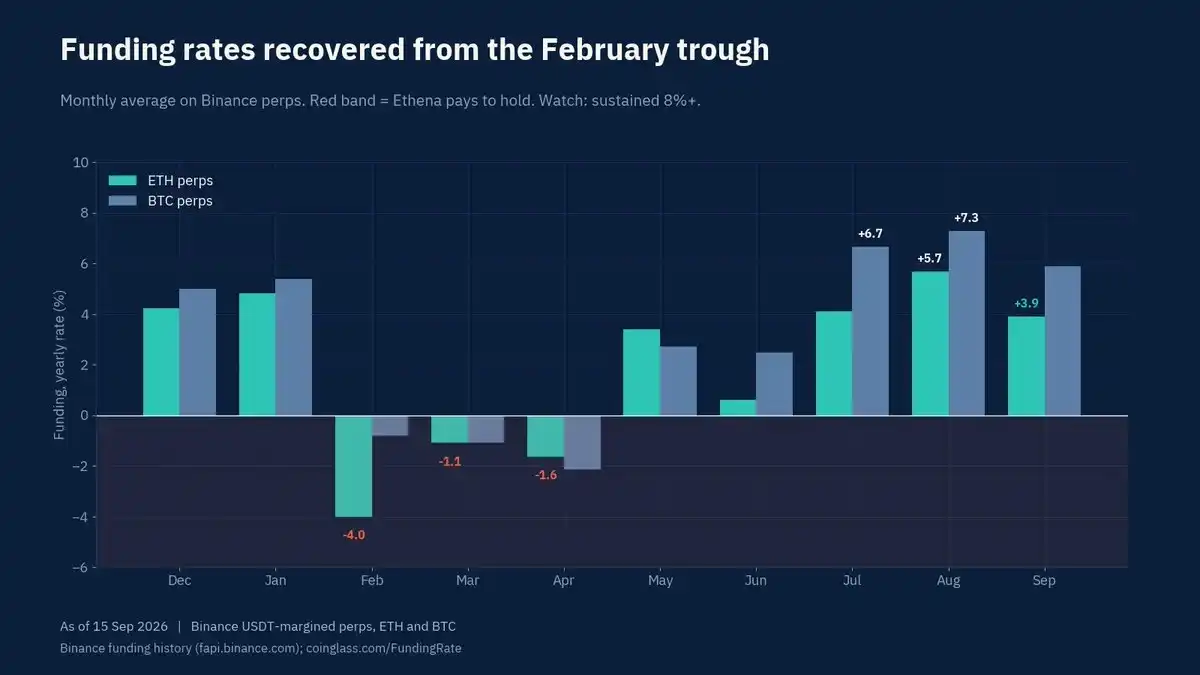
From February to April 2026, crypto funding rates on Binance were negative. ETH averaged -4.0% in February, its weakest month since 2023. During that stretch, Ethena shifted backing away from basis trades and into DeFi lending, liquidity stablecoins, institutional lending, and RWAs. Until recently, only 1% of USDe backing was in basis trades.
Those allocations yielded less than crypto basis trades did in 2024, but they still provided a stable 4% to 5% return for sUSDe holders when funding rates were not paying.
The article says BTC is now trading at $80,000 and funding rates have turned positive again. In August, ETH funding averaged +5.7% and BTC averaged +7.3%. If market conditions keep improving, Ethena could rotate more of the book back into crypto basis trades, repeating the setup that helped USDe supply reach $15 billion in 2024 and 2025.
It also argues that Ethena’s crypto basis trade has now shown Lindy characteristics, having survived historic liquidation events such as 10/10 and other poor market conditions while smaller rivals failed.
3. Distribution: TRON launch and CEX collateral
The article says yield alone will not grow USDe. Users also need a place to buy it and a reason to hold it.
Traders can now use USDe as margin on Bybit and Binance, and hold it on Bybit, OKX, Bitget, and Binance. Coinbase and Robinhood have also integrated it into their products, specifically Coinbase Vault and Robinhood Earn. USDe went live on TRON on Sept. 11. The article notes that TRON is already the largest chain for stablecoin trading volume and argues that chain expansion matters when a growth strategy is executed well, citing USDe reaching $300 million soon after its Robinhood launch.
On Sept. 1, Ethena launched Ethena Pay (@EthenaPay), led by @gdog97_ and @litocoen. Users can earn up to 6% on USDe balances and receive 5% AVAX cashback on spending. From Sept. 1 to Sept. 9, onchain card spending reached $632,000, while average daily spend rose from $16,000 to $61,600.
The article describes the product as still being in beta, with only a few hundred non-U.S. and non-EU users at launch, but says it marks the first time ordinary users can hold USDe, earn yield on it, and spend it through a card. It also points to the success of crypto card products from EtherFi and Plasma, along with Ethena Pay’s AVAX-backed rewards, as reasons it could become one of the products that helps push USDe toward $7.5 billion.
How the fee switch works
If those catalysts lift USDe supply above $7.5 billion, the fee switch turns on and part of Ethena’s revenue starts buying ENA in the open market.
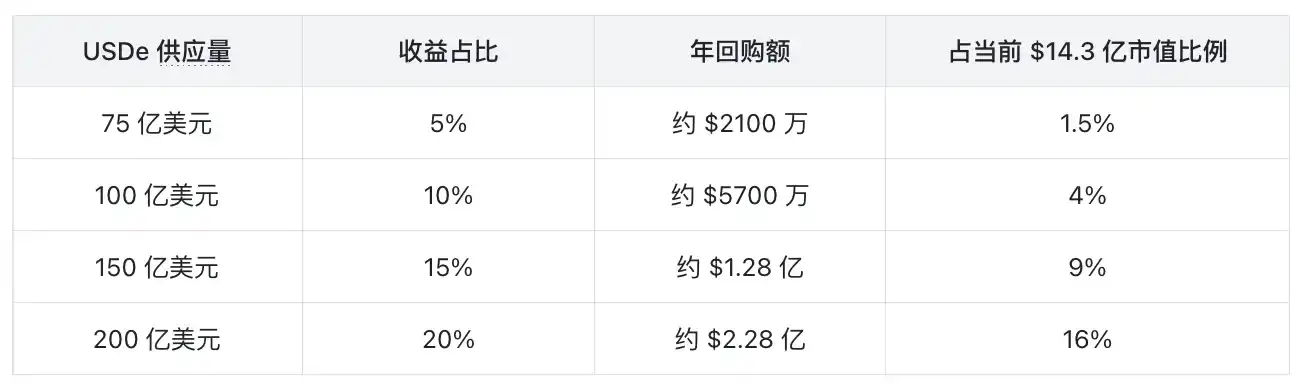
- At $7.5 billion in USDe supply, 5% of revenue is allocated
- At $10 billion, 10%
- At $15 billion, 15%
- At $20 billion, 20%
Of that allocation, 95% goes to buybacks.
The article gives the formula as:
USDe supply × protocol yield × fee-switch share × 95%
Protocol yield here refers to the rate Ethena earns on the assets backing USDe. Under a 6% protocol yield assumption, the first tier is relatively small. The more important levels are $10 billion and $15 billion, the latter being a level USDe reached at one point in 2025. At those tiers, the article says annual buybacks would amount to about 4% and 9% of current market capitalization, respectively.
Reference: Ethena Foundation announcement
Risks flagged in the article
Oct. 5 unlock
All VC token unlocks have been compressed into Oct. 5, according to the article. It estimates the amount at 14% of circulating supply, worth about $200 million at current prices and accelerated by 17 months relative to the original vesting schedule. The Ethena Foundation said it had bought the locked tokens of large seed investors who would have sold ENA after Oct. 10, 2025. The article says that eases some supply pressure, but does not remove the need for caution.
Funding rates turn negative again
If the broader market stalls and crypto perpetual funding rates move back below zero, USDe reserves could rotate again into lower-yield, non-basis allocations in the 4% to 5% range. The article says that would weaken demand for holding USDe, especially among sUSDe holders and PT loopers.
Stock perpetuals fail to scale
If stock perpetual deployments are delayed, open interest shrinks, or stock funding rates fall back toward crypto levels, the impact of this new non-crypto-correlated yield source would be much smaller. In that case, blended sUSDe yield could remain stuck in the mid-single digits, which the article says would be a weaker reason to mint USDe up to $7.5 billion.
Lending or credit losses
A large share of reserves sits in DeFi lending and institutional credit, including Aave, Morpho, Maple, and FalconX. An exploit or borrower default could reduce backing and halt minting, the article says.
USDe never gets above $7.5 billion
If USDe supply stays below the threshold throughout 2027, the fee switch never turns on and ENA remains only a governance token.
The article’s bottom line
The piece argues that once USDe supply holds above $7.5 billion, the fee switch will activate. It identifies three new drivers that could get it there: stock perpetuals, positive crypto funding rates, and new distribution channels for buying and holding USDe, including TRON, CEX collateral integrations, and Ethena Pay.
It also references a now-deleted October 2024 post by @0xENAS titled "Ethena: a trillion-dollar crypto opportunity," saying the opportunity at the time was the stablecoin market plus crypto basis trades that could pay yield on USDe. The article argues that the market is now larger and distribution is stronger.
The final point is explicit: the whole thesis depends on whether those catalysts can push USDe supply back to $7.5 billion and beyond. If not, the case for holding ENA weakens materially. If yes, the fee switch becomes the mechanism that links protocol revenue to the token.