
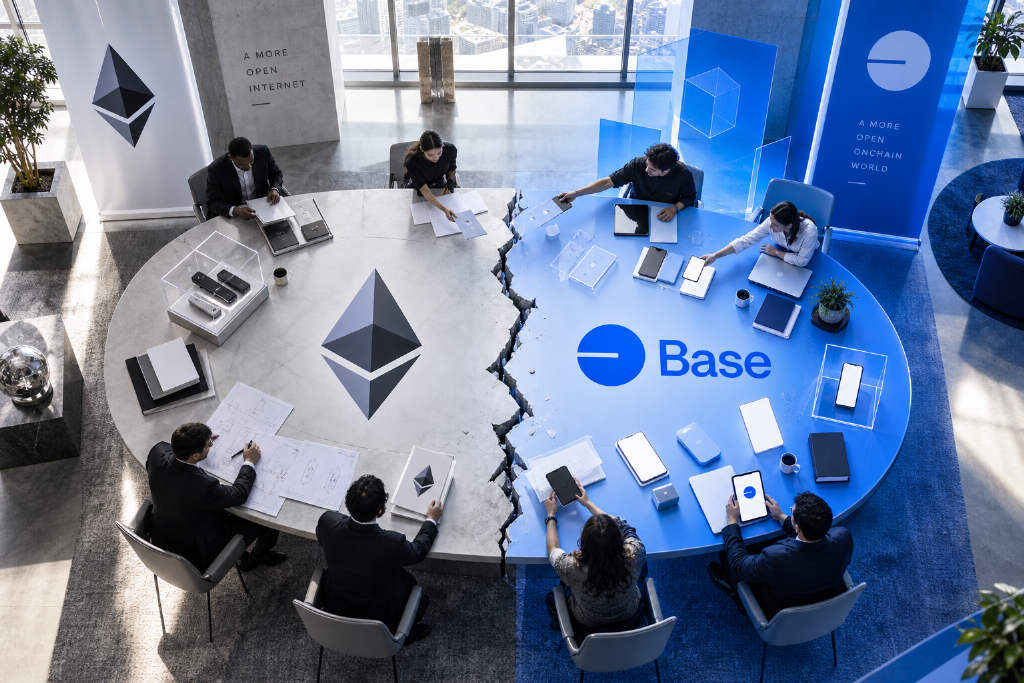
Ethereum and Base have ended their attempt to agree on a common wallet standard, leaving the two networks to pursue separate paths for Account Abstraction, or AA.
Derek Chiang, an Ethlabs researcher and co-author of Ethereum Improvement Proposal EIP-8141, said in a post on X on Monday that talks aimed at giving wallets a consistent experience across both chains broke down last week. He said the result shifts the implementation burden to wallet developers, who now face the prospect of supporting different standards on each network.
Ethereum backs EIP-8141 while Base moves with EIP-8130
The split leaves each side advancing a different AA proposal.
On Ethereum, EIP-8141, known as Frame Transactions, has been positioned as the leading proposal for the Hegotá upgrade. The proposal would bring native AA functionality into the protocol layer and lay groundwork for quantum-safe authentication. Base, meanwhile, is backing EIP-8130, or Keystore, as its route to native AA. According to the report, that work has already been running on devnet.
The Ethereum Foundation said in an official blog post published on Sept. 7 that EIP-8141 is one of Hegotá’s priority items. The foundation grouped it with EIP-7702 as part of the core package for the next round of protocol upgrades.
A split rooted in Layer 1 and Layer 2 priorities
Chiang said the breakup reflects a deeper difference in design philosophy between Layer 1 and Layer 2 systems.
In his account, Ethereum as a Layer 1 network places censorship resistance, anti-takeover protections, open-source development, privacy, and security at the top of the stack. That naturally pushes it toward a more conservative and more decentralized AA standard. Base, as a Layer 2, is more focused on scalability and user experience. In that context, a design such as EIP-8130, which the report describes as better suited to high-speed transactions and a simplified verification flow, is a more natural fit.
Account Abstraction allows wallets to define transaction authorization rules and fee payment logic through code, rather than relying on a single private-key signature path. If Ethereum and Base do not share interoperable standards, wallet developers will need to support both transaction formats to preserve a smooth experience for users moving between the two chains.
More room for innovation, but fragmentation risk grows
Chiang took a positive view of the split. He said the separation gives both networks more freedom to push AA innovation in line with their own visions.
That does not remove the trade-off. If Ethereum, Base, Arbitrum, and Optimism each end up adopting different AA standards, the wallet ecosystem could become more fragmented. The report notes that user experience could move backward if standards diverge, even as AA itself becomes more widely adopted.
Timeline: Hegotá after Glamsterdam
Ethereum’s Hegotá upgrade is expected to begin rolling out in the second half of 2026, after Glamsterdam.
Glamsterdam is described in the report as one of Ethereum’s most important upgrades in 2026, with goals that include improving scalability, strengthening Layer 1 security, and improving user experience. A mainnet launch date has not been determined.
What to watch next
The report says this split may only be the beginning. One immediate question is where other Layer 2 networks line up.
If Arbitrum and Optimism align with Ethereum’s EIP-8141, Base could stand apart. If they favor EIP-8130 instead, the standard coming from Ethereum mainnet could lose influence.
Wallet providers are another major variable. How MetaMask, Rainbow, and WalletConnect handle support for two standards will shape whether users actually feel the ecosystem dividing in practice. As for whether the Ethereum Foundation might revisit its strategy and try again to coordinate a shared standard with Layer 2 networks, the report said there is no signal of that at this stage.
The direction of AA standards will shape the user experience and security model of the next generation of wallets. In this case, the break is not only about technical implementation. It also reflects a disagreement over governance and priorities.