
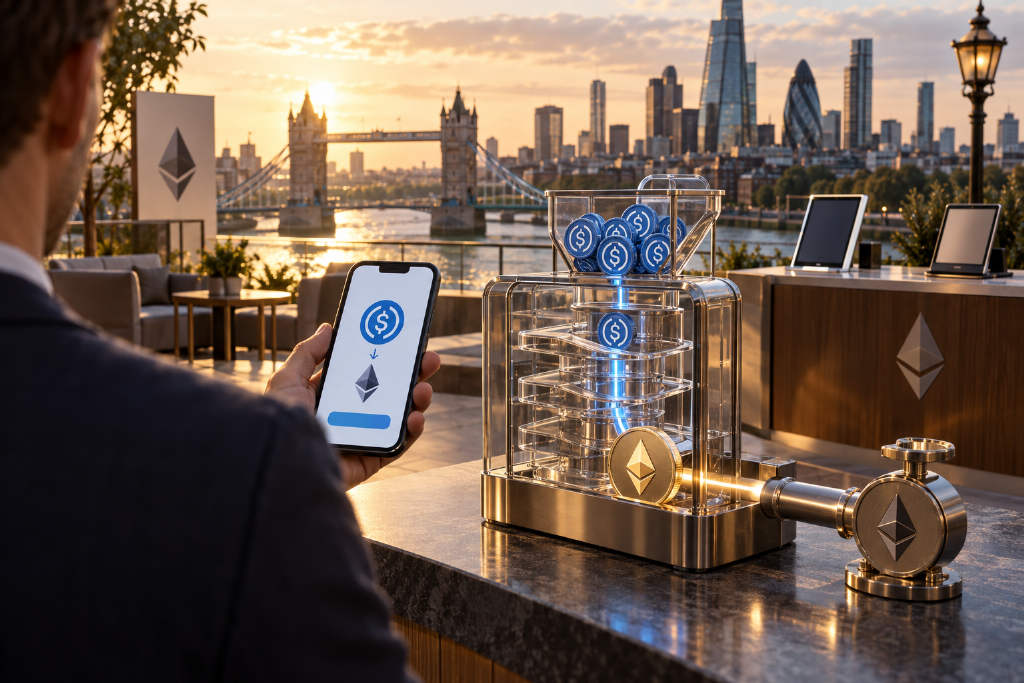
Progress on EIP-8141, or Frame Transactions, has reopened a familiar argument around Ethereum: if users no longer need to hold ETH to send a transaction or cover gas, what does that mean for ETH itself?

The piece by imToken argues the answer is less dramatic than the market reaction suggests. The asset a user sees on the front end is not the same thing as the asset Ethereum uses to settle fees at the protocol layer.
Paying fees in USDC does not mean Ethereum starts charging gas in USDC
The article starts with a simple example. If Frank has 1,000 USDC in his wallet and wants to send 100 USDC to a friend, that transfer usually cannot go through today if his wallet holds no ETH.
The reason is straightforward. In the current structure of a standard Ethereum account, the transaction sender is also the one paying gas. Frank signs the transaction, Frank submits it, and ETH from Frank’s balance covers the network fee. Those steps are effectively tied together.
EIP-8141 is designed to separate them. Under the current design, a Frame Transaction can be split into multiple frames, each handling a different part of the process, including transaction verification, confirming who pays gas, and executing the user action.
That means Frank could still sign to confirm that the 100 USDC transfer is his instruction, while a Paymaster or another account supplies the ETH needed to pay Ethereum gas on his behalf. Frank would then settle that cost with the Paymaster using a small amount of USDC.
From the user’s perspective, the wallet may simply show a transfer of 100 USDC with a network fee of 0.1 USDC. Frank would not need to preload ETH or even pay attention to the prevailing ETH gas price.
At the protocol level, though, this does not turn USDC into Ethereum’s gas token. Someone in the background still pays gas in ETH and settles separately with the user afterward.
The article points to the official ERC-20 payment example tied to EIP-8141. In that model, a Sponsor approves and covers gas, while the user transfers ERC-20 tokens to the Sponsor as payment.
To make the distinction clearer, the piece compares it with spending abroad using a renminbi credit card in Japan. The customer experiences a renminbi charge, and the merchant may ultimately receive yen. That does not change the base settlement currency of the local payment system. Front-end payment and back-end settlement can be different by design.
That is the core abstraction in EIP-8141. Users may no longer need to hold ETH directly, while another party pays ETH-denominated gas and later collects the equivalent cost in USDC or another token.

Ethereum is trying to remove the need for ordinary users to understand gas
The article notes that the idea itself is not entirely new. ERC-4337 introduced account abstraction and Paymaster support, which already allow smart accounts to sponsor gas and let users cover costs with stablecoins.
The difference, according to the piece, is architectural. ERC-4337 achieves this by adding infrastructure outside the base protocol, including UserOperation, Bundler, EntryPoint, and Paymaster. EIP-8141 tries to place similar capabilities more natively inside Ethereum’s transaction structure.
At the center of this push is a simple question: why should ordinary users need to understand gas at all before they can use Ethereum?
The article contrasts crypto with mainstream payment apps. If someone sends a friend 200 yuan on WeChat, the app does not ask that person to first buy a separate settlement token on another platform. Crypto users, however, have often been forced into exactly that sort of workflow.
On Ethereum they need ETH. On Solana they need SOL. On BNB Chain they need BNB. Even when moving to a new layer-2 network, one of the first checks is whether the wallet holds enough starter funds to begin. Experienced users may bridge assets and top up gas in a few minutes, but for newcomers that step can be enough to make them close the page and leave.
The article also says frame transactions could clean up other long-standing UX issues. A trade on a DEX for a new token often requires one approval transaction and then a separate swap transaction, which means two wallet confirmations.
If the swap fails, the approval can remain live on-chain and continue to carry risk. With frames, those two actions could be bundled into a single atomic batch, so if the swap fails, the approval rolls back with it.
That opens a wider design space. Authorization, execution, payment, and verification may no longer need to be handled by the same account or in the same order.
ETH’s role stays in place, but demand may move to different holders
The article says discussion around EIP-8141 tends to split into two extremes. One side argues that if users stop paying gas directly in ETH, ETH loses value. The other says lower friction could drive a sharp rise in activity and turn the change into a major positive for ETH.
imToken does not claim a final answer yet, but it draws one firm line: EIP-8141 does not remove ETH from Ethereum’s gas and fee settlement layer.
Even if users no longer see ETH in the payment flow, the Paymaster, app, or other account paying on their behalf still has to cover network fees denominated in ETH. The article also says the existing EIP-1559 fee market is not being replaced by stablecoins through frame transactions.

What changes is where ETH demand sits. Today, that demand may be spread across 1 million users, each holding a small amount of ETH in a wallet just to keep transacting. In a future frame-based setup, a smaller set of Paymasters, wallet providers, and applications could hold larger revolving ETH balances and process gas for large numbers of end users.
The article also pushes back on a common leap in reasoning. It says there is no basis to assume that every stablecoin-denominated fee paid by a user would trigger an immediate spot-market purchase of the same amount of ETH in the background.
Paymasters can hold inventory in advance, replenish dynamically, or hedge exposures through other treasury methods. Because of that, the ability to pay gas in stablecoins does not by itself reveal how much incremental spot demand ETH would gain.
In the article’s framing, the real question is narrower and more practical: once the user experience improves, does Ethereum actually attract more genuine usage, and does the overall pie become bigger?
It illustrates the point with a simple example. If 100 people intended to use Ethereum in the past, but 70 dropped out because they had to buy gas, check gwei, or bridge assets around before they could begin, then only 30 ended up completing a transaction. If wallets absorb that complexity in the background and 80 users now complete their transactions smoothly, Ethereum could consume and burn more ETH in practice even if those users never hold any ETH themselves.
The reverse is also true. If the ecosystem does not gain new activity and only shifts gas payment from self-funded users to sponsored users, the structure alone does not create new value.
For wallets, the direction is clear: users should not have to learn gas first
The article closes with a view from the author. What EIP-8141 weakens is the requirement that every user must stock a little ETH in advance just to use Ethereum. What Ethereum is really betting on is that once this barrier disappears, more people will actually use the network.
For ordinary users, the piece says there is no immediate need to change current habits because of this proposal. For wallet design, however, the direction already looks clear.
A well-designed wallet may increasingly stop asking users to understand gas before doing anything. Users decide where assets should go and what action they want to take. The wallet should present the risks and the final cost. Which account pays, whether billing is shown in ETH or a stablecoin, and whether a gas sponsor is available are protocol details that can fade into the background.
That, in imToken’s view, is the real significance of EIP-8141. It is not Ethereum abandoning ETH in its fee system. It is Ethereum trying to remove one of the first barriers that keeps people from using the chain at all.
