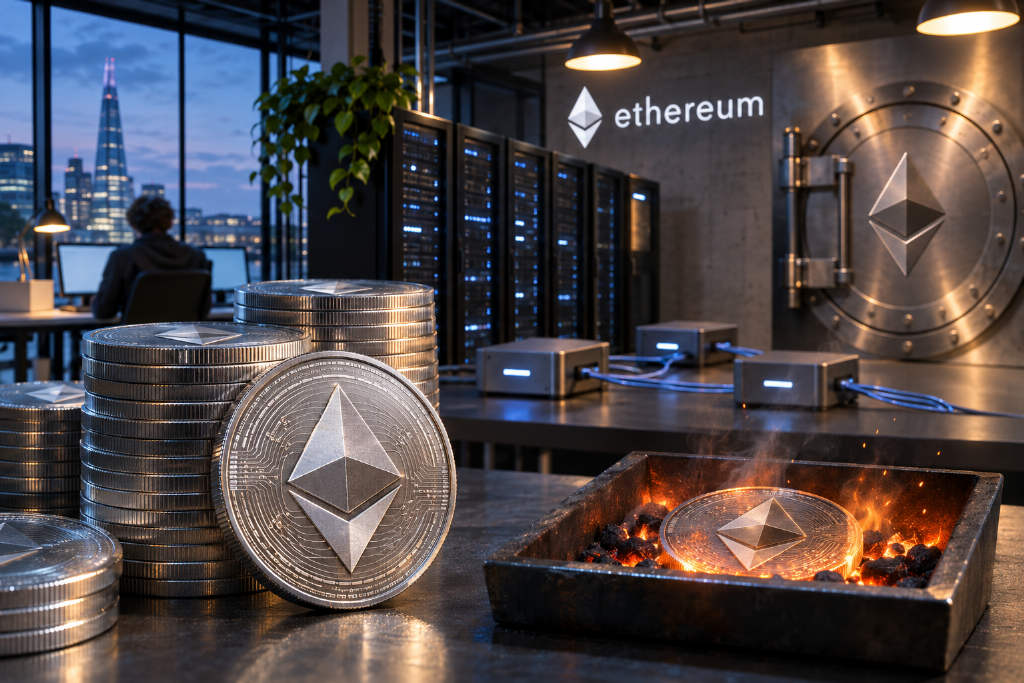
Vitalik Buterin reopened the debate over ETH’s value on November 8, posting a long thread on X. His argument challenges the idea that fee burning can serve as a dependable floor for the valuation of a crypto asset.
Ethereum’s “Ultrasound Money” narrative was built around a straightforward chain of events: stronger activity would increase gas consumption, persistent fee burning would offset inflation, and ETH could eventually become deflationary. Buterin said much of the historical fee revenue came from speculative activity inside the crypto market. When that market activity weakens, the amount available for burning can fall with it.
He still supports keeping EIP-1559. Even if burns remain below 10% of new issuance over the long term, that would not necessarily be a reason for regret. Deliberately pursuing higher fees to preserve a large burn rate could damage Ethereum’s decentralization and long-term development.
How major networks issue and remove tokens
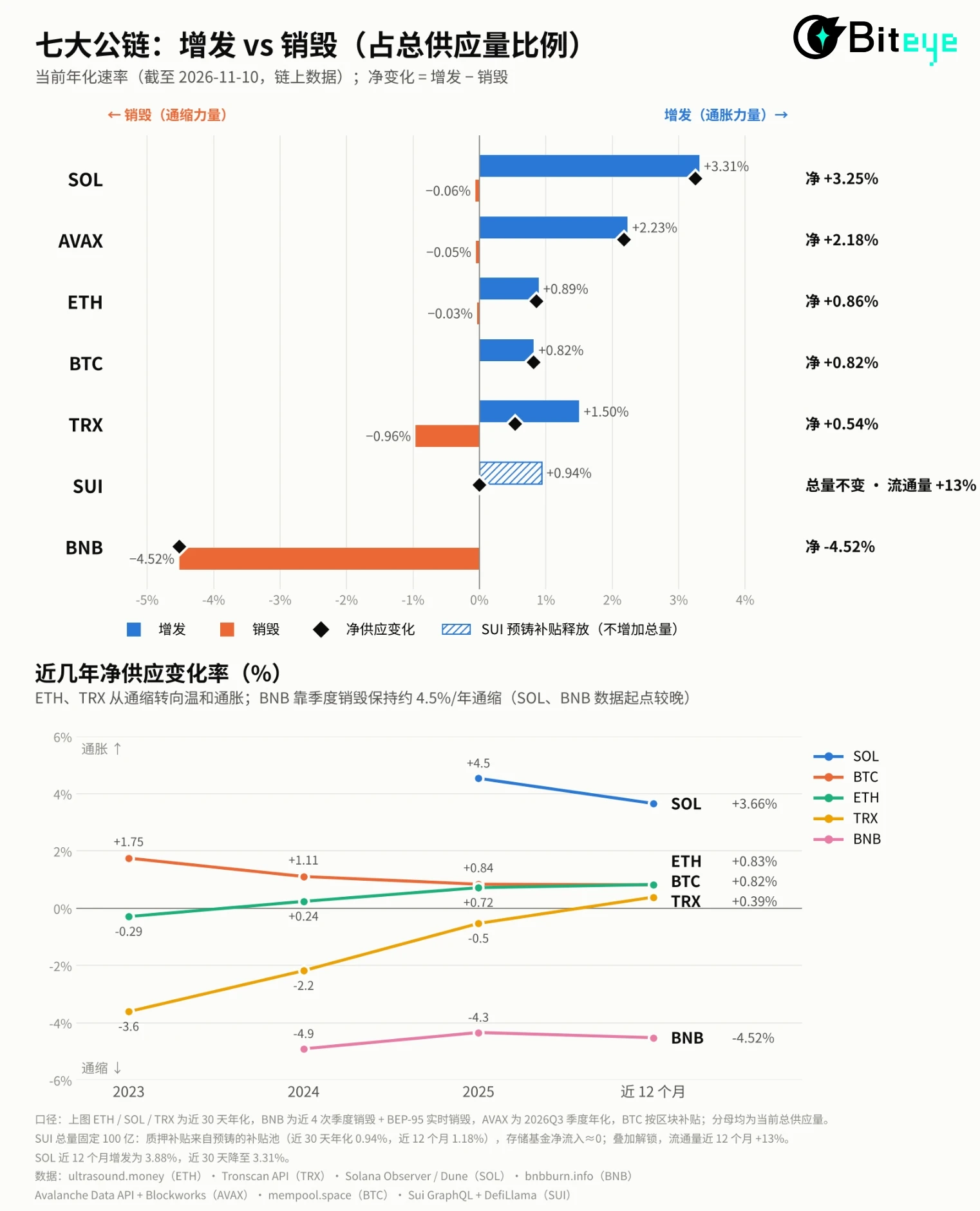
Most proof-of-stake networks issue tokens to reward validators and use fee burning to reduce supply. Their different issuance and burn rules produce very different changes in circulating supply.
Bitcoin: halving keeps inflation on a declining path
Bitcoin has a supply cap of about 21 million coins. The current block reward is 3.125 BTC. With one block produced on average every 10 minutes, the network adds about 164,300 BTC a year, equal to an annual supply inflation rate of roughly 0.82%. The block reward is cut in half every four years, causing the inflation rate to decline over time.
Ethereum: issuance fell after The Merge, but burns have weakened
After The Merge in 2022, new ETH issuance dropped sharply. Since the upgrade, cumulative supply growth has been about 1.37%. EIP-1559 burns the base fee in full, but the wider use of Layer 2 networks and lower gas fees have reduced the burn rate. Over the most recent 30-day period cited in the article, ETH burns offset only about 3.2% of new issuance, putting pressure on the old deflationary narrative.
Solana: ongoing issuance with a declining inflation target
Solana began with an annual inflation rate of 8%. That rate declines by 15% each year, with a long-term target of 1.5%. During the 2024 memecoin boom, daily SOL burns at one point exceeded 10,000 SOL. In January 2025, burns were reported to offset about 23% of new issuance.
After the implementation of SIMD-0096, all priority fees went to validators, while only 50% of base fees were burned. Daily burns subsequently fell at one point to about 700 SOL.
BNB: supply reduction without continuous issuance
BNB does not rely on continuous issuance. Its supply is reduced through quarterly Auto-Burns and the real-time gas burn under BEP-95, with a target total supply of 100 million BNB. The first four quarterly burns of 2026 removed about 6.2 million BNB. Auto-Burn determines the amount using the token price and block production, while BEP-95 burns part of network fees.
TRX: transfer activity does not guarantee higher burns
TRON issues TRX through block rewards and burns the Energy and Bandwidth resources paid by users. Users can also obtain those resources through staking or rentals. As a result, a rise in USDT transfer activity does not necessarily produce a matching rise in TRX burns.
AVAX: a supply cap plus fee burning
AVAX has a maximum supply of 720 million tokens. The network issues new tokens as validator rewards, while fees on the mainnet X, C and P chains are burned in full. By early November 2026, about 474 million AVAX had been minted, including roughly 114 million AVAX from staking rewards. Cumulative burns stood at about 5.18 million AVAX, still below the amount of new issuance.
SUI: a fixed supply makes unlocks the key variable
SUI has a fixed total supply of 10 billion tokens. Circulating supply mainly grows through scheduled unlocks. Its Storage Fund locks part of storage fees and compensates validators through staking returns. When data is deleted, most of the fee can be recovered. The portion that is not returned remains in the fund and reduces freely circulating supply, but it is not permanently burned.
The limits of burn-based valuation
Buterin revisited a burn-based valuation model that was once widely discussed:
Token valuation = annual burn value ÷ discount rate
If a blockchain permanently burned tokens worth $1 billion each year, a 4% discount rate would produce a theoretical valuation of about $25 billion. Buterin argued that this supposed valuation floor is not reliable.
Ethereum offers a clear example. The network burned about 1.48 million ETH in 2022, worth roughly $3.6 billion. By November 8, 2026, cumulative burns for the year stood at only about 19,200 ETH, worth approximately $43 million. If that figure were simply annualized to about $50 million and divided by the same 4% discount rate, the theoretical valuation would be around $1.25 billion. ETH’s market capitalization during the same period was about $270 billion.
The gap is more than 200 times, exposing the limits of the model itself. Other networks face similar valuation problems.
- Fee revenue is not stable. Earlier periods of heavy burning were driven largely by speculative activity such as NFTs. Once that activity cooled, revenue declined, making it difficult to treat burns as a durable cash flow.
- Burning is only one way for a blockchain to distribute captured value. Solana’s priority fees go to validators, while TRON’s resource rentals may become staking returns. Those forms of economic value do not all appear in token burns.
Burn value can measure part of the value captured by a network, but it cannot serve as a universal valuation standard for every blockchain.
From fee burning to a store of value
If fee burning cannot provide a reliable valuation base, where can ETH’s long-term value come from? Buterin placed more weight on Ethereum’s decentralization, censorship resistance, open-source structure, privacy and security. He also pointed to the rapid development of artificial intelligence, arguing that systems able to operate reliably over the long term without control by a single actor could become more valuable.
There are still major objections. ETH already has a market capitalization in the hundreds of billions of dollars, which cannot be explained by fee income alone. Demand for ETH as an on-chain collateral asset, a medium of exchange and the native asset of financial infrastructure may itself create a monetary premium.
ETH also has no fixed supply cap. Its issuance rules can be changed through protocol upgrades. If ETH is to compete with BTC in the store-of-value market, it must answer a basic question: why should users place the same long-term trust in its supply rules and monetary policy?
Fee burning can at least be calculated. The monetary premium associated with a store of value is much harder to measure with a single valuation standard.
For years, the crypto industry pursued higher transaction volumes, lower fees and more active on-chain ecosystems. As fees fall and burns become less able to support valuation, blockchain projects are being pushed to reconsider the sources of value for their native tokens. Buterin’s renewed focus on a store of value may point to a change in how public blockchains are valued.
Whether the market will pay a monetary premium similar to Bitcoin’s for a growing number of networks that emphasize scarcity, security and long-term consensus remains unresolved. So does another question: if blockchain applications expand tenfold while fee revenue keeps falling, what will support the value of their native tokens?
Crypto markets carry risk. This article is not investment advice. Readers should assess whether the opinions, views and conclusions presented here fit their own circumstances, and bear responsibility for any investment decisions based on the article.