
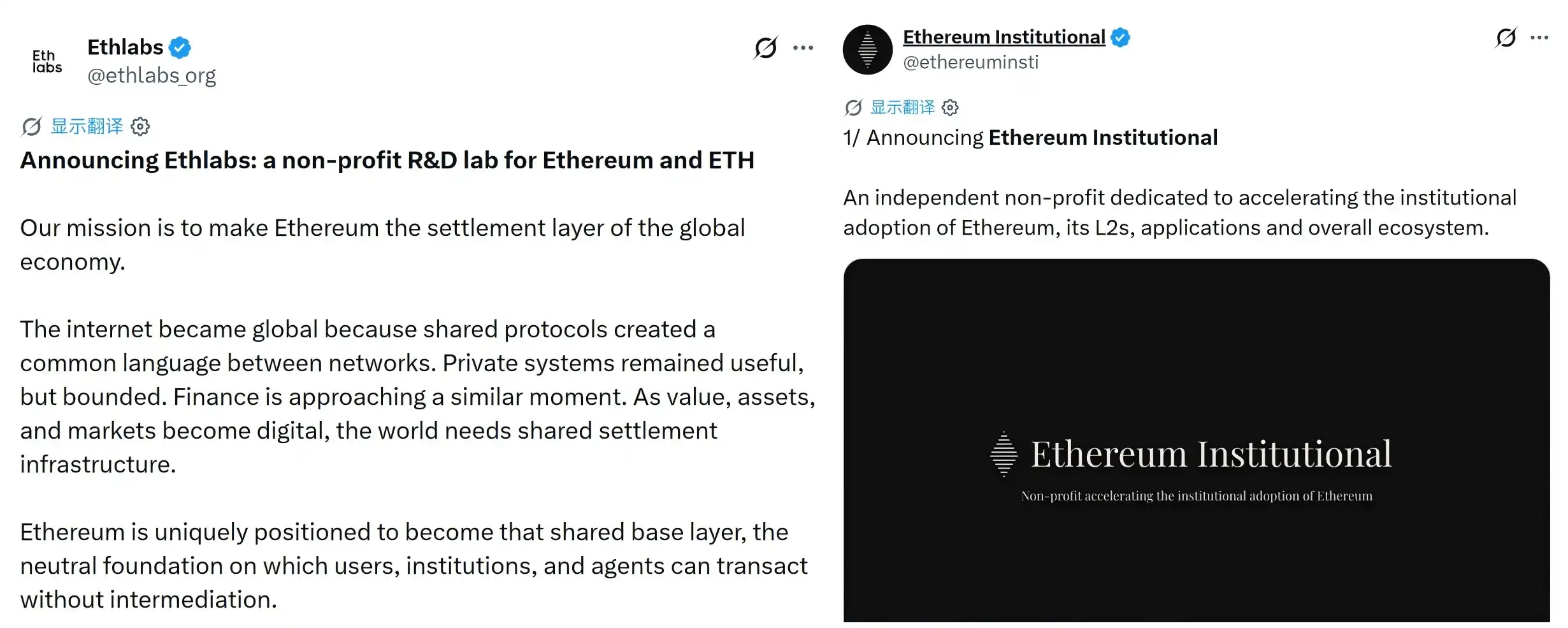
Ethereum has entered an unusually active period of organizational change over the past two weeks. On June 22, 2026, five former core researchers from the Ethereum Foundation, or EF, announced the launch of Ethlabs, an independently operated non-profit research and development lab. One day later, the Foundation unveiled a new organizational structure and confirmed it would part ways with 54 employees, roughly 20% of its total headcount. Then, on July 1, another independent non-profit, Ethereum Institutional, officially launched and assumed institutional partnership work that had previously been handled by EF’s market expansion team.
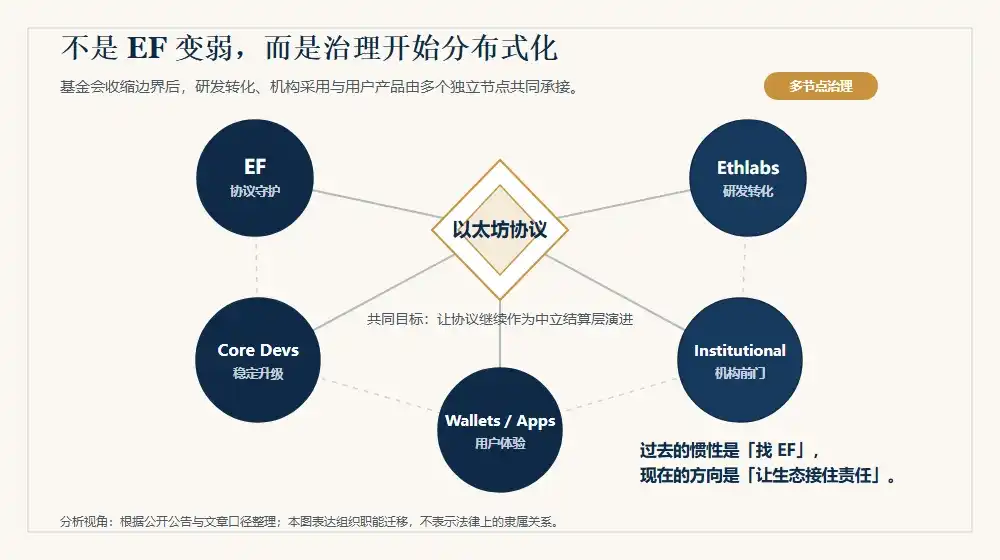
Viewed in isolation, those developments could easily feed a familiar bearish narrative: financial stress at the Foundation, loss of key talent, and instability across the broader ecosystem. But placed on a single timeline, the picture looks different. What is emerging is a deliberate restructuring in which Ethereum reduces its dependence on one foundation and redistributes functions that had long been concentrated inside EF to a wider set of independent, specialized nodes.
Why the Ethereum Foundation Is Intentionally Getting Smaller
In a traditional corporate context, layoffs are usually interpreted as evidence of revenue pressure, business contraction, or strategic failure. The Ethereum Foundation, however, is not a conventional company. It has no shareholders in the usual sense, does not optimize for market share or quarterly earnings, and does not “own” the Ethereum network. Its role is closer to that of a protocol steward: supporting core protocol research, funding public goods, coordinating ecosystem resources, and protecting principles that should not be traded away lightly during Ethereum’s long-term development.
That creates a structural tension. Ethereum requires sustained investment in protocol research, upgrades, and public infrastructure. At the same time, if research, capital, talent, and decision-making become too concentrated inside the Foundation, EF itself can become Ethereum’s largest source of centralization risk. For that reason, the Foundation has long embraced a subtractive organizational philosophy: a healthy Ethereum ecosystem should be maintained by many independent organizations and contributors, not by an ever-expanding central body.
This direction did not appear overnight. In its 2025 treasury policy, EF had already stated that it would gradually narrow its scope and reduce annual operating expenses over a five-year horizon, aiming for a more sustainable long-term model. That broader period also brought visible internal change. Aya Miyaguchi was elevated to president, Vitalik Buterin committed to rebuilding the leadership structure, Hsiao-Wei Wang and Tomasz K. Stańczak became co-executive directors, Danny Ryan led the launch of the new narrative and marketing vehicle Etherealize, the board was reorganized, and the Foundation restructured its research division to sharpen focus on core protocol priorities.
The operational results were notable. On May 7, 2025, the Pectra upgrade was activated. Less than seven months later, Fusaka reached mainnet on December 3. In its year-end review, EF described 2025 as one of the most productive years for Ethereum at the protocol layer. Against that backdrop, the June 2026 headcount reduction looks less like an isolated shock and more like the first highly visible expression of a longer strategic shift.
Following the reorganization, EF grouped its work into five major clusters: protocol, access, user, community, and institutional, plus operations, management, and related support functions. The Foundation said the staff reduction was intended to concentrate resources on work that only EF can and must do. In other words, it is not merely shrinking; it is redefining its boundary.
Ethlabs: Independent Research With a Growth Interface
To understand where those responsibilities are moving, Ethlabs is the first key piece. The organization was announced one day before EF disclosed its layoffs, and its founding team includes Ansgar Dietrichs, Barnabé Monnot, Caspar Schwarz-Schilling, Josh Rudolf, and Julian Ma. All five are closely associated with major Ethereum research areas, including finality, scaling, data availability, virtual machine design, and protocol economics.
Ethlabs describes itself as an independent non-profit R&D lab serving Ethereum and ETH, with a concise mission: to make Ethereum the settlement layer for the global economy. In its framing, Ethereum should not be seen only as a blockchain for token issuance and decentralized applications. It should become neutral settlement infrastructure for digital assets, stablecoins, onchain markets, institutions, and AI agents.
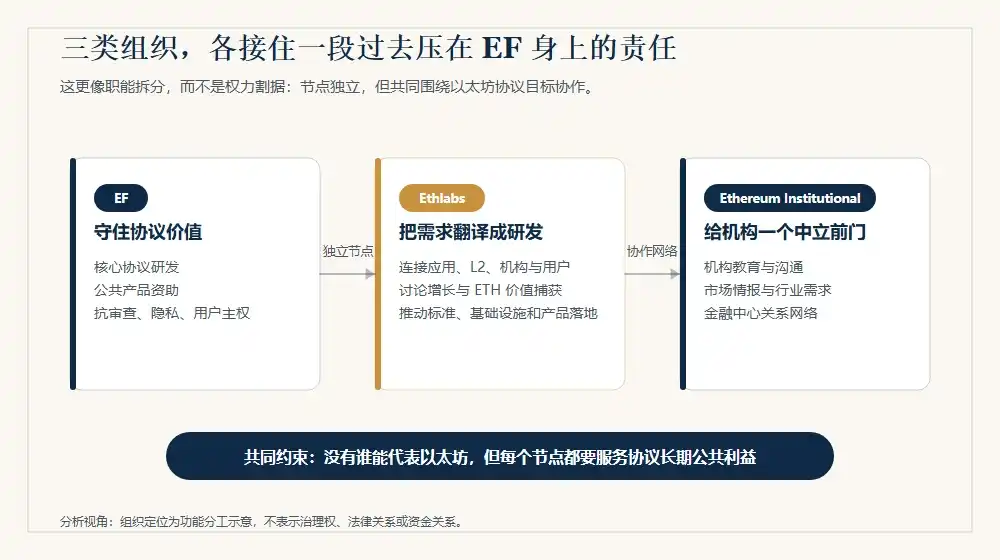
That mission highlights an important distinction from the Foundation. EF’s job is to ensure Ethereum does not compromise censorship resistance, privacy, or user sovereignty in exchange for short-term adoption or commercial gain. Ethlabs, by contrast, can speak more directly about growth, ETH value capture, institutional demand, and real-world deployment. It positions itself between wallets, applications, Layer 2 teams, infrastructure providers, institutions, and actual users on one side, and Ethereum’s protocol researchers and core developers on the other. Its purpose is to translate demand from the ecosystem’s edge into protocol work, common standards, infrastructure, and deployable products.
Ethereum Institutional: A Neutral Front Door for TradFi
The second key piece is Ethereum Institutional, which takes over a different set of responsibilities. If Ethlabs is the bridge between research and growth-oriented execution, Ethereum Institutional is the entity inheriting the business development and compliance-facing outreach that EF had been handling itself. It officially launched on July 1 and took over institutional engagement work that the Foundation’s market expansion team had been developing for more than a year.
Its central proposition is straightforward: to function as a neutral front door for traditional institutions entering the Ethereum ecosystem. That addresses a long-standing problem. When a bank, asset manager, custodian, or market infrastructure provider wants to build on Ethereum, who exactly should it call? Ethereum’s commitment to decentralization and credible neutrality has long limited the existence of a single outward-facing institutional interface, even as competing ecosystems such as Solana have maintained clearer foundations, business development teams, and partnership channels.
This has created a practical contradiction. Neutrality is a strength in governance and technical design, but in real commercial settings it can also look like there is no accountable point of contact. Institutions such as BlackRock may not expect Ethereum to have a central owner, but they still want a team that can engage over time, coordinate discussions, and help navigate the ecosystem. Ethereum Institutional is designed to solve that contradiction without claiming to represent Ethereum in a centralized sense.
According to the information disclosed so far, Ethereum Institutional was incubated with backing from Bitmine, Sharplink, and Joe Lubin, and is led by senior industry figures including former Blackstone executive Joseph Chalom. Its target audience includes banks, asset managers, custodians, market infrastructure providers, fintech firms, and sovereign institutions.
Its core work is organized around five areas:
- Institutional education and communication, helping traditional financial firms understand Ethereum’s architecture, governance, and ecosystem status.
- Institutional market intelligence, tracking adoption trends, obstacles, and best practices.
- Promotion of ETH and the broader Ethereum ecosystem to traditional finance audiences.
- Research on industry demand and standards, turning institutional requirements into standards proposals and product needs.
- Relationship building and events across financial centers such as New York, London, Hong Kong, and Singapore.
From EF-Centric Coordination to a Modular Governance Network
Taken together, these moves make Ethereum’s division of labor much clearer. EF is increasingly focused on protocol values and public-interest functions. Ethlabs focuses on converting research into growth-relevant execution. Ethereum Institutional focuses on institutional adoption. Wallets, applications, and infrastructure teams continue to own the end-user layer and product experience. What is changing is not simply personnel distribution; it is the governance topology of the ecosystem.
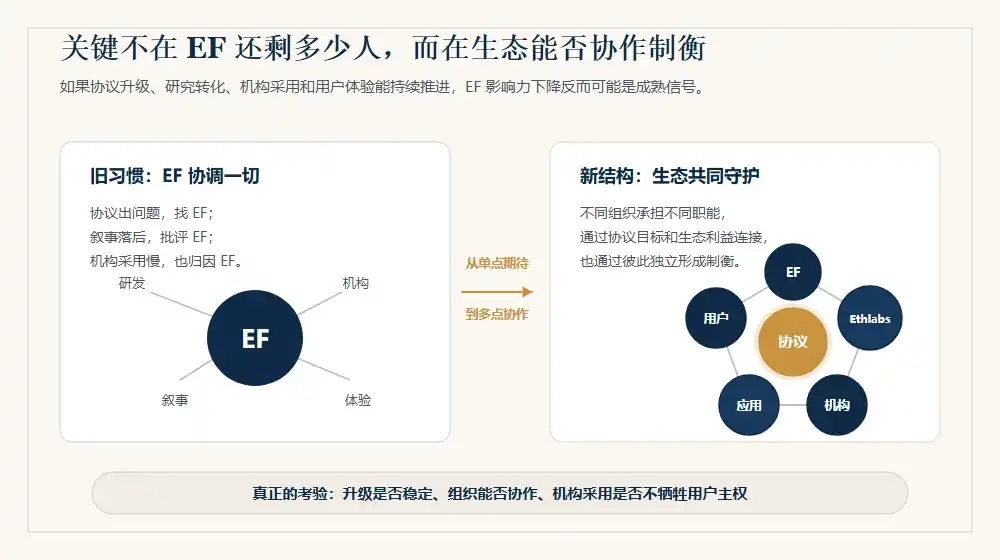
For years, Ethereum governance was open in form but still relied on EF as the place where many critical expectations accumulated. When protocol work slowed, people looked to EF. When Ethereum’s market narrative lagged, EF was criticized. When ETH underperformed, institutional adoption moved slowly, or user experience failed to improve fast enough, external observers often treated the Foundation as the final responsible party. That arrangement was always in tension with Ethereum’s stated ambition to be a decentralized network not dependent on any single organization.
A more modular structure is now taking shape. But that does not mean Ethereum has found a perfect governance model. Distributing functions across independent organizations raises coordination costs. It also introduces familiar risks: duplicated research, fragmented execution, funder influence over technical direction, and the possibility that institutional priorities could outweigh the interests of ordinary users.
Yet those risks are also part of the cost of decentralization. A genuinely decentralized protocol cannot remain permanently dependent on a single expanding foundation, nor should it lose momentum whenever a handful of core contributors change roles or leave one institution. The test of this transition will not be how many people remain inside EF. It will be whether the protocol continues to upgrade reliably, whether researchers leaving EF remain within Ethereum’s orbit, whether independent organizations can cooperate while checking one another, whether institutional adoption can expand without sacrificing openness or user sovereignty, and whether wallet and application teams can turn lower-layer progress into products people can actually use.
If those conditions are met, a reduction in the Ethereum Foundation’s relative influence may not signal weakness at all. It may instead mark Ethereum’s maturation into a more resilient ecosystem—one sustained not by a single foundation, but by a distributed network of foundations, research labs, developers, wallets, applications, enterprises, and users.