

The Ethereum Foundation has dissolved its protocol support team, a move that comes after the departure of co-executive director Wang Xiaowei and at least eight senior staff exits this year, according to the source article.
The staff changes are unfolding alongside the rise of independent nonprofit groups such as Ethlabs and Ethereum Institutional, both of which are taking on work that had been closely tied to the foundation. The article also points to recent technical progress from EF’s security team, which said it used AI agents in red-team style testing of software relied on by the Ethereum ecosystem and found a real vulnerability.
In the source article’s framing, the foundation now faces a more fragmented and demanding phase after its internal overhaul.
Protocol support team dissolved after June restructuring
The article says the Ethereum Foundation has long faced criticism inside the community over what critics describe as a rigid structure, concentrated decision-making, disputed organizational values, and token sales that affected market sentiment. It notes that Bankless founder David Hoffman had previously voiced frustration by saying he sold his last ETH position and calling on the community to build the ecosystem in its own way.
A major turning point came on June 23, when the foundation published its “new EF structure” announcement. In that post, the organization broke its work into the protocol, access, user, community, and institutional layers. It also said 54 people were laid off, equal to 20% of EF members.
The article quotes the announcement as saying, “Through this process, we gained the structure, activities, and people needed to execute the critical tasks ahead.”
Before being dissolved, the protocol support team focused on infrastructure-heavy coordination work. Its responsibilities included organizing and coordinating core developer meetings, tracking Ethereum network upgrades, supporting Ethereum Improvement Proposal progress, and running parts of the Ethereum protocol process. Those functions have now been placed under EF’s protocol layer, the article says.
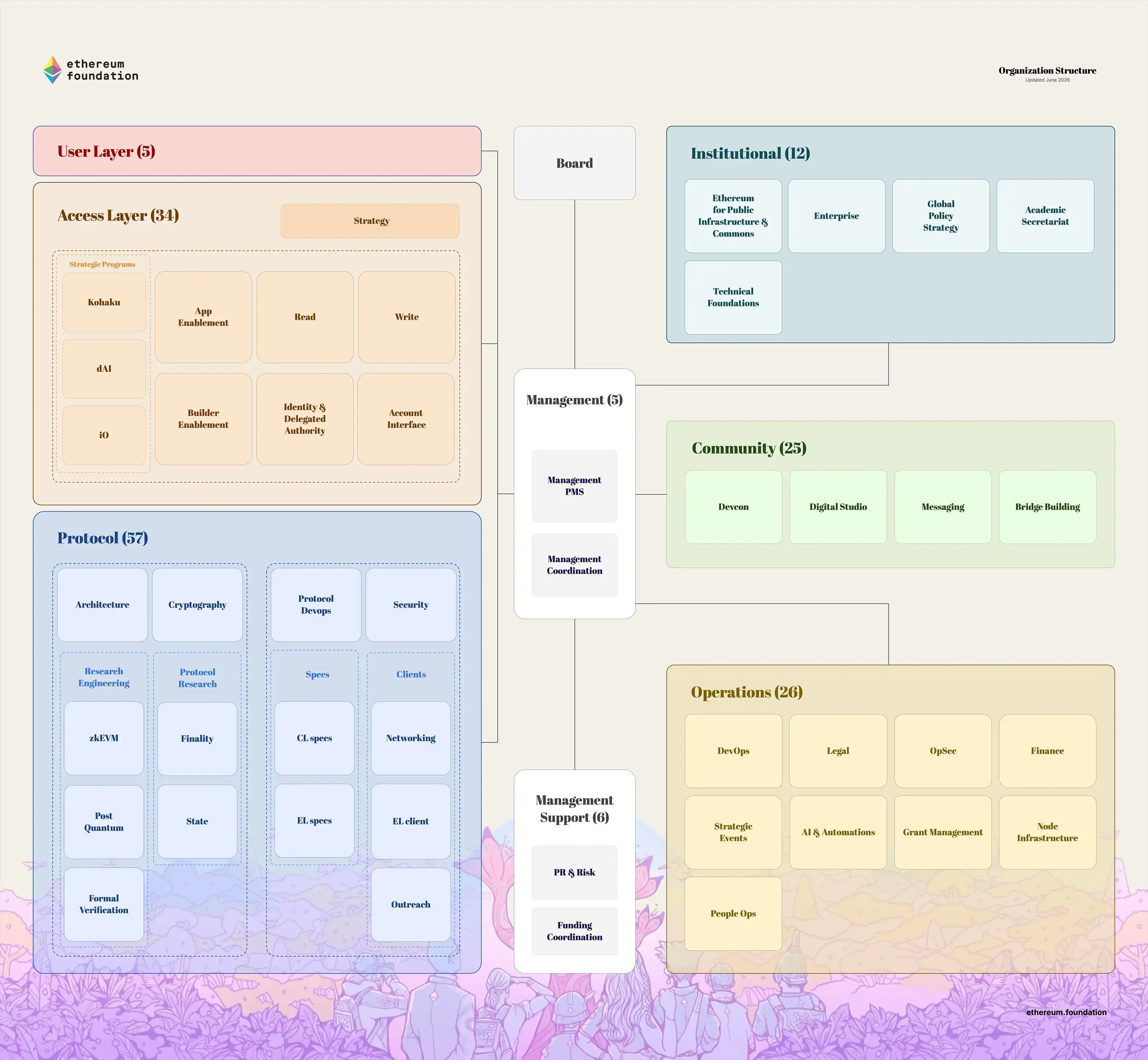
The source article describes the team’s dissolution as a key marker of organizational fragmentation inside the foundation and argues that this round of change is different from last year’s reforms pushed by Vitalik, because it involved a much broader personnel reduction rather than leadership reshuffling alone.
Ethlabs and Ethereum Institutional move in
On the same day EF announced its new structure, Ethlabs was formally introduced. The nonprofit research and development lab was founded by five former EF researchers and says its goal is to help make Ethereum the settlement layer for the global economy.
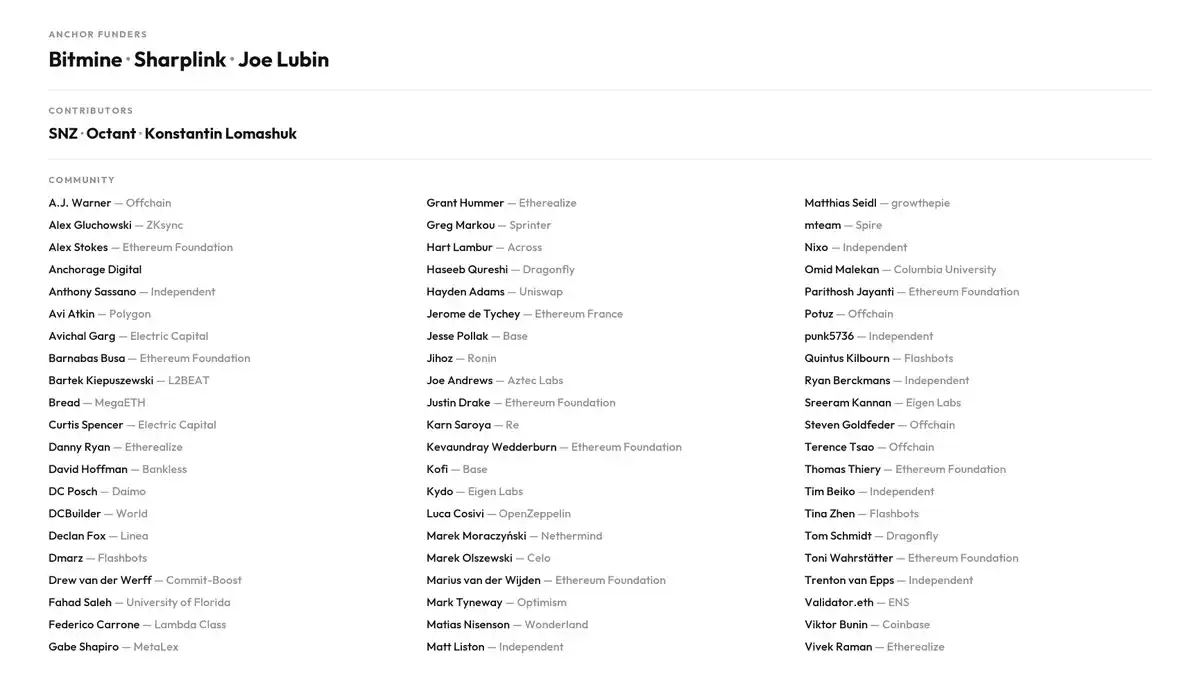
According to the article, Ethlabs has backing from Ethereum co-founder Joe Lubin, ETH treasury company BitMine, Sharplink, crypto investment firm SNZ, Ethereum ecosystem projects, independent supporters, and EF members.
Then on July 1, Ethereum Institutional was unveiled by former EF members David Walsh, Marius Smith, and Matthew Dawson. The group presents itself as an institutional Ethereum initiative focused on expanding regulated and enterprise-grade use of Ethereum, its layer-2 nodes, applications, and the broader ecosystem.
The article says Ethereum Institutional works with Ethlabs, Etherealize, and the Enterprise Ethereum Alliance. Its role is to interface with institutional demand and explain Ethereum’s value proposition to banks, while Ethlabs is more focused on turning those needs into technical products. As an independent nonprofit, Ethereum Institutional says it will provide free Ethereum-related consulting to banks and asset managers.
One week later, the organization said it had opened hiring for its core team. Roles to be filled in the coming weeks include institutional go-to-market, marketing and community operations, solution architecture, and technical project leadership.
In the article’s account, the appearance of these two independent groups, together with the shutdown of the protocol support team, marked the close of this restructuring episode while making the redistribution of functions more visible.
EF security team says AI agents found a real bug
Separately, researchers on the Ethereum Foundation’s protocol security team said in a blog post that they had deployed a set of AI agents to test software used across the Ethereum ecosystem, looking for weaknesses in cryptographic systems, protocol code, and smart contracts.
One issue found by the agents was a remotely triggerable panic problem in libp2p gossipsub, the peer-to-peer layer used by Ethereum consensus clients. The issue has been fixed and disclosed on GitHub as CVE-2026-34219.
The researchers said the AI agents were organized into specialist roles for reconnaissance, search, gap-filling, and verification. The goal was to identify potential attack paths, reproduce failures, and check whether they applied to production code. EF said AI has not replaced security researchers, but it has changed how they work by allowing the team to cover far more ground than manual review alone. At the same time, researchers now have to judge a large number of plausible-looking results more carefully.
EF’s place in Ethereum is still being renegotiated
The article looks back to January last year, when Vitalik was pushing EF reform more aggressively. By May this year, it says, his language had shifted, with the view that the Ethereum Foundation should not be the center of the ETH ecosystem and should instead follow a smaller, long-term path.
It also cites former EF researcher and Ethlabs member Ansgar Dietrichs, who said on a podcast earlier this month that “after five years of failing to break above $5,000, ETH still lacks a clear value narrative.”
The article argues that as Ethereum has grown into an asset with a market value in the hundreds of billions, the nearly 10-year-old foundation is finding it harder to stay at the center of every major task. In that reading, parts of the work tied to adoption, institutional investment, and ecosystem coordination are already being shared by Ethlabs, Ethereum Institutional, and Etherealize.