

Ethereum has undergone three major organizational developments in rapid succession over the past two weeks. On June 22, five former core researchers from the Ethereum Foundation, or EF, announced the launch of Ethlabs, an independent nonprofit R&D laboratory. One day later, EF unveiled a new internal structure and confirmed that it had ended cooperation with 54 employees, or roughly 20% of its total staff. On July 1, another independent nonprofit, Ethereum Institutional, formally went live and took over institutional engagement work that had previously been handled by the Foundation’s market development team.
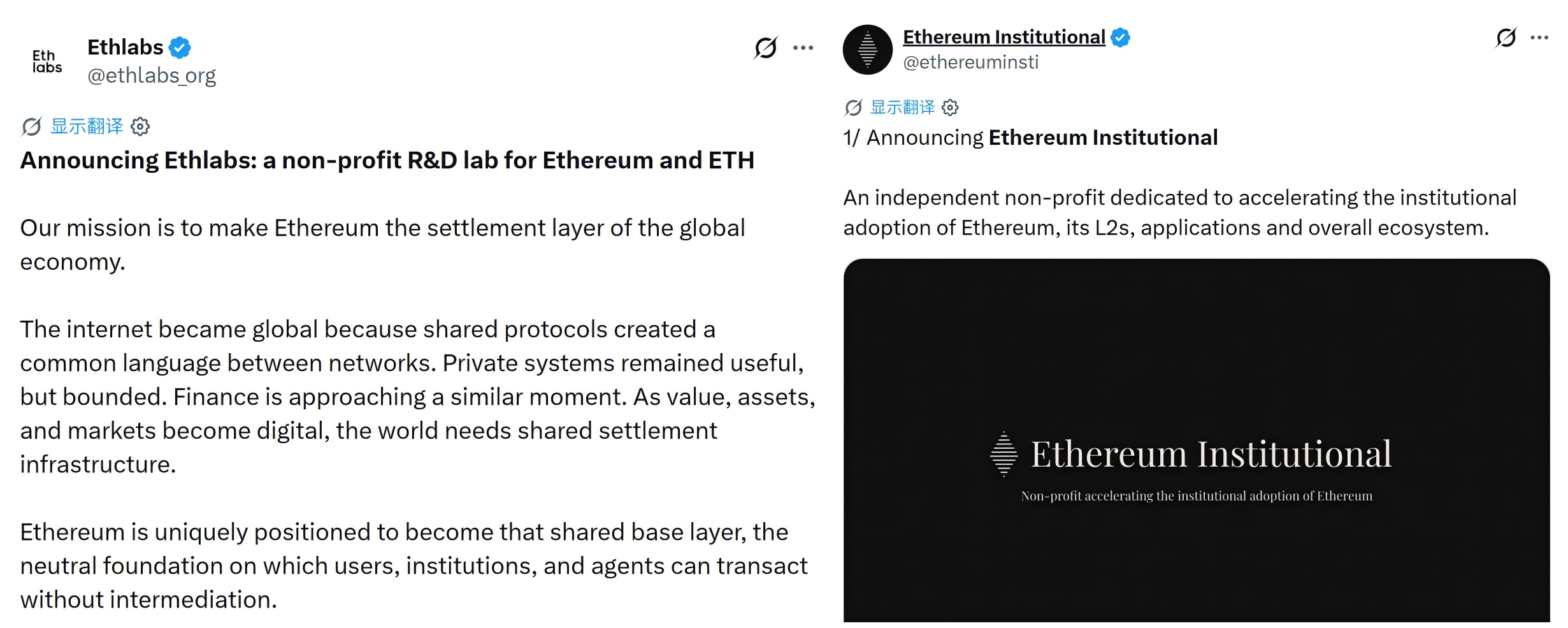
Viewed separately, these events are easy to fit into a pessimistic narrative centered on financial pressure, talent loss, or ecosystem instability. But when placed on the same timeline, they suggest something more deliberate: Ethereum is attempting to reduce structural dependence on a single foundation and distribute functions that were once concentrated inside EF across multiple independent but connected entities.
Why the Ethereum Foundation is intentionally getting smaller
In a conventional corporate setting, layoffs are usually read as signs of weakening revenue, strategic retreat, or operational failure. But EF is not a typical company. It has no traditional shareholders, does not optimize around quarterly earnings or market share, and does not “own” the Ethereum network in any practical sense. Its role is closer to that of a protocol steward: supporting core protocol research, funding public goods, coordinating ecosystem resources, and defending principles that Ethereum is not supposed to compromise lightly.
That structure creates a persistent tension. Ethereum needs long-term investment in protocol development, upgrades, and public infrastructure. At the same time, if research, funding, talent, and decision-making become too concentrated inside EF, the Foundation itself becomes one of Ethereum’s largest sources of centralization risk. This is why EF has long emphasized a subtractive organizational philosophy. In its own framing, a healthy Ethereum ecosystem should be sustained by many independent organizations and contributors, not by an ever-expanding foundation.
This approach did not emerge overnight. In its 2025 treasury policy, EF had already stated that it would gradually narrow its scope of responsibility and lower annual operating expenses over a five-year period, moving toward a more durable and sustainable foundation model. The year 2025 also brought a visible wave of internal restructuring. Aya Miyaguchi was elevated to president, Vitalik Buterin pledged leadership reform, Hsiao-Wei Wang and Tomasz K. Stańczak became co-executive directors, Danny Ryan led the creation of Etherealize as a new narrative and marketing-focused vehicle, the board was further reshaped, and the Foundation reorganized its research department to sharpen focus on core protocol priorities.
That restructuring was followed by a stronger execution cadence at the protocol level. On May 7, 2025, the Pectra upgrade was activated. Less than seven months later, on December 3, Fusaka successfully reached mainnet. EF later described 2025 as one of the most productive years for Ethereum’s protocol layer, and the back-to-back major upgrades made the long-discussed goal of accelerating hard fork cadence feel more achievable. From that perspective, the June 2026 layoffs look less like an emergency response and more like the first highly visible manifestation of a longer strategy.
Under the new arrangement, EF’s work is grouped into five primary clusters: protocol, access, user, community, and institutional, along with operations, management, and related support functions. The Foundation’s explanation is straightforward: cutting about 20% of staff is meant to concentrate resources on the work that only EF can and should do.
What Ethlabs and Ethereum Institutional are meant to do
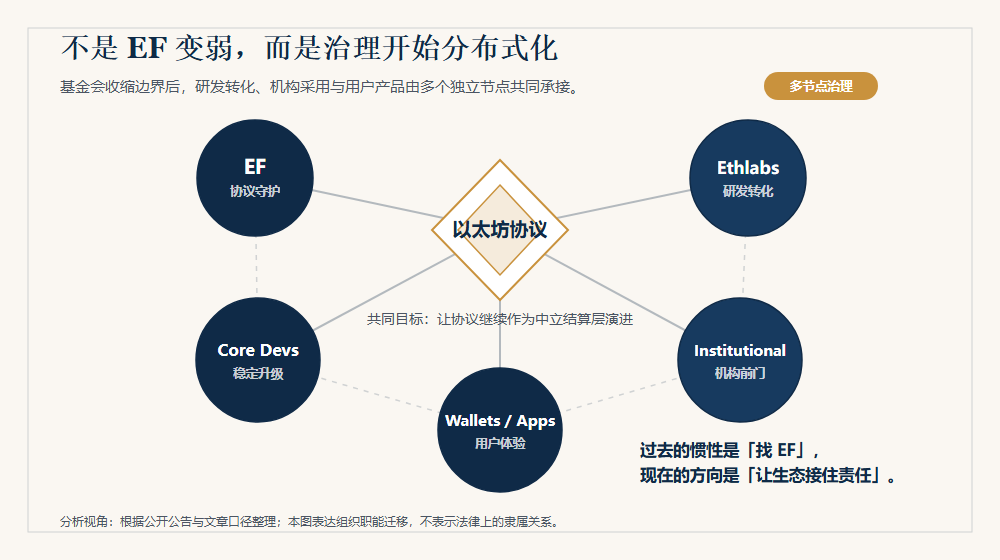
If there is a simple way to visualize the shift, it is that functions once housed under EF are now being distributed outward. But this is not a classic spinout story with parent-subsidiary lines or a fight over organizational control. EF, Ethlabs, and Ethereum Institutional are better understood as three distinct nodes within Ethereum’s broader governance network, each with a different mandate and a different operating posture.
Ethlabs was launched by five former EF researchers: Ansgar Dietrichs, Barnabé Monnot, Caspar Schwarz-Schilling, Josh Rudolf, and Julian Ma. These figures have previously contributed to areas including Ethereum finality, scaling, data availability, the virtual machine, and protocol economics. Ethlabs describes itself as an independent nonprofit R&D lab serving Ethereum and ETH, with a mission statement boiled down to one line: to make Ethereum the settlement layer for the global economy.
That framing separates it from EF in a meaningful way. EF’s role is to ensure Ethereum does not sacrifice censorship resistance, privacy, or user sovereignty in pursuit of short-term growth or commercial gains. Ethlabs, by contrast, can speak more directly about growth, ETH value capture, institutional demand, and real-world adoption. In practice, it positions itself between two worlds: on one side are wallets, applications, Layer 2 networks, infrastructure teams, institutions, and users; on the other are the core protocol, researchers, and core developers. Its purpose is to translate real demand from the first group into protocol work, shared standards, infrastructure, and deployable products.
Ethereum Institutional is a parallel answer to a different problem. If Ethlabs is taking on the research-to-growth conversion layer that EF is less suited to house internally, then Ethereum Institutional is taking over the commercial and compliance-facing outreach that the Foundation has struggled to carry as a long-term internal function. The organization officially launched on July 1 and assumed institutional engagement work previously conducted for more than a year by EF’s market development team.

Its role is framed as a neutral front door for traditional institutions entering Ethereum. The question it wants to answer is simple but increasingly urgent: when a bank or asset manager wants to build on Ethereum, who exactly should it call? Over the past several years, this gap has become more apparent. Ecosystems such as Solana have maintained clearer foundation structures, business development teams, and institutional interfaces. Ethereum, by contrast, has long emphasized decentralization and credible neutrality, which has often meant the absence of a unified external point of contact.
That reflects a deeper contradiction. Neutrality is a strength in technical and governance terms, but in commercial practice it can translate into a lack of clear ownership. When a major institution such as BlackRock wants to deploy products on Ethereum, it usually expects to meet a team that can maintain continuity in communication and execution, not a body that insists on remaining so neutral that it avoids behaving like a counterpart at all.
Ethereum Institutional is designed to address exactly that tension. No one can represent Ethereum in a sovereign sense, yet institutions still need a credible entity they can talk to over time. The nonprofit was incubated with backing from Bitmine, Sharplink, and Joe Lubin, and is led by senior industry figures including former Blackstone executive Joseph Chalom. That profile gives it immediate credibility with banks, asset managers, custodians, market infrastructure providers, fintech firms, and sovereign institutions.
According to its own materials, Ethereum Institutional’s work spans five areas:
- institutional education and communication, helping traditional financial firms understand Ethereum’s architecture, governance, and ecosystem;
- institutional market intelligence, tracking adoption trends, barriers, and best practices;
- promotion of ETH and the Ethereum ecosystem to the traditional financial world;
- industry demand and standards research, translating institutional needs into standards proposals and product requirements;
- events and relationship networks in financial centers such as New York, London, Hong Kong, and Singapore.
From “EF drives Ethereum” to a multi-node stewardship model
For years, Ethereum’s governance has been open by design, yet many critical responsibilities still flowed back to EF in practice. When protocol development slowed, people looked to the Foundation. When Ethereum’s narrative felt weak, critics blamed EF. When ETH underperformed, institutional adoption lagged, or user experience remained poor, the Foundation often became the default target of frustration. That was always something of a contradiction: Ethereum wanted to be a decentralized network that did not depend on any single organization, while the ecosystem continued to treat EF as the final accountable party.
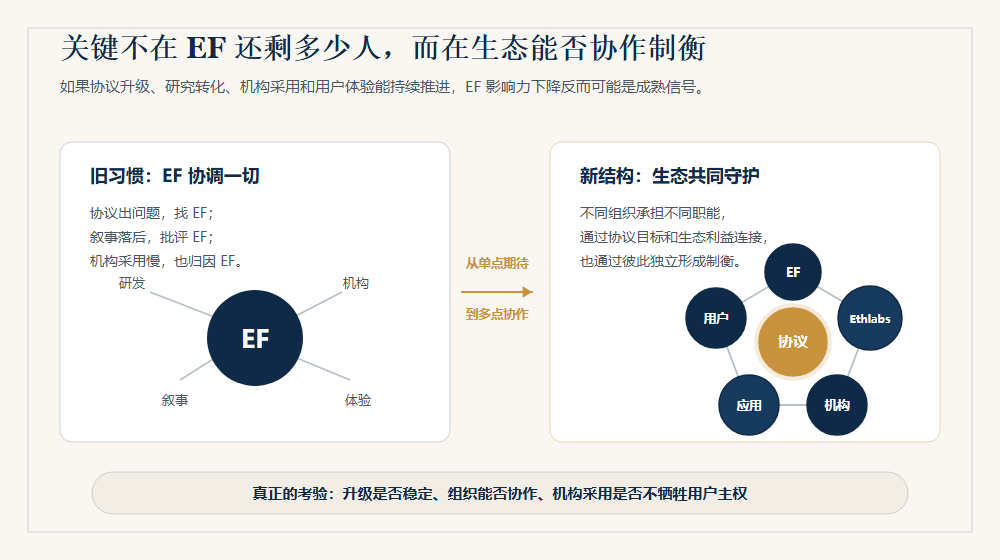
What is now emerging is a more modular structure. EF is being recentered around protocol values and public-interest responsibilities. Ethlabs sits at the boundary between research and growth-oriented implementation. Ethereum Institutional handles institutional adoption and external engagement. Wallet, application, and infrastructure teams remain responsible for turning lower-layer improvements into actual user-facing products. The broader governance model is therefore shifting from a blurry “EF coordinates everything” framework toward a distributed arrangement of specialized organizations.
That does not mean Ethereum has already discovered a perfect post-foundation model. On the contrary, the real test may only be beginning. Once functions are spread across independent organizations, coordination costs rise. There is a need to avoid duplicated research, fragmented execution, funding influence over technical priorities, and a future in which institutional adoption begins to outweigh the interests of ordinary users. A more distributed governance architecture is likely to be more resilient, but it is also more complex.
For that reason, the success of this transition should not be measured by how many people remain inside EF. The more relevant questions are whether the core protocol can continue to upgrade reliably, whether researchers leaving EF stay inside the Ethereum ecosystem, whether independent organizations can maintain both cooperation and mutual checks, whether institutional adoption can expand without compromising openness and user sovereignty, and whether wallets and applications can convert protocol progress into products that ordinary users can actually use.
If those conditions are met, then a decline in EF’s relative influence may end up being evidence of Ethereum’s maturity rather than its weakness. At that point, Ethereum would no longer resemble a young network that still needs a foundation to prop it up at every stage. It would look more like a distributed ecosystem maintained by a mix of foundations, research organizations, developers, wallets, apps, enterprises, and users. In that sense, Ethereum’s governance structure is beginning to look more like Ethereum’s own network architecture.