

Ethereum’s recent debate has moved beyond scaling. The focus now is what the protocol should preserve at its core over the next decade.
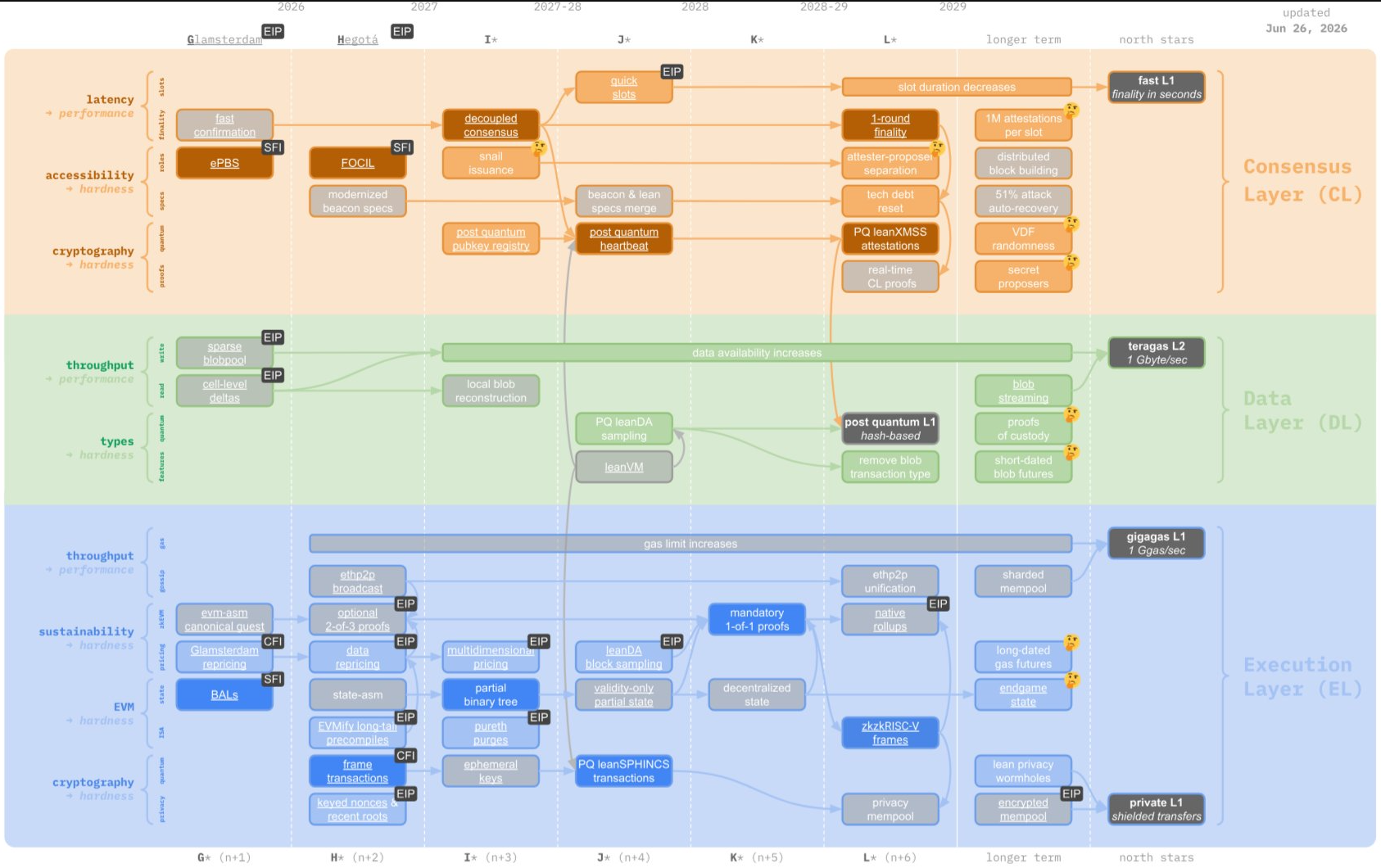
On July 4, Vitalik Buterin revisited the main direction of Lean Ethereum using an updated long-term roadmap and described it as Ethereum’s “third major iteration” after The Merge. At the same time, research on 0x02 compounding validators added another signal: for smaller stakers, a native compounding mechanism could deliver about a 5% relative increase in consensus-layer APR.
Set side by side, those developments point to a broader reset in how Ethereum is thinking about its future. The network is reworking its organizational structure, its protocol base, and its staking reward model around a common goal: a system built to run for the next 10 years and beyond with more distributed responsibility, easier verification, and a more sustainable return structure.
From one foundation to several responsibility centers
For years, outsiders have tended to treat the Ethereum Foundation, or EF, as a stand-in for Ethereum itself. Protocol upgrades, research priorities, ecosystem grants, and external communication often led back to the same question: what is the EF going to do?
But the EF is not a conventional company. It does not have shareholders in the usual sense, it does not target market share or quarterly profit, and it does not literally own the Ethereum network. That leaves it in a persistent tension. Ethereum needs a long-term steward for protocol R&D, upgrade coordination, and public goods. Yet if research, capital, talent, and decision-making become too concentrated inside the foundation, the EF itself can turn into Ethereum’s largest centralization risk.
Recent changes appear designed to push against that dynamic. In its latest round of adjustment, the EF reduced staff by about 20% and refocused internal work around different layers including protocol, users, and institutions. By the foundation’s own description, the goal is to become “leaner” and “more focused,” prioritizing the core work that only the foundation can and must handle.
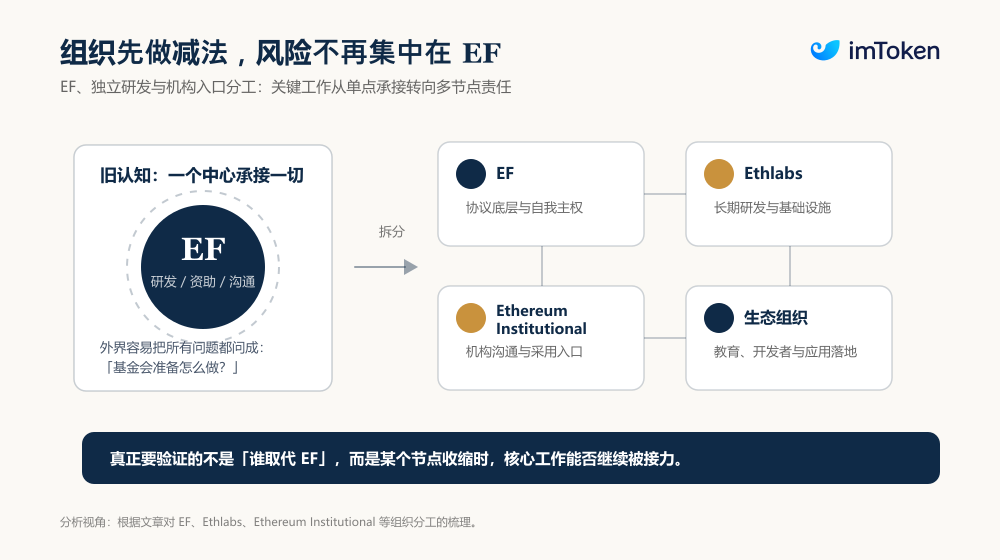
Some capabilities that had been housed inside the EF are also moving outward to independent groups.
- On June 22, five former core Ethereum Foundation researchers said they had formed Ethlabs, an independently operated nonprofit R&D lab for protocol research, infrastructure, and institution-grade technical needs.
- On July 1, another independent nonprofit, Ethereum Institutional, officially launched and took over institutional partnership work previously handled by the EF’s market development team, becoming a dedicated interface for traditional financial institutions entering the Ethereum ecosystem.
The two groups split along technology research and institutional adoption, creating a more specialized division of labor. In practice, Ethereum is trying to separate research, ecosystem, and market functions that once sat in a single organization into several relatively independent responsibility nodes. Under that arrangement, the EF is more tightly focused on the protocol base and self-sovereignty, Ethlabs handles long-horizon research, Ethereum Institutional covers institutional communication, and other groups continue to work on education, developer support, and application deployment.
This model raises coordination costs. Different organizations do not share identical funding sources, priorities, or execution tempo, and future disagreements over direction or competition for resources remain possible. Still, a decentralized protocol that relies on one foundation for nearly all key work carries its own structural risk.
The question, then, is not who replaces the EF. It is whether Ethereum can build a cooperative structure in which core functions continue even if one organization shrinks, shifts direction, or disappears.
Lean Ethereum is being elevated, not introduced
Strictly speaking, Lean Ethereum did not appear for the first time this week. Back in July 2025, Ethereum Foundation researcher Justin Drake laid out a 10-year “lean Ethereum” vision built around Lean Consensus, Lean Execution, and Lean Data. The stated targets were to scale base-layer throughput to 10,000 transactions per second and L2 throughput to 10 million transactions per second while preserving decentralization and 100% uptime.
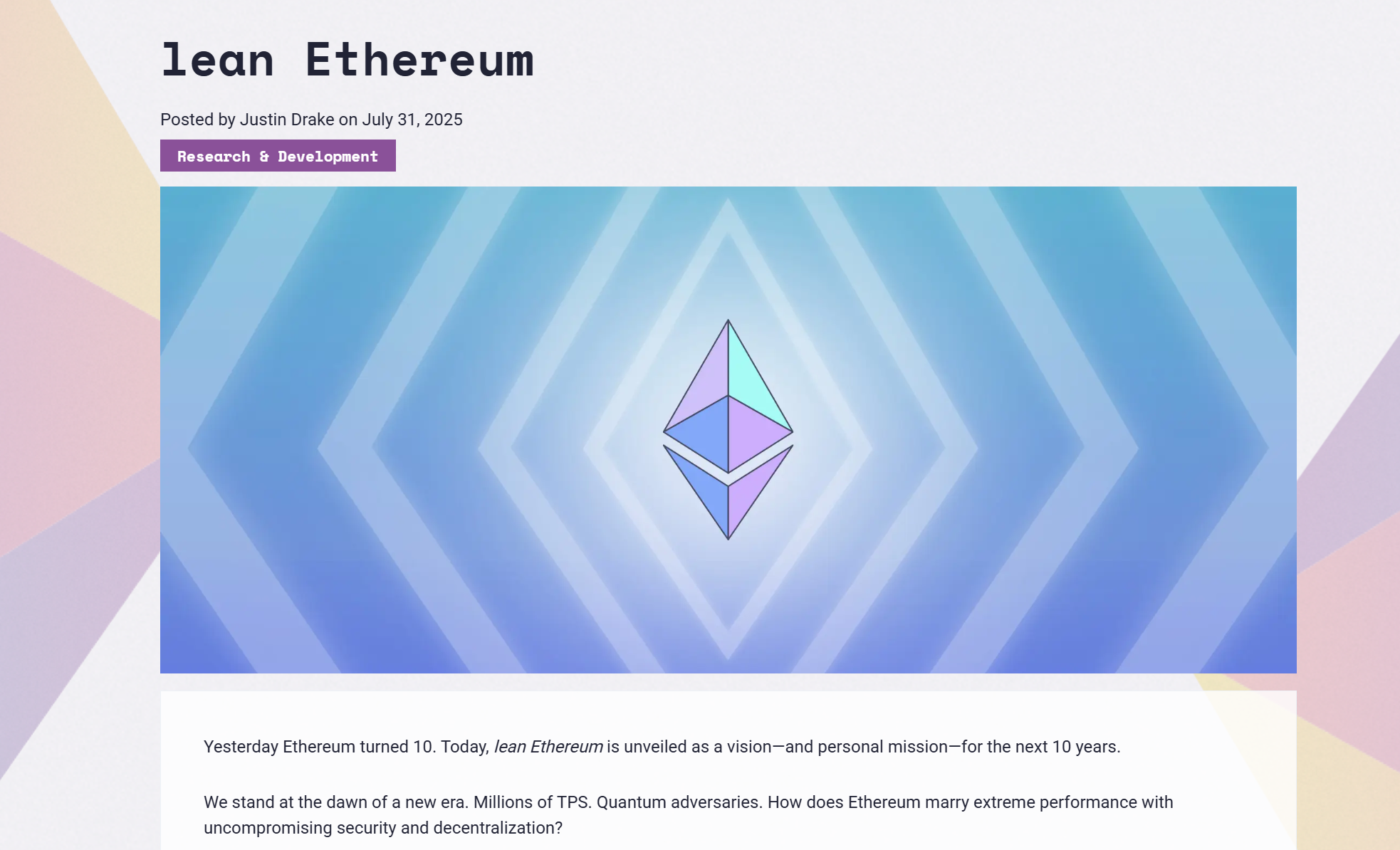
That earlier vision already called for major upgrades across the consensus, data, and execution layers, including a Beacon Chain 2.0 upgrade, post-quantum blobs 2.0, and a possible EVM 2.0 based on the open-source RISC-V instruction set. On the cryptography side, the design would rely entirely on hash-based signatures, Merkle-style data commitments, and a native hash-based zero-knowledge virtual machine to achieve quantum resistance.
What changed this week is the weight attached to those ideas. Based on the latest strawmap, Buterin moved these lines of research into a clearer and more central place in Ethereum’s roadmap. In his framing, Lean Ethereum is not a one-off hard fork. It is a set of changes that would arrive gradually over the next three to four years, and together they make up Ethereum’s “third major iteration.”
Protocol simplification, quantum resistance, privacy, and lighter verification
By Buterin’s summary, Lean Ethereum reaches into nearly every core part of the protocol.
One major direction is simplification at the protocol level, shifting from heavy execution toward light verification. Recursive STARKs would become a core native component, with proof verification replacing direct transaction re-execution. Client architecture, the state model, and multidimensional gas design would change alongside that shift, with the aim of making the protocol leaner and easier to verify formally.
Another direction is the reprioritization of quantum resistance. Quantum safety is no longer being treated as a distant issue. Existing cryptographic components seen as vulnerable to quantum computing would be replaced gradually with post-quantum alternatives, while quantum-safe design for blobs has been marked as an urgent item.
Privacy is also being moved into the protocol’s first tier of goals instead of being treated as something the application layer needs to bolt on later. New designs for frames, the mempool, and the state tree would support quantum-safe private transactions without intermediaries.
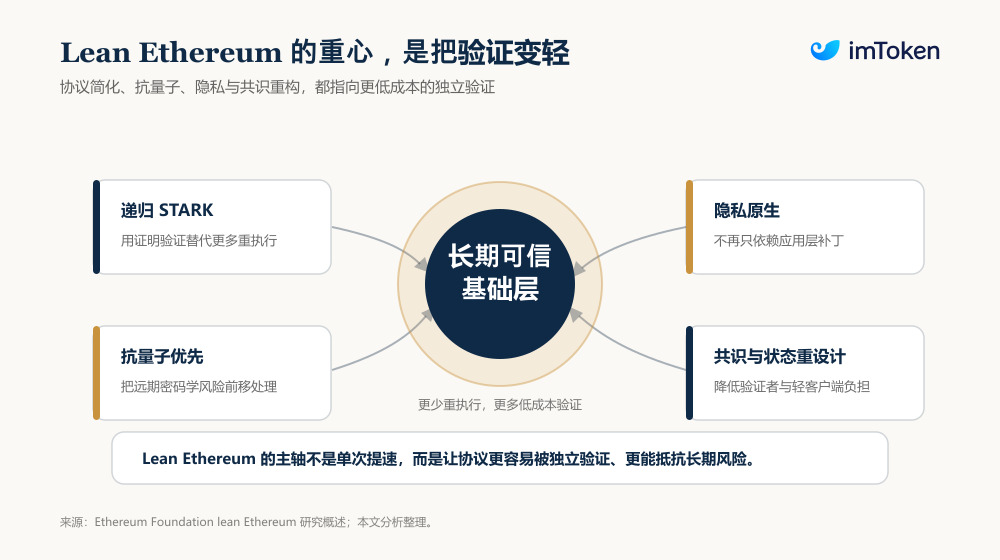
On the consensus side, the roadmap would try to decouple block availability from finality. The target is second-level finality, or final confirmation in one to two voting rounds. At the same time, a redesigned state structure combining dynamic state with new scalable state types would reduce the burden on validators and light clients.
The individual pieces are broad, but the logic under them is straightforward: concentrate computation and complexity among a smaller set of nodes that generate proofs, and let a wider set of participants verify outcomes at lower cost.
That marks a change in emphasis. Ethereum is no longer presenting short-term TPS gains or L2 compatibility as the only organizing story. It is putting the focus back on the protocol as long-term trusted infrastructure, with verifiability, censorship resistance, quantum resistance, privacy, and light verification at the center.
0x02 validators aim to reduce the compounding gap for smaller stakers
The discussion around 0x02 compounding validators fits into the same longer time horizon.
For a long time, ETH staking conversations have centered on APR and DeFi-based yield strategies. Under the traditional 0x01 model, each validator has an effective balance cap of 32 ETH. Consensus-layer rewards above 32 ETH are periodically swept out rather than kept in stake.
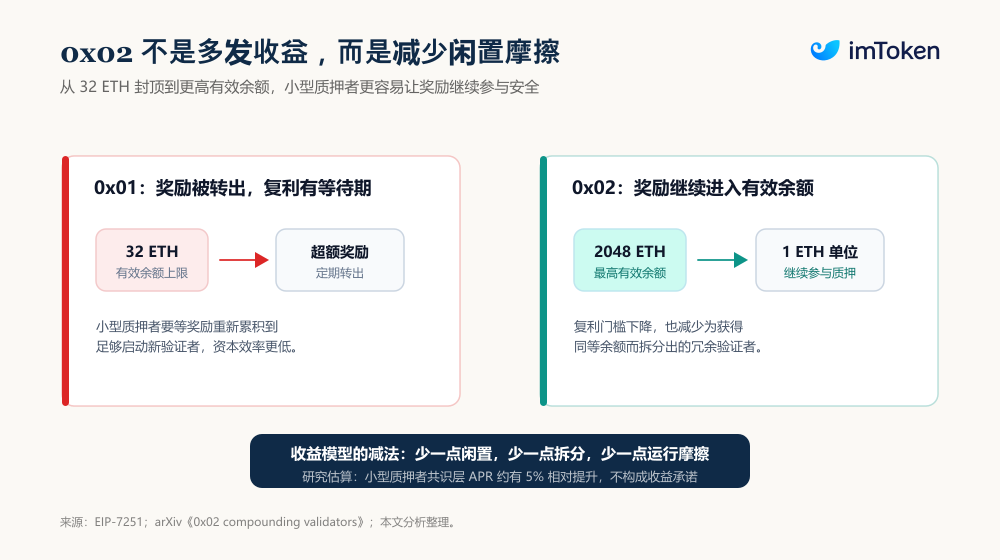
That creates a natural disadvantage for smaller stakers. If someone runs only one validator or a small number of validators, rewards must accumulate all the way back to 32 ETH before a new validator can be started and begin earning again. Large providers, by contrast, can aggregate rewards across many validators and launch new nodes much faster.
Pectra’s 0x02 mode changes that setup. It raises the maximum effective balance for a single validator to 2048 ETH and allows rewards to continue compounding in 1 ETH increments. That lowers the threshold for small stakers to achieve compounding, narrows the capital-efficiency gap between participants of different sizes, and also reduces redundant validators and network operating load.
Research cited in the discussion says the native compounding mechanism could improve consensus-layer APR by about 5% on a relative basis for smaller stakers.
That should not be read as a simple claim that the validator set will become more decentralized in headcount terms. A more precise description is that 0x02 improves operational efficiency for the validator set at the protocol level while also improving the capital efficiency and relative position of smaller stakers, allowing participants of different sizes to access native protocol yield with less friction.
Three shifts, one question about Ethereum’s next decade
From the EF’s downsizing, to the emergence of independent groups such as Ethlabs and Ethereum Institutional, to Lean Ethereum’s renewed emphasis on simplification, quantum resistance, privacy, and light verification, and then to 0x02 validators turning staking rewards from periodic outflows into a more sustainable form of reinvestable native income, these are not isolated developments.
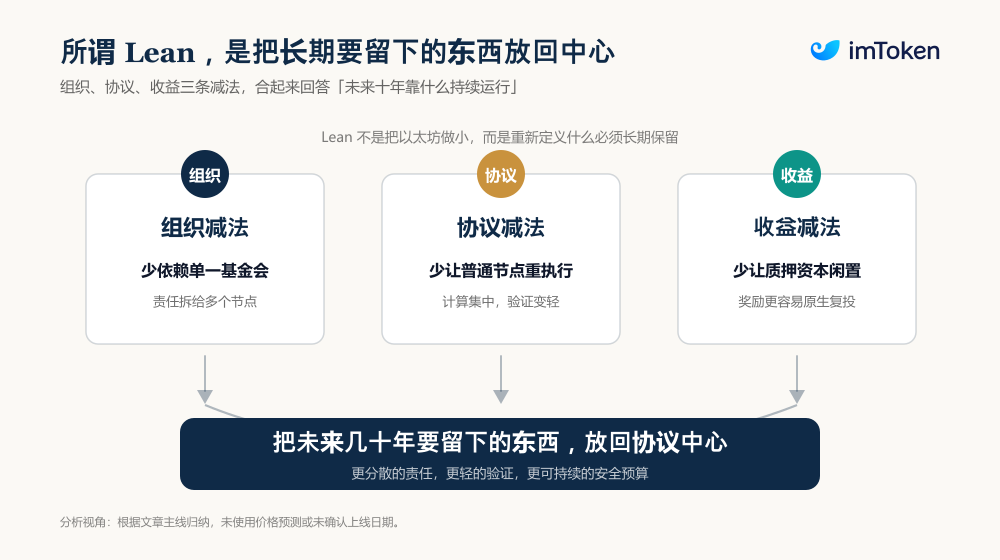
They all reduce something. Dependence on a single organization. The cost ordinary participants bear to verify the protocol. Idle capital and duplicated overhead in staking operations.
In return, Ethereum is trying to build a more distributed responsibility system, a base protocol that can be independently verified more easily, and a reward structure better suited to long-term holders and participants securing the network.
None of this is likely to act as an immediate price catalyst. Lean Ethereum may take three to four years or longer to roll out. The new organizational structure still has to show that multi-node coordination will not turn into strategic fragmentation. And the compounding advantage for 0x02 validators will take time to show up across a full cycle.
Still, the next phase of Ethereum is not only about whether it can keep shipping upgrades. As the value carried by the protocol grows and the outside environment becomes more complex, the harder test is whether it can rely less on any single organization, become easier for ordinary devices to verify, and offer a steadier, more sustainable long-term return for capital participating in network security.
In that sense, “lean” does not mean making Ethereum smaller. It means putting back at the center the things the protocol needs to preserve for decades.