

Vitalik put the phrase "crypto world computer" into Ethereum’s endgame vision on Sept. 27. Two days later, Aztec, an Ethereum-based privacy-first Layer 2, restarted zk.money after a three-year pause. That sequence quickly pushed Ethereum privacy back into the market conversation.
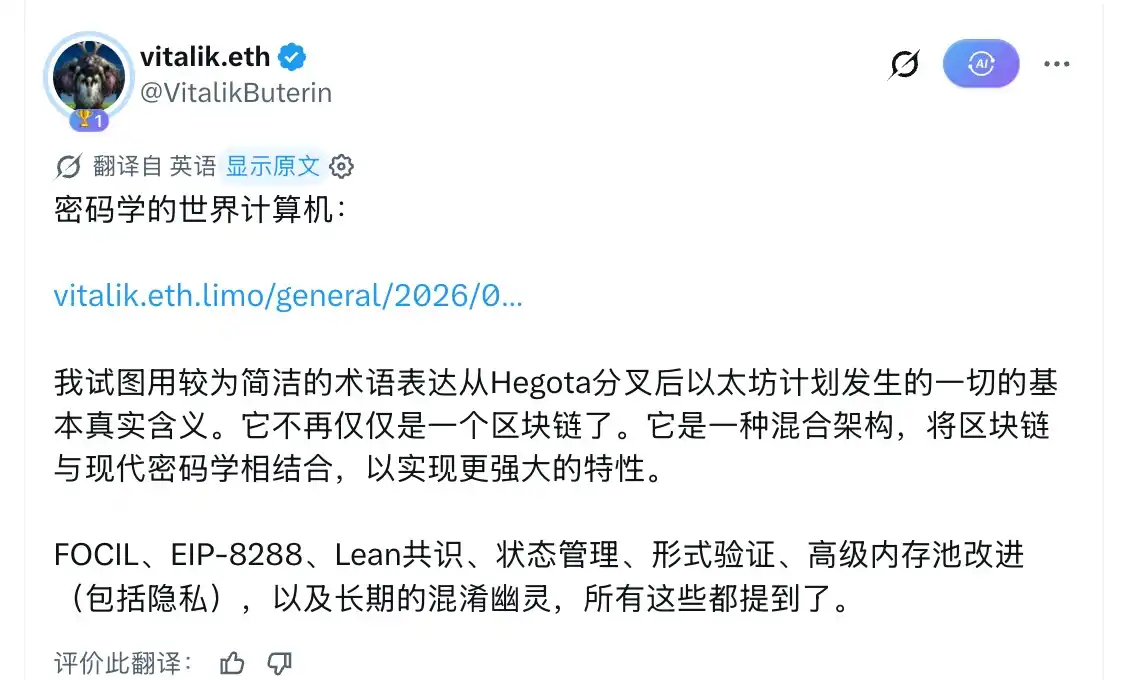
According to the MarsBit article written by Claude for TechFlow, the privacy thesis inside Ethereum has shifted away from older standalone privacy coins. The focus now is on folding DeFi positions, smart contracts and stablecoin payments into Ethereum’s main architecture. In that race, the article singles out AZTEC, RAIL and ZAMA as the three most important names to watch.
zk.money gives users a visible privacy entry point again
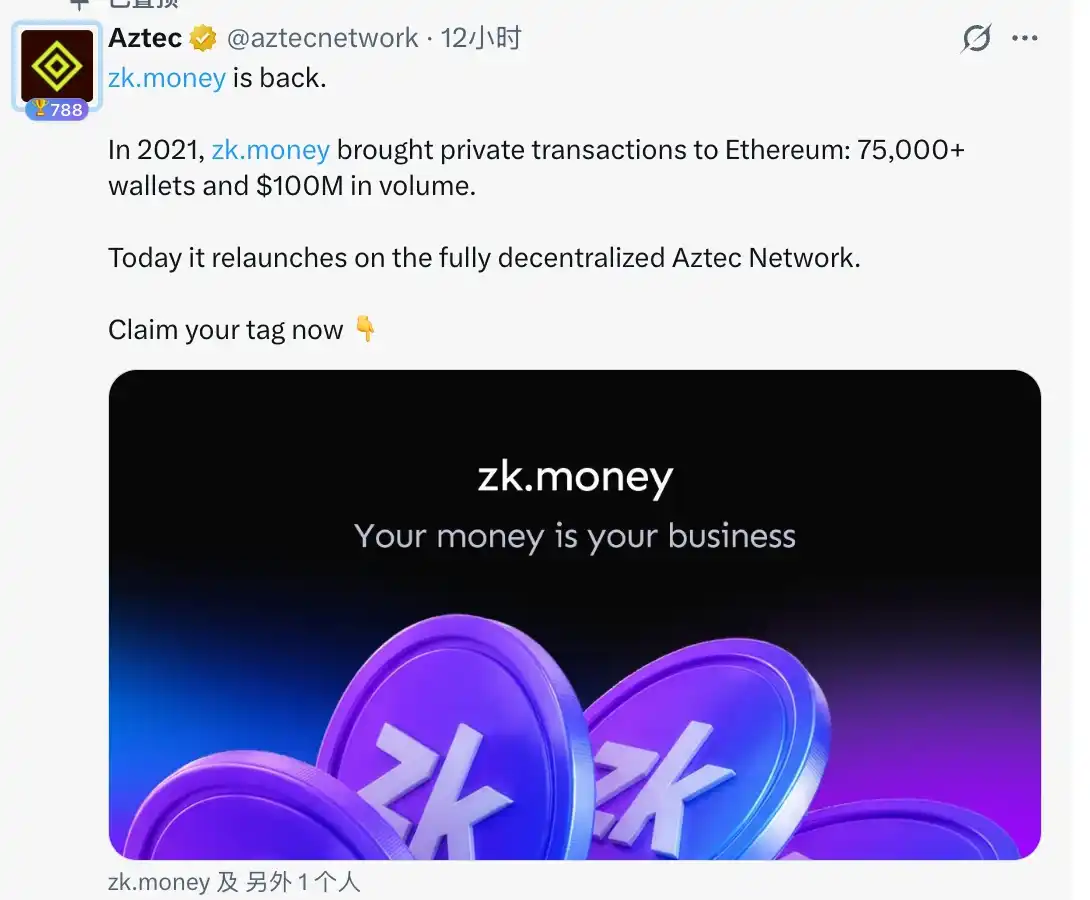
The article describes the new zk.money as the most direct catalyst for the theme. Running on Aztec’s Layer 2, it lets users send transfers through readable labels such as bob.zk.money. On Ethereum’s public ledger, the balance, flow and counterparty for those funds are hidden, according to the report.
For long-time users, the restart marks a return with clear ambition. During its 1.0 phase from 2021 to 2023, zk.money handled more than 75,000 addresses and over $100 million in transaction flow, the article said. The current version, however, comes with strict compliance limits: each transfer is capped at $2,500, the network-wide daily deposit limit stands at $50,000, and traces from assets bridged in from Ethereum mainnet remain fully visible.
The contrast is sharper in the network data cited in the piece. Aztec has already built a decentralized skeleton of more than 3,100 sequencer nodes with over 580 million AZTEC staked, yet its actual total value secured, or TVS, is still only in the range of several thousand dollars. The article’s conclusion is straightforward: Aztec has shown that Ethereum-native privacy can work at the engineering level, but there is still a wide gap before it could serve as a settlement layer for large institutional flows.
AZTEC: closest to the news, still priced on future expectations
AZTEC is presented as the token most directly tied to the headline event. It also carries the most narrative sensitivity and the thinnest current fundamentals.
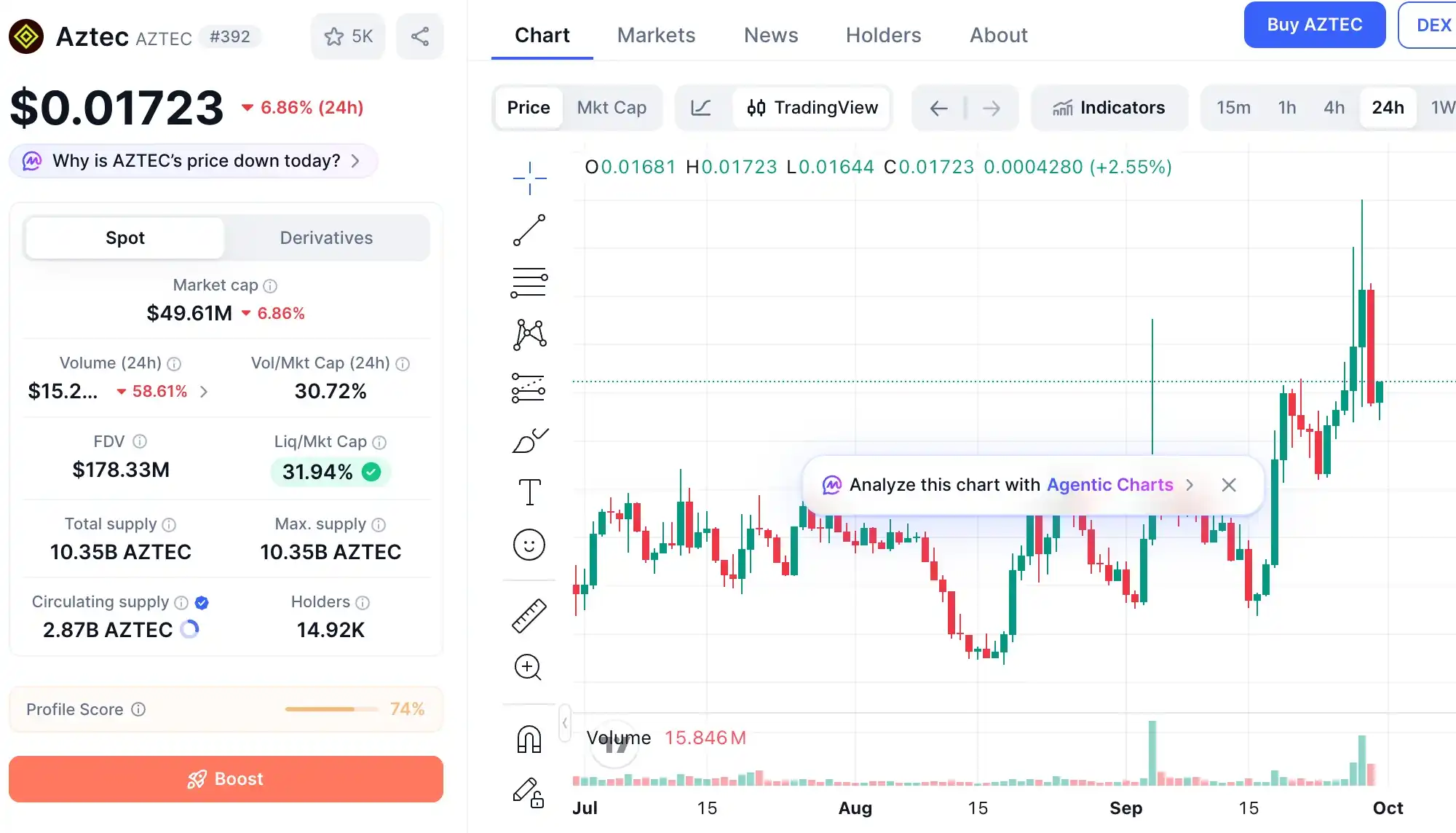
The article puts AZTEC’s circulating market capitalization at about $50 million, a notable discount to its public auction valuation from early 2026. On the day the news landed, the token did not surge and instead pulled back with the broader market. In the article’s reading, traders are valuing it as an option on an early Alpha network rather than as a mature Layer 2.
On value capture, AZTEC currently has no buyback mechanism. Its main uses are sequencer staking and governance, with a single-node staking threshold of 200,000 AZTEC. First-year network rewards imply annual inflation of about 2.41%. The design aims to offset that through fee burning, referred to as Fee Juice, but with current usage still very low, deflation remains theoretical. The article says that holding AZTEC is effectively a bet that private DeFi can keep capital on the Aztec chain long enough for staking demand to outweigh unlock-related selling pressure.
RAIL and ZAMA offer two different business models
For investors unwilling to rely only on AZTEC’s early-stage profile, the article points to RAIL and ZAMA as more mature comparisons inside Ethereum’s privacy segment. Each represents a different commercial route.
RAIL: a privacy plug-in with active fee distribution
RAIL, or Railgun, does not require users to move onto a new chain. Instead, it adds a shielding pool on top of DeFi activity on Ethereum mainnet or existing Layer 2 networks. The article says the project currently has about $100 million in real TVL. It also stands out as one of the few projects in the segment that has already built a revenue-sharing model: moving funds in or out of the shielding pool carries a 0.25% fee, and 4.2% of treasury income is distributed to locked stakers every two weeks.
At a circulating market capitalization of roughly $150 million, RAIL offers what the article calls a real fee moat. The trade-off is heavier friction when capital enters or leaves the system.
ZAMA: a confidential computing layer built on FHE
ZAMA takes the fully homomorphic encryption, or FHE, route. Its goal is to let smart contracts compute while data remains encrypted. The article argues that this is closer than simple wallet privacy to the kind of "strong privacy for dedicated applications" that Vitalik has described.
On token mechanics, the report says 100% of protocol fees are burned, though annual inflation still runs at about 5%. ZAMA’s circulating market capitalization has already moved above $230 million, with fully diluted valuation reaching the $1.1 billion range. The article calls it the highest-quality narrative chip among the group, but says price has already pulled a meaningful part of those expectations forward, while fee burn has not yet caught up with issuance.
The article warns against treating ZEC and XMR as Ethereum infrastructure plays
The piece also flags what it sees as the easiest trading mistake in the current setup: chasing large privacy coins as if they were direct proxies for Ethereum’s privacy buildout.
It notes that the privacy sector’s market capitalization expanded from $12 billion to $36 billion in mid-2026, with ZEC and XMR leading that move. But their pricing logic was different. The article describes them as independent hedge currencies tied to anxiety over broad surveillance, and says ZEC also benefits from a strong compliant capital channel through a U.S. spot ETF.
ZEC and XMR cannot run smart contracts and cannot plug into Ethereum DeFi without friction. In the article’s framing, once Vitalik defines privacy as a component of Ethereum’s main architecture, the market starts looking for lower-layer execution rights such as AZTEC and middleware such as RAIL, not standalone stores of value. Folding ZEC into Ethereum’s upgrade narrative, it argues, is a category error.
The narrative is in place, but onchain confirmation is still missing
The article ends by saying that Vitalik’s post and zk.money’s relaunch have moved privacy from a slogan to an engineering theme inside Ethereum. That does not mean the trade is automatically ready. It suggests two gauges to watch: whether more industry participants begin talking up the catalyst, and whether dashboards for AZTEC, RAIL and ZAMA show sustained growth in TVL and revenue.
Until those onchain signals show up, the article characterizes the current setup as a call option with premium-driven volatility.