

A new Ethereum power structure is emerging
On July 1, Ethereum Institutional announced its launch, consolidating Ethereum Foundation marketing efforts into a dedicated organization focused on pitching Ethereum’s tokenization and stablecoin capabilities to banks and asset managers. Only days earlier, Ethlabs had also surfaced as a new force in the ecosystem. The group was formed by five former senior Ethereum Foundation researchers and is focused on two core priorities: improving on-chain settlement efficiency and strengthening the broader monetary narrative around ETH.
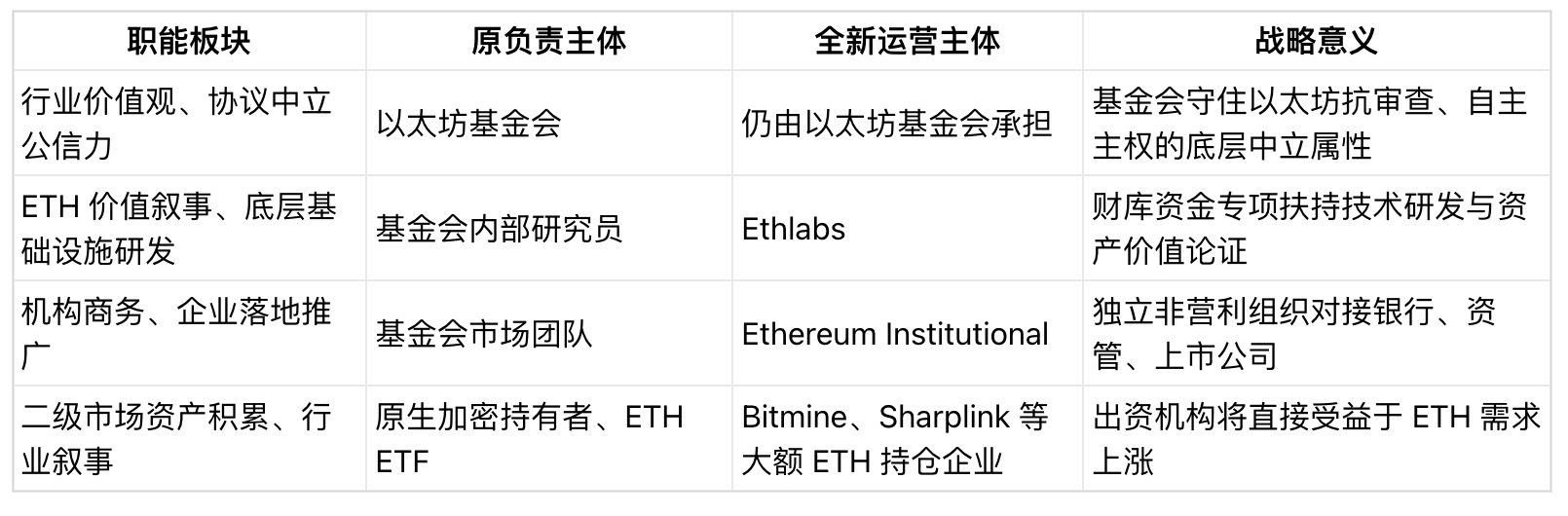
These launches are not isolated organizational developments. They represent a more deliberate redistribution of responsibilities across the Ethereum ecosystem. Back in March 2026, the Ethereum Foundation published a revised functional charter that sharply narrowed its own identity. Rather than presenting itself as Ethereum’s parent company or ultimate decision-maker, the Foundation framed its role as defending sovereign user rights, censorship resistance, open-source development, privacy, and security. In practice, that left a commercial vacuum, and that vacuum is now being filled by external institutions.
The result is a three-center structure. The Ethereum Foundation now anchors legitimacy, protocol values, and long-term stewardship. Ethlabs is positioned around technical development and the logic of ETH value capture. Ethereum Institutional is tasked with business development, institutional messaging, and corporate relationship management. The practical advantage is clear: Ethereum can separate neutral stewardship from explicitly commercial work. The trade-off is equally clear: influence over Ethereum’s market-facing narrative is shifting away from the Foundation and toward independent operators.
Leadership turnover accelerated the handoff
The timing matters. The emergence of these new groups coincides with ongoing executive turnover inside the Ethereum Foundation. On June 18, co-executive director Hsiao-Wei Wang announced her departure. Earlier, Tomasz Stańczak had already submitted his resignation. Over the previous five months, at least eight senior executives are reported to have left the Foundation. For an organization that increasingly defines itself through neutrality and public-good stewardship, such departures reinforce the idea that commercialization will no longer be managed directly from inside the Foundation.
That makes the division of labor more significant. Ethlabs appears to be taking over the infrastructure and narrative layer needed to reduce institutional hesitation around Ethereum. Its mandate is not merely engineering in a narrow sense. It also includes constructing a coherent framework for ETH as a monetary asset, something increasingly important in a market where institutions care not just about blockspace, but about long-term reserve assets, collateral quality, and settlement credibility.
Ethereum Institutional, by contrast, is outward facing by design. It is responsible for relationship-building, industry events, institutional education, and custom business outreach. In other words, Ethlabs addresses whether Ethereum can satisfy institutional-grade operational and settlement demands, while Ethereum Institutional addresses whether those institutions can be converted from interest into actual capital deployment. This separation solves a longstanding credibility problem: a neutral standards-oriented foundation cannot simultaneously function as a promotional arm and enterprise sales team without undermining its own public standing.

The funding base reveals where influence now sits
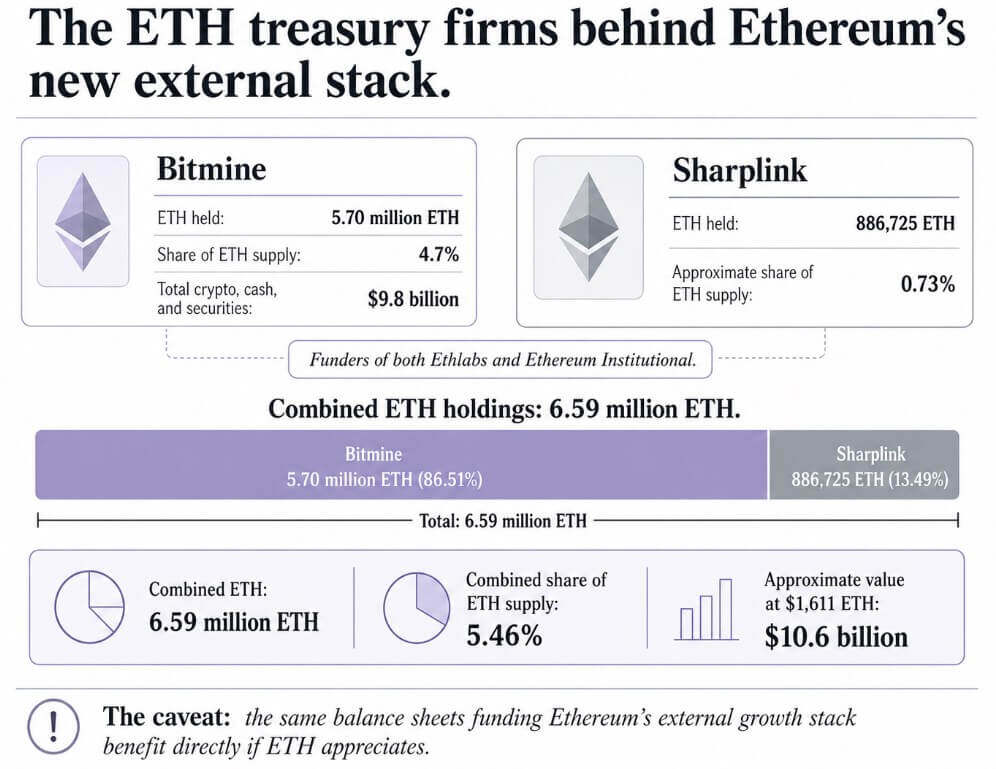
The key issue is who is financing this new structure. Ethlabs and Ethereum Institutional are backed by Bitmine, Sharplink, and Ethereum co-founder Joe Lubin. That matters because the leading corporate supporters are not passive donors. They are extremely large ETH holders whose financial outcomes are tightly linked to Ethereum’s market success. The same entities supporting institutional expansion also stand to benefit materially if improved infrastructure and stronger institutional adoption increase ETH demand.
Ethereum Institutional has already highlighted the scale of its network. According to its own disclosures, the team has engaged with more than 500 top-tier banks, global asset managers, sovereign funds, custodians, and market infrastructure service providers. Its Ethereum institutional summit reportedly brought together more than 150 senior financial executives from organizations representing a combined $250 trillion in assets under management. That level of access helps explain why these functions were split out rather than kept as a supporting unit under the Foundation. This is no longer routine ecosystem development. It is strategic market infrastructure for channeling institutional attention and potentially institutional money.
Holding data makes the concentration even more striking. Bitmine currently holds 5.7 million ETH, equal to 4.7% of total circulating ETH supply. Including cash and marketable securities, its total asset base is reported at $9.8 billion. Sharplink holds 886,725 ETH and, on June 28, added another 10,000 ETH at an average price of $1,611. Combined, the two companies control 6.59 million ETH, representing 5.46% of the 120.7 million circulating supply. At current prices, that stake is worth nearly $10.6 billion. Bitmine’s own market capitalization stands at $6.55 billion, while Sharplink’s exceeds $1 billion.

In practical terms, Ethereum has addressed one execution problem by creating another structural dependency. Commercial expansion can now proceed faster through specialized external entities, but the channels that shape Ethereum’s institutional image are increasingly influenced by balance-sheet-heavy ETH whales. The ecosystem gains convenience and focus, yet gives up some distance between public-interest stewardship and holders with direct market exposure.
Institutional success still depends on scaling and cost improvements
No amount of messaging can substitute for infrastructure. If this new model is going to work, Ethereum must continue proving that it can support large-scale settlement, tokenization, and compliant financial activity at acceptable cost. On that front, the data has improved. PeerDAS is already live and is expected to increase data availability capacity for layer-2 networks by roughly 10x. The next major step, Glamsterdam, is planned for the second half of 2026 and is intended to advance base-layer scaling, parallel transaction processing, and larger block payloads.

A June 2026 academic report suggested meaningful progress. According to the report, combined transaction throughput across Ethereum mainnet and layer-2 networks has doubled. Median mainnet fees have fallen from above $2 to below $0.02, while layer-2 fees have dropped by more than 95% to as low as $0.0015. For institutions considering stablecoin settlement, tokenized real-world assets, or high-volume transfers, those figures matter more than abstract ecosystem narratives.
At the same time, the report’s longer-term outlook was restrained. It argued that before 2034, Ethereum mainnet throughput may still remain below 100 transactions per second. It also suggested that layer-2 throughput would not surpass Solana until March 2029, although by then layer-2 fees would likely be far lower than the competitor’s. This distinction is important. Ethereum’s institutional case does not rest on winning a simple TPS race at the base layer. It rests on whether the combined architecture of mainnet plus layer-2s can deliver standardization, reliability, and low-cost settlement at scale. That is exactly the domain Ethlabs is expected to address.
The bull case and the bear case are both credible
The optimistic case starts with existing scale. Ethereum currently hosts about $157 billion in stablecoins, representing more than half of the global stablecoin market. It also holds around $37.2 billion in DeFi total value locked, equivalent to 62% of the sector. According to RWA.xyz, Ethereum supports $15.8 billion in tokenized real-world assets out of a total market of $31.52 billion, keeping it firmly in first place among public blockchains. These numbers give Ethereum a real foundation for institutional expansion rather than a purely aspirational story.

External forecasts reinforce that opportunity, at least in the more bullish scenarios. Citibank projects that the global market for tokenized real-world assets could expand from roughly $17 billion today to $5.5 trillion by 2030, with a lower bound of $2.7 trillion and an upper bound of $8.2 trillion. If Ethlabs continues to improve the technical stack and Ethereum Institutional successfully converts relationships into deployed capital, then companies such as Bitmine and Sharplink could become early and direct beneficiaries. In that scenario, Ethereum could strengthen its position as the default compliant settlement layer for digital finance, while ETH itself benefits from deeper monetary and collateral demand.
The bearish case begins with price. Citi has cut its 12-month ETH target from $3,175 to $2,240, citing weak ETF demand and negative fund flows, and it placed its bear-case scenario at $1,094. Standard Chartered has taken the opposite view, maintaining that ETH could reach $4,000 by the end of 2026. The sheer size of that gap says a great deal about current uncertainty. The institutional narrative may be improving, but market conviction is still divided.
If ETH stays weak for an extended period, the consequences will go beyond token holders. Should Bitmine and Sharplink continue trading at discounts relative to the value of their underlying crypto assets, their ability to finance Ethlabs and Ethereum Institutional could steadily deteriorate. Even if the two nonprofit entities remain operational, the stability of their funding base would become more fragile. Under those conditions, skepticism could rise around whether these organizations exist to build durable institutional infrastructure or to support the market value of ETH through better promotion and stronger demand optics.

Regulation strengthens the broader bull case, but not exclusively for Ethereum. In 2025, the U.S. GENIUS Stablecoin Act established a federal regulatory framework for stablecoins. Visa, Mastercard, and a Coinbase-linked consortium then moved to launch the Open USD stablecoin. Better regulation can expand institutional settlement activity across the industry, but that tailwind is not unique to Ethereum. Meanwhile, McKinsey has offered a much more conservative estimate, putting the tokenization market at roughly $2 trillion by 2030, far below Citi’s more optimistic projection. That divergence underscores how uncertain the long-term size of the opportunity remains.
In the end, Ethereum has found a way to reconcile neutrality and commercialization by structurally separating them. The Ethereum Foundation preserves its credibility as a neutral steward. Ethlabs and Ethereum Institutional take on the work of infrastructure development, institutional advocacy, and market conversion. But the financing behind that arrangement comes from actors with very large ETH exposure. That makes the architecture simultaneously efficient and fragile. The upside is a more professional push into Wall Street and regulated token finance. The downside is that the ecosystem’s expansion machinery is now deeply tied to the financial health of corporate ETH whales. Over the next year, ETH price action, infrastructure execution, and actual institutional capital deployment will determine which side of that tension becomes dominant.