

Ethereum’s “world computer” claim runs into a geography problem
Ethereum has been framed by founder Vitalik Buterin as a permissionless, globally accessible “world computer” since the mainnet launched in 2015. After the network moved to proof-of-stake in 2022, validators took on a central role in block proposal, transaction validation, and consensus, making their physical distribution relevant to censorship resistance, propagation speed, and resilience.
A new analysis from the Four Pillars research team argues that the network still falls short of that global ideal. Drawing on experience operating more than 25,000 validators in Asia, the authors say the clearest answer lies in the geographic spread of validator nodes.
The U.S. and Germany account for more than half of all validators
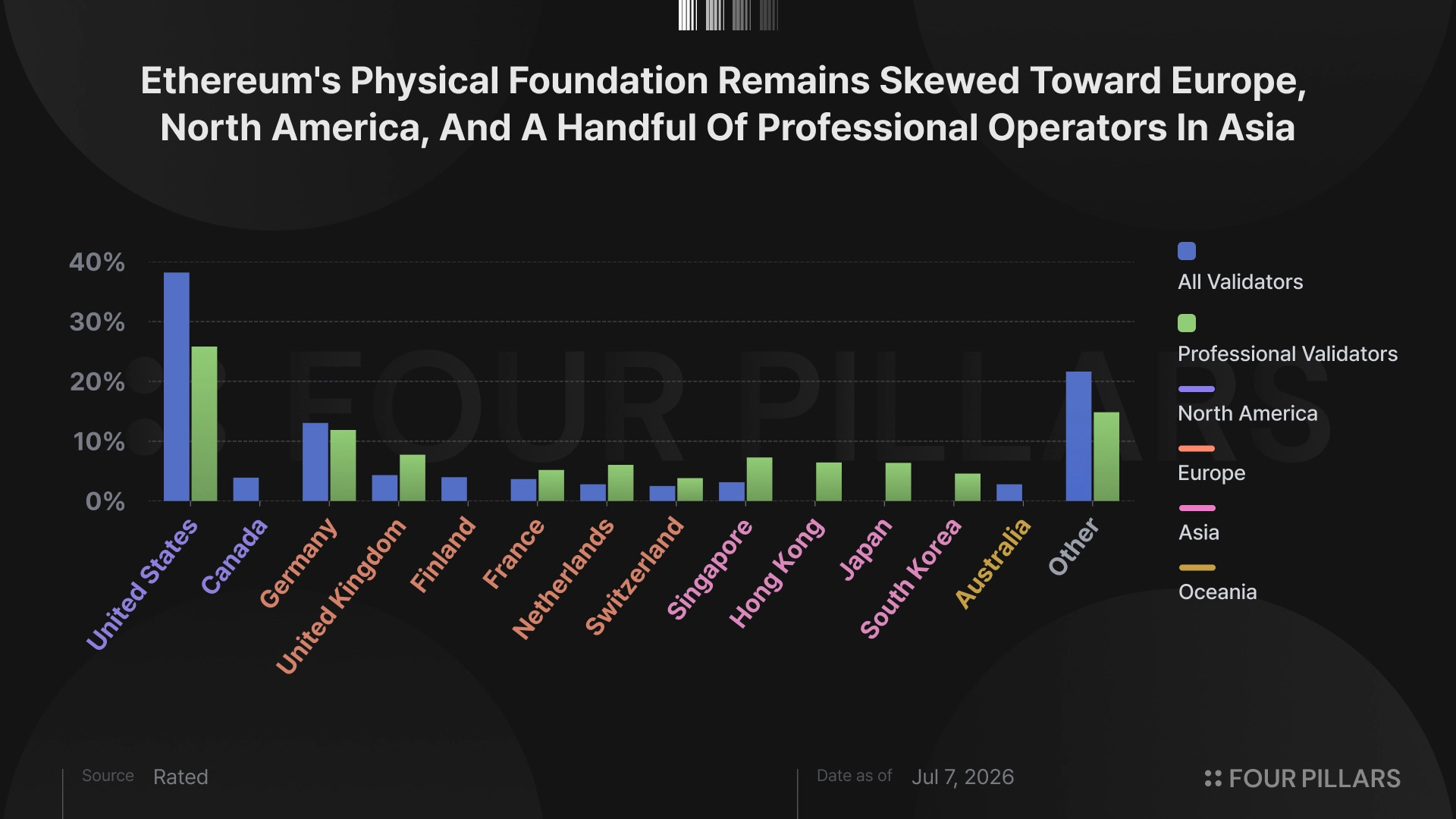
When the full validator set is counted, including home operators and institutions, the United States holds 38.19% and Germany 13.04%. Together, they make up more than half of the network. Among the top 10 countries, Singapore is the only Asian market listed, with a 3.15% share.
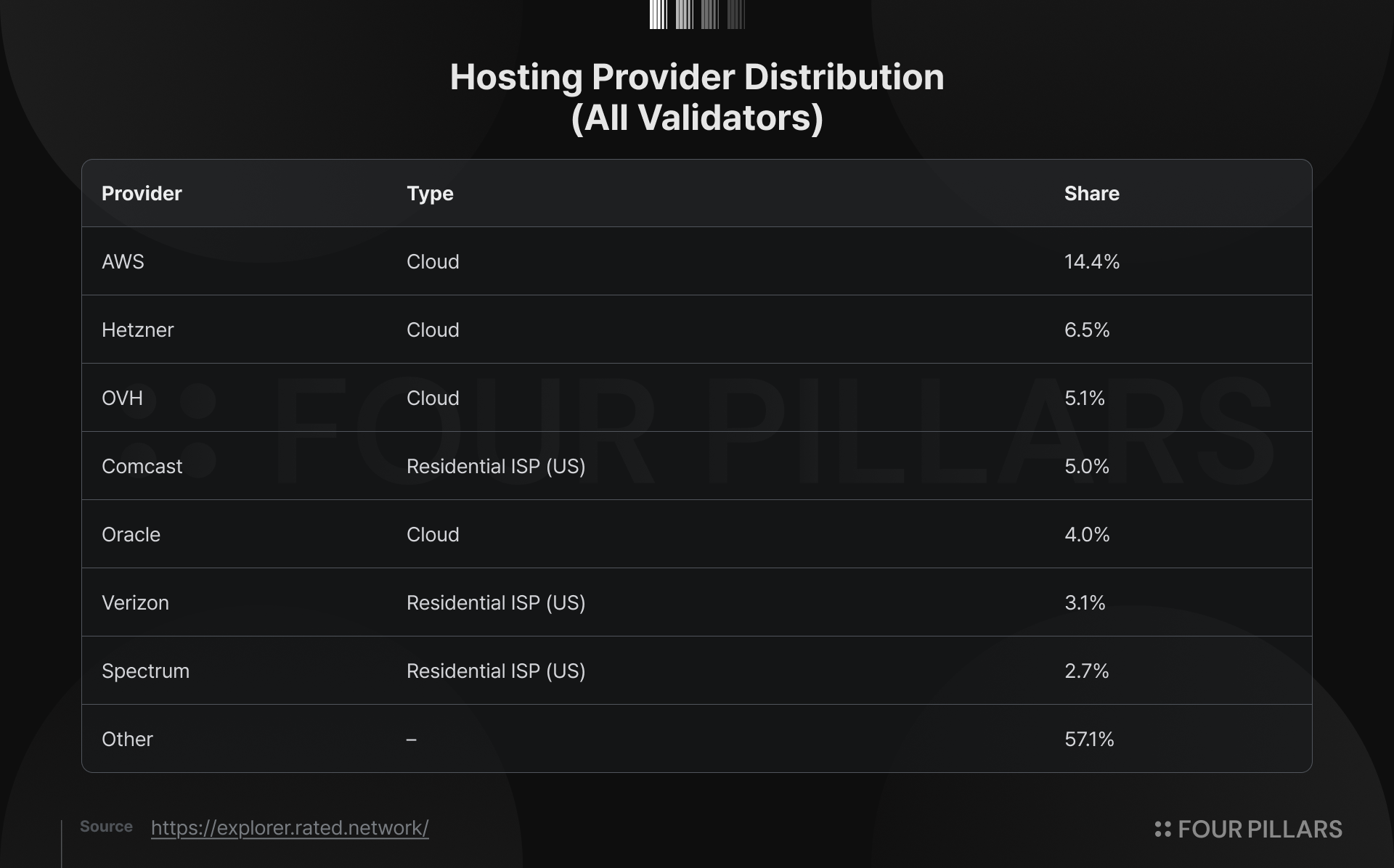
Finland, at 3.98%, and Canada, at 3.9%, also rank near the top. The report ties that presence to cloud infrastructure rather than purely local adoption. Germany and Finland host regions for European cloud provider Hetzner, while Canada hosts a major OVH region. Based on hosting distribution, Hetzner carries about 6.5% of validators and OVH 5.1%.
The report also highlights the role of U.S. residential internet providers. Comcast accounts for 5%, Verizon 3.1%, and Spectrum 2.7%. That suggests more than 10% of validators are running on home broadband in the U.S., not in professional data centers.
Why the network clusters in a few regions
The analysis points to cost, convenience, and infrastructure. Cloud services are mature in the U.S. and Europe, power is cheaper, and the legal environment is described as relatively friendly, making it easier for individuals and small teams to run nodes. In many parts of Asia, by contrast, server costs, cross-border compliance, and network stability remain constraints.
Home-based nodes add diversity, but they also bring uptime risk. A local internet outage can hurt validator performance.
Institutional validators are spread more evenly, with Asia catching up
The distribution looks different when home-based operators are removed and only professional validator operators are counted. The U.S. share drops to 25.81%. Singapore rises to 7.28%, Hong Kong to 6.44%, Japan to 6.38%, and South Korea to 4.59%. Combined, those four Asian markets account for about 24.7%, close to the U.S. level.
The report says this points to a more balanced geographic layout in institutional-grade infrastructure. Even though the U.S. and Europe still offer strong economics for deployment, firms continue to place nodes in Asia for two main reasons:
- to meet jurisdictional requirements from institutional clients, including Asian funds, family offices, and listed companies that want custody and staking in local or compliant jurisdictions;
- to reduce latency for applications and trading activity serving Asian users, which can improve user experience and confirmation speed.
In that reading, deployment in Asia is not a fallback choice. It is a deliberate strategy.
P2P design may create regional blind spots
South America, the Middle East, and Africa are largely absent from the top 10 country list. The report singles out the Middle East. It says the region, with the United Arab Emirates at the center, is building out regulatory frameworks quickly and attracting exchanges, funds, and custody businesses, yet still sits on the edge of Ethereum’s physical infrastructure map.
According to the analysis, Ethereum’s consensus-layer P2P propagation model structurally disadvantages regions with low node density. The network uses protocols such as gossipsub to spread blocks and attestations across a mesh of peers, and each node’s peer score affects how central it is inside that propagation network.
In sparse regions, messages tend to arrive later. Later delivery can reduce peer scores; lower scores can push a node toward the mesh edge; and edge placement can make future messages arrive even later. The report says this loop can make validators in those regions more likely to miss proposal or attestation deadlines, which can hurt staking returns and, in extreme cases, affect finality.
Growing U.S. staking scale could widen the gap
The report says the current direction is not encouraging. Large U.S. staking companies and staking ETFs are still expanding, and new staking capital is continuing to concentrate in the U.S. That, it argues, could widen regional disparities further.
The issue is framed as more than a technical one. If the network cannot serve global users equally at the physical layer, then its claims of censorship resistance and global accessibility are weakened. Regional outages or regulatory intervention could also hit users in sparse-node regions harder.
Underrepresented regions may become the next infrastructure opening
The same imbalance could create an opening. If Ethereum is to become a global settlement layer and a true “world computer,” institutions in more regions will need localized staking infrastructure. The report argues that operators who build reliable validator capacity first in the Middle East, South America, or Africa may gain an early edge in serving local institutions.
It gives the example of large funds in the UAE or Saudi Arabia seeking compliant staking. In that case, providers able to meet local regulatory needs, data sovereignty requirements, and low-latency performance could stand out from the field. The report adds that Asia has already shown how demand can drive local validator deployment, and says similar patterns may emerge in other regions.