
Ether.fi’s consumer finance push has reached a new scale, but the token has not kept pace. A report by Alea Research, cited in a MarsBit article translated by TechFlow, said Ether.fi Cash monthly spending volume rose from $54.3 million in January to $100.3 million in July, up 85%. Over the same period, ETHFI rebounded 45% between Aug. 13 and Aug. 30 to $0.55, yet it was still down 21% from Jan. 1.
The market’s immediate focus is a foundation proposal published on Aug. 30. The vote closes on Sept. 3. If passed, contributions from card, swap and staking revenue would be used to fund weekly ETHFI purchases through CoW Swap. Using July data as an illustration, the proposal points to $1.33 million a month, or about $16 million annualized, though that figure still awaits approval and does not deduct reward distribution.
Ether.fi’s account model
Ether.fi wants users to manage funds through a self-custodial account. In May 2024, it laid out a model that combines staking, liquidity and cash management. The account now bundles four functions.
- Save and earn: users hold assets in a self-custodial vault and can access staking and investment strategies.
- Spend and transfer: users pay through Cash and move funds through fiat and crypto rails.
- Trade: the app supports crypto, tokenized stocks and metals, depending on local availability.
- Borrow: users can access liquidity against eligible collateral through a dedicated Aave market.
Ether.fi also offers business accounts for treasury management and employee cards. Its user interface integrates services built partly on partner infrastructure, including Aave lending and card payment rails. The article argues that this vertical integration, and the way each piece feeds into the next, gives Ether.fi a strategic edge.
The idea is to tie investing and everyday spending into one account structure. Yield-bearing assets can support collateralized borrowing, and borrowed funds can then be used for Cash spending without forcing users to sell assets. That setup generates fee revenue and reduces the need to move funds to other providers. Membership benefits also encourage users to stake ETHFI, which extends staking-based utility across several business lines.
Cash spending nearly doubled in seven months
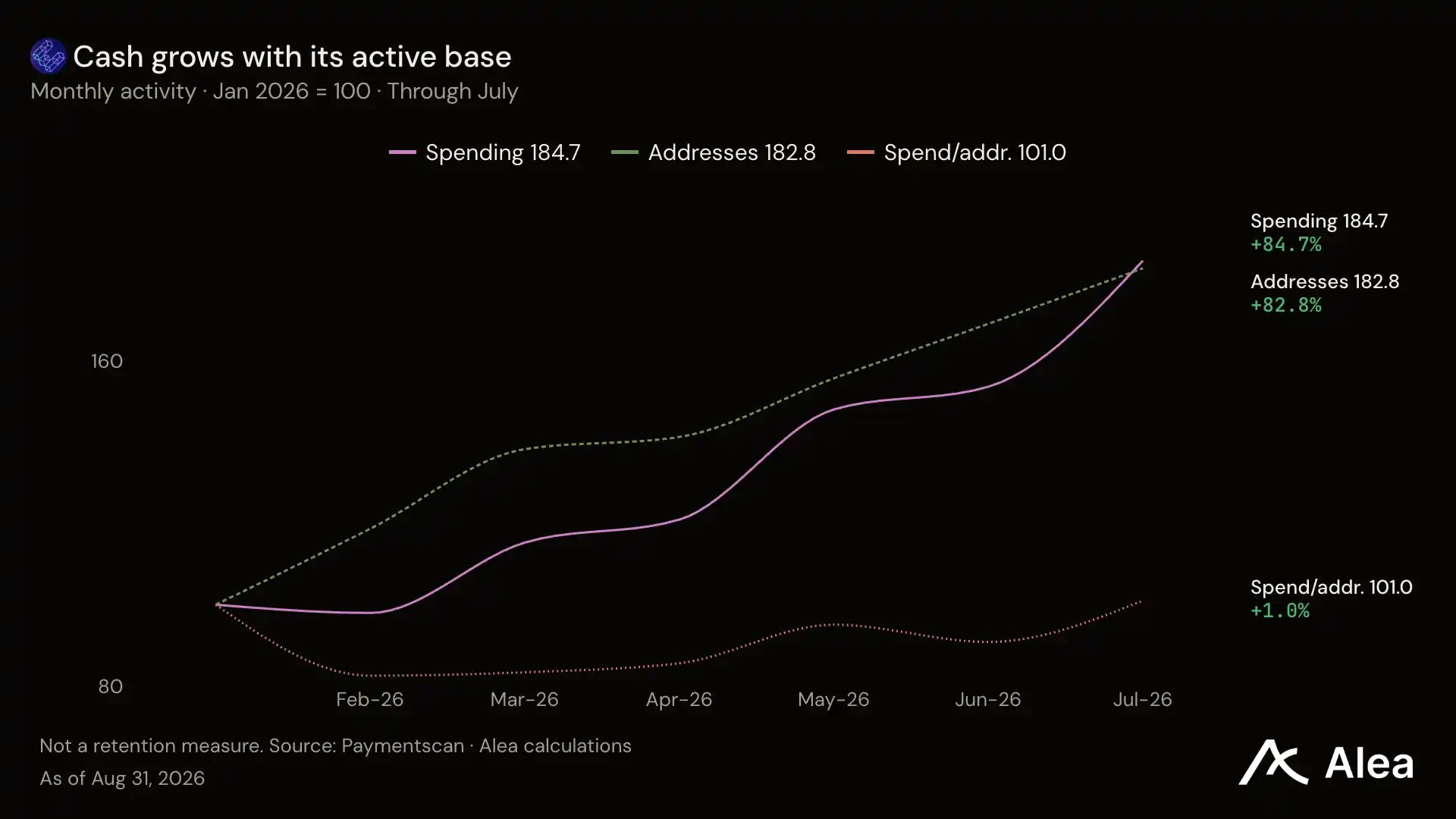
Paymentscan data cited in the article shows Ether.fi Cash monthly spending at $54.3 million in January and $100.3 million in July, an 85% increase.
Monthly active addresses rose from 21,898 to 40,040, up 83%. Spend per address was largely unchanged, moving from about $2,479 to $2,505. Monthly transactions per address fell 22%, while average ticket size increased 29%. That suggests most of the spending growth came from a larger active user base rather than heavier spending by each address.
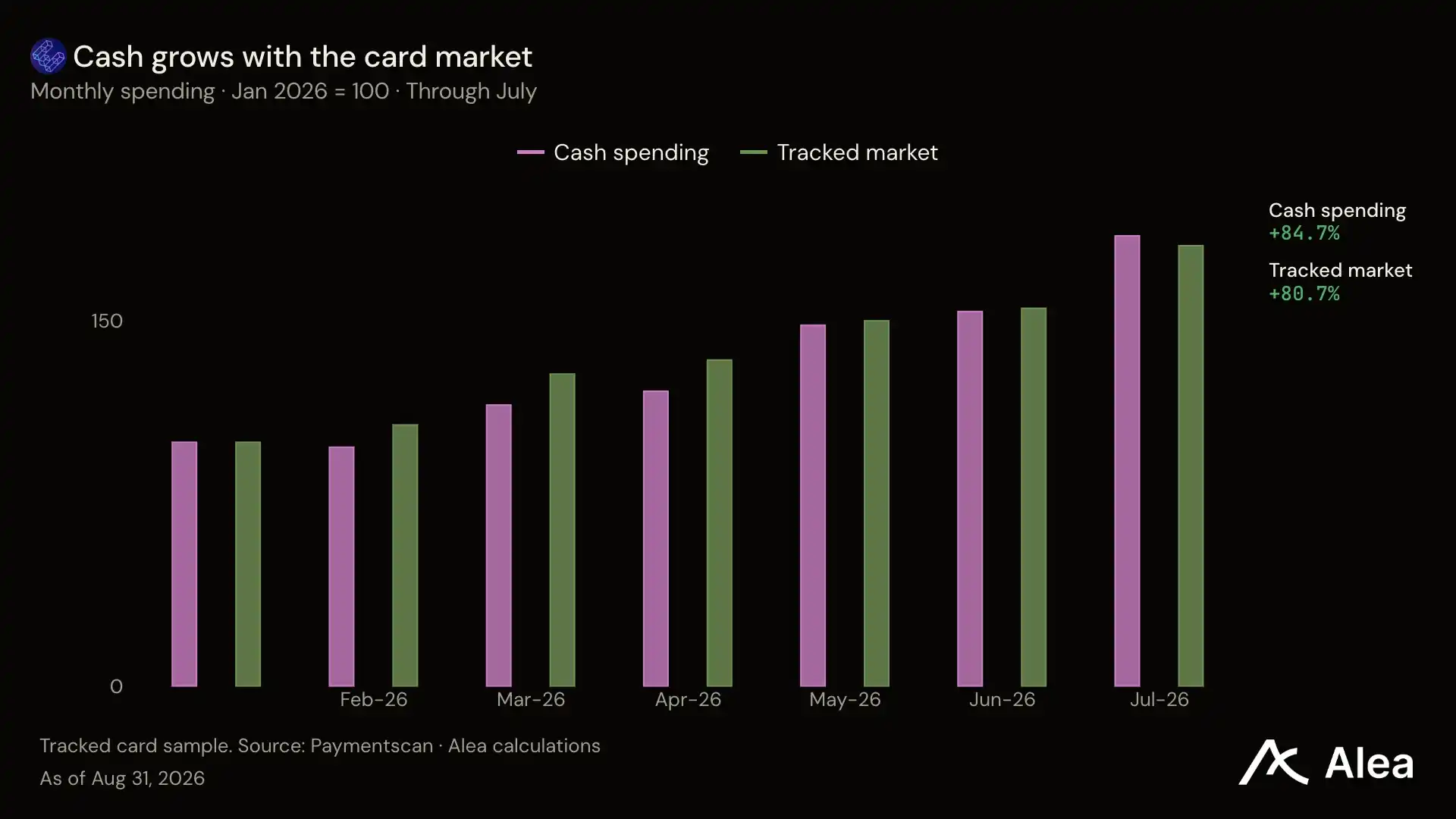
During the same period, the broader tracked market expanded 81%. Cash’s share moved from 9.5% to 9.7%, a relative increase of 2%. In other words, Cash broadly kept pace with a category that was already growing quickly. Paymentscan said its coverage includes self-reported offchain data, and the sample excludes parts of the card market.
The article lists several competitors. Nexo already combines borrowing and spending. KAST ties cards, accounts and yield together. Gnosis Pay supports self-custodial spending. RedotPay leads current transaction volume rankings tracked by Paymentscan. The opening for Ether.fi, according to the piece, lies in cross-service convenience, with repeat usage and contribution margin after rewards determining how durable that advantage is.
How the business makes money
The article breaks Ether.fi revenue into four lines. Cash monetizes spending through card fees. Earn charges staking and vault fees. Trading adds transaction fees. Borrowing contributes a share of retained fees from the lending market.
DefiLlama has published an adapter that estimates Cash revenue at 1.38% of spending volume. On that basis, every $1 billion in annual transaction volume would imply $13.8 million in revenue before company costs.
The revenue split for borrowing was disclosed in an Aave proposal dated July 14. Ether.fi receives 80% of protocol fees from the instance, while Aave receives 20%. That split excludes loan principal and interest paid to lenders. Ether.fi is responsible for operating costs and risk management.
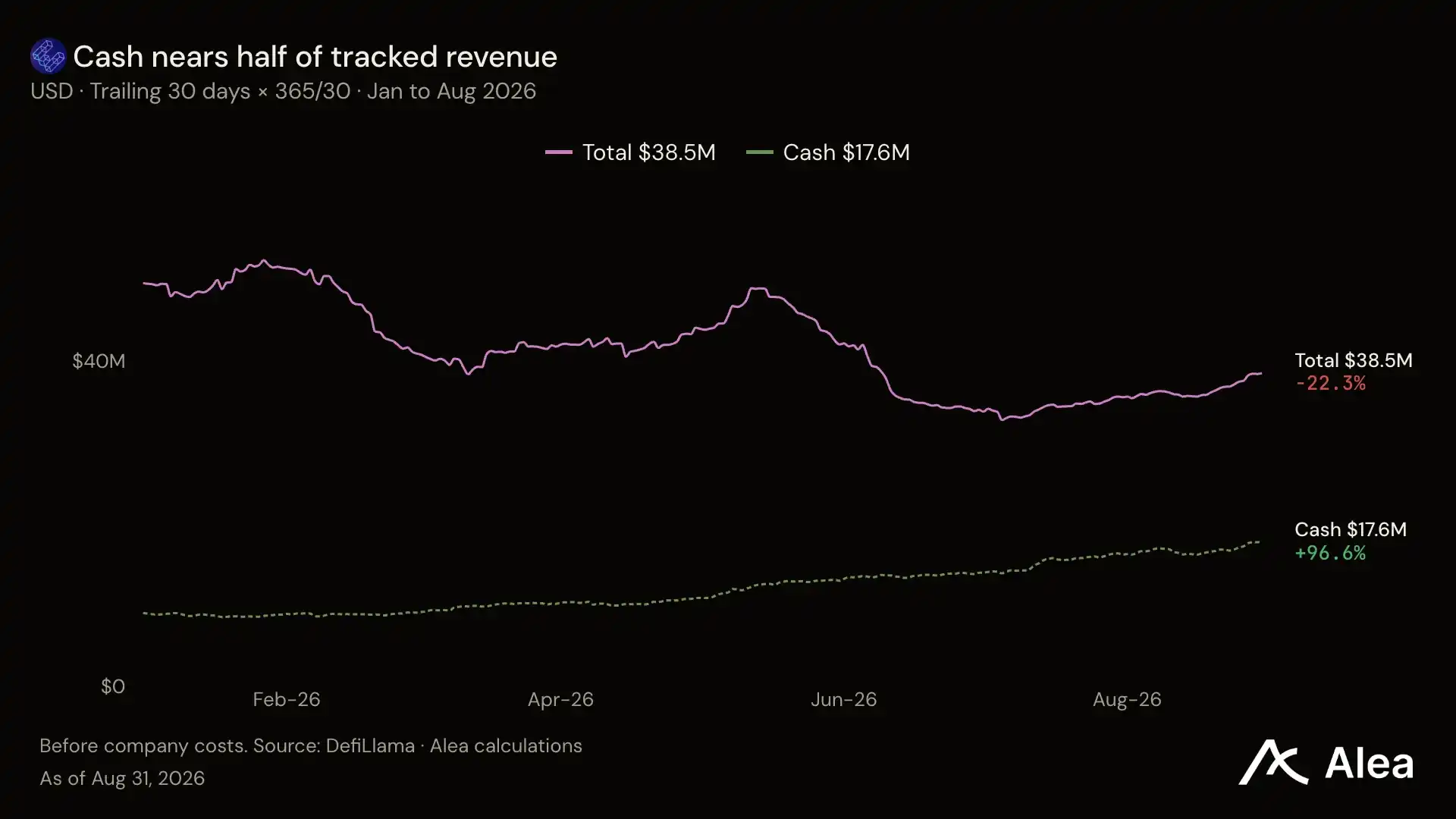
Across the four business lines tracked by DefiLlama, rolling 30-day annualized revenue totaled $38.5 million as of Aug. 30, with $17.6 million coming from Cash. Cash’s annualized run rate has almost doubled since Jan. 1, while tracked total revenue fell 22% because staking weakened and the price of ETH declined.
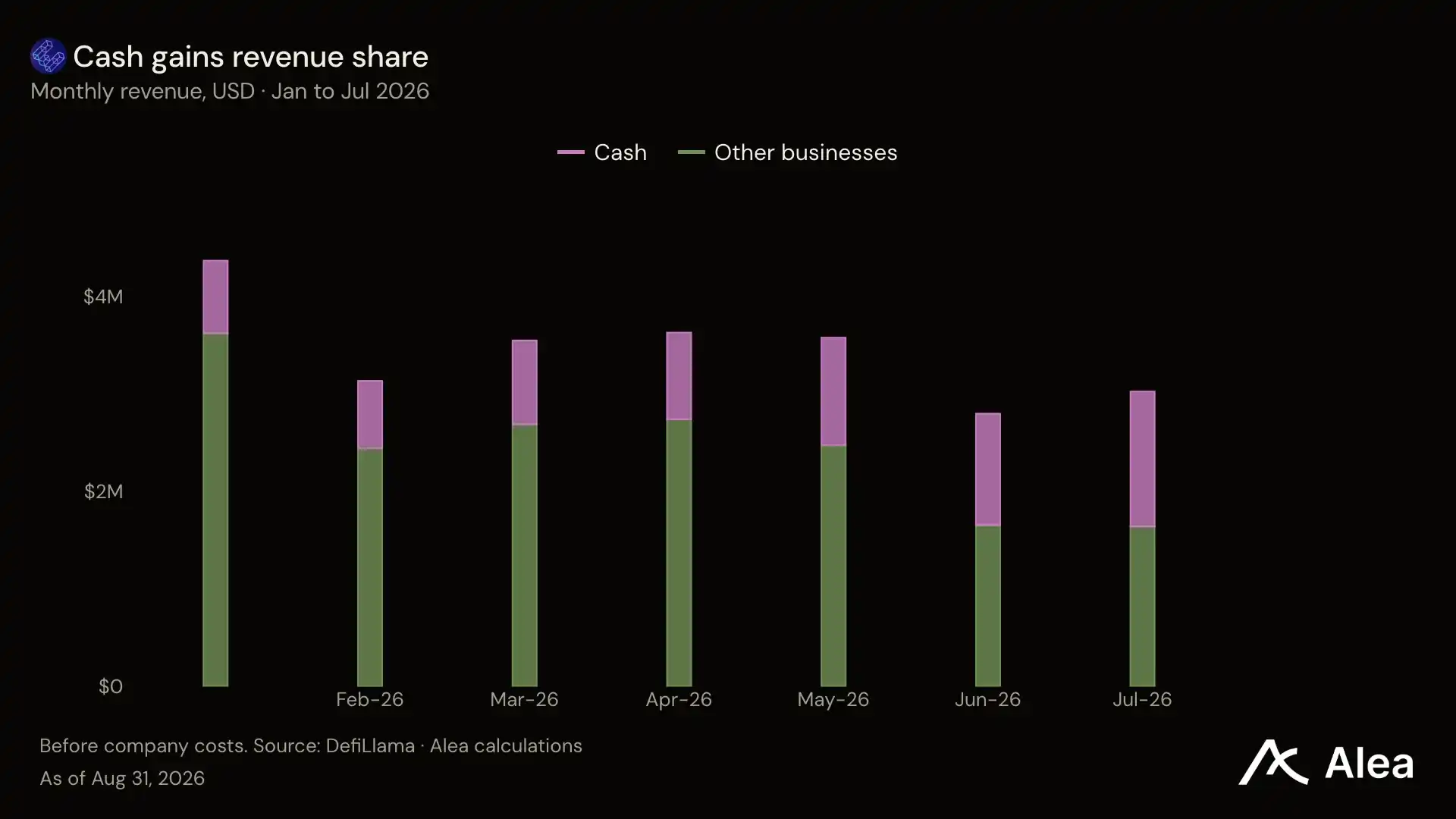
That shift has made Cash a much bigger part of the mix. Its share of monthly revenue rose from 17% in January to 46% in July. As total revenue narrowed, Cash took a larger role and helped diversify the income base away from weaker staking activity.
What changed on Aug. 13
Ether.fi’s summer release on Aug. 13 added trading in tokenized stocks and metals, along with an integrated Aave market. The redesigned app also introduced more than 30 currencies and payment methods. Those additions went live for both new and existing users on the day of release.
In that update, management said the platform had more than 500,000 members and an annual transaction run rate of $2 billion.
How fees could flow into ETHFI buybacks
The foundation published its proposal on Aug. 30, with voting set to close on Sept. 3. If approved, contributions from card, swap and staking revenue would fund weekly ETHFI purchases through CoW Swap.
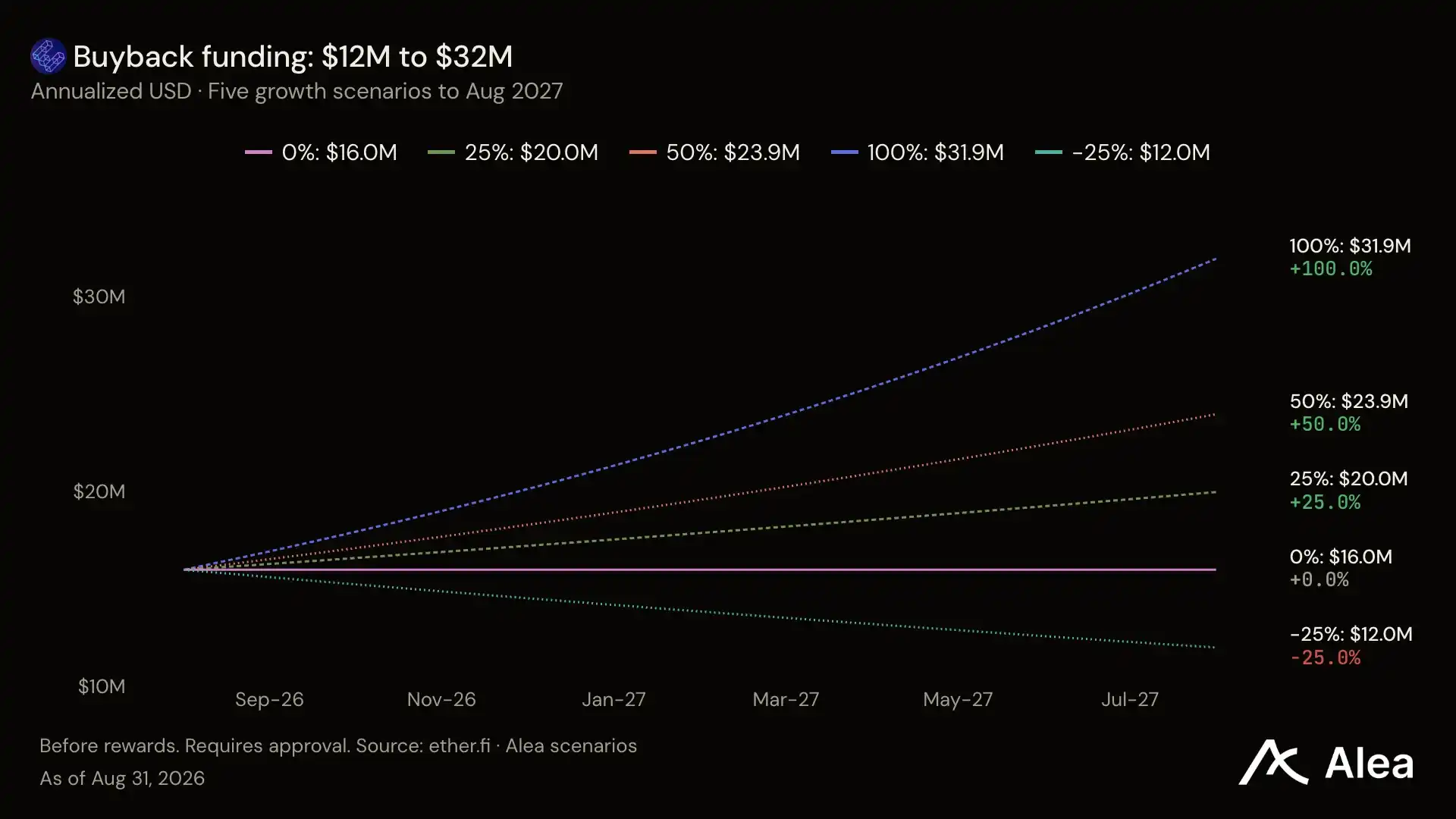
The mechanics are laid out in steps. Labs would first collect fiat card fees and convert them into USDC. It would then move the contribution onchain for the foundation to execute purchases. Using July as the example month, the foundation put the figure at $1.33 million, implying about $16 million annualized, pending approval and implementation.
The article gives one swap example. A $10,000 trade charged at a 0.5% fee generates $50 in fees. Labs keeps $20. The remaining $30 is used to buy ETHFI, with $15 retained in the foundation treasury and $15 allocated as user rewards.
The proposal also authorizes the use of up to 20 million ETHFI from the treasury to cover reward shortfalls. The foundation would be able to adjust rewards and fee splits or change the purchase cadence. The article notes that if contributions grow, buying capacity rises before reward distribution is applied.
Its sensitivity example shows that a 25% contraction would reduce the annualized funding anchor to $12 million, while 50% growth would lift it to $24 million. With the token price held constant at $0.55, $16 million would buy about 29 million ETHFI. A higher token price would reduce the number of tokens purchased.
Cash growth has not translated into price recovery
The article highlights a divergence between operating traction and token price. ETHFI climbed 45% from Aug. 13 to Aug. 30 and reached $0.55, but it was still down 21% compared with Jan. 1.
Price had moved back above its 30-day and 90-day moving averages, according to the piece, yet the August rebound still left the token below its starting point for the year.
Using a fixed maximum supply of 1 billion tokens, a price of $0.55 implies a reference valuation of $545 million. At that level, ETHFI trades at 14.2x tracked annualized revenue and 3.6x gross fees. The article notes that gross fees include staking rewards and card cashback, which do not accrue to ETHFI holders.
The proposed $16 million annual funding anchor equals 2.9% of that $545 million reference valuation before reward distribution. If contributions grow 50% and price stays unchanged, that ratio would rise to 4.4%. The article adds that these ratios measure gross funding capacity, and ETHFI holders do not have an equity claim on Labs.
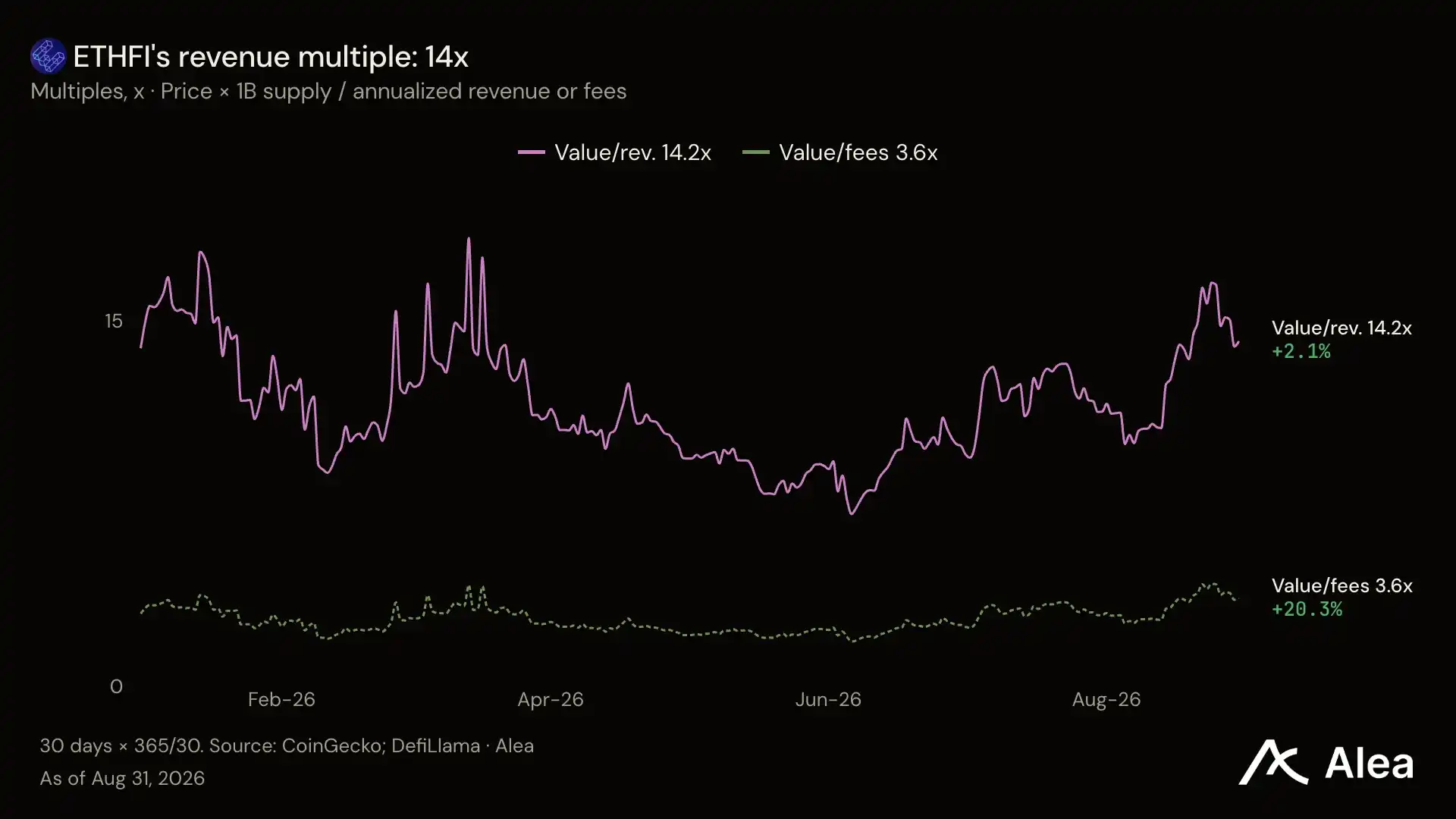
It also offers a valuation scenario: at a 10x revenue multiple, maintaining a $545 million valuation would require $54.5 million in annual revenue, 42% above the current run rate.
Sept. 3 vote remains the key near-term event
The vote ends on Sept. 3. As of Aug. 31, voting power stood at about 245,800 ETHFI, or roughly 25% of the 1 million-token quorum requirement.
The article also flags another number to watch before the deadline: borrowing has joined the funding pool at a size of $50 million, while the proposal cites $26 million.
For Ether.fi, Cash has become one of the fastest-growing parts of the business. The buyback proposal is an attempt to connect that fee stream more directly to ETHFI. Whether that results in sustained market demand still depends first on the vote itself, and then on contribution growth, reward allocation and the pace of execution.