

MiCA moves into enforcement after the CASP transition period ends
The transition period for Crypto-Asset Service Providers under the European Union’s Markets in Crypto-Assets Regulation, or MiCA, ended on July 1. As described in the article, crypto asset trading platforms that have not obtained CASP authorization are, in principle, no longer allowed to continue serving users in the EU.

The piece describes the date as a dividing line for the industry. MiCA’s framework for crypto-asset service providers had already become applicable by the end of 2024, but the market spent the following year and more working through transition arrangements, license applications, and business restructuring. With the transition now over, the rules have entered the execution stage.
MiCA is the EU’s unified regulatory framework for crypto assets across its 27 member states. It covers issuance, trading, custody, exchange, order execution, transfers, and related services. The framework is aimed at two broad groups: issuers of crypto assets, especially asset-referenced tokens, or ARTs, and electronic money tokens, or EMTs; and crypto-asset service providers, known as CASPs.
The article focuses on CASPs rather than issuer rules.
CASP authorization is service-based, not a universal exchange license
MiCA’s CASP regime looks at what services a platform provides to clients, including trading, custody, exchange, order execution, investment advice, portfolio management, and transfer services. Regulatory requirements center on capital, governance, risk controls, client asset protection, disclosure, and operating compliance.
A key point in the article is that CASP authorization is not a one-size-fits-all exchange permit. Holding a CASP authorization does not automatically mean a company can operate a trading platform. What a platform can legally do depends on the specific service codes it applied for and received.
The article says 279 entities currently hold MiCA CASP authorization. Of those, about 222 can provide trading-related services such as exchange or order execution. Only 18, however, hold the b-type authorization that specifically permits operation of a crypto-asset trading platform.
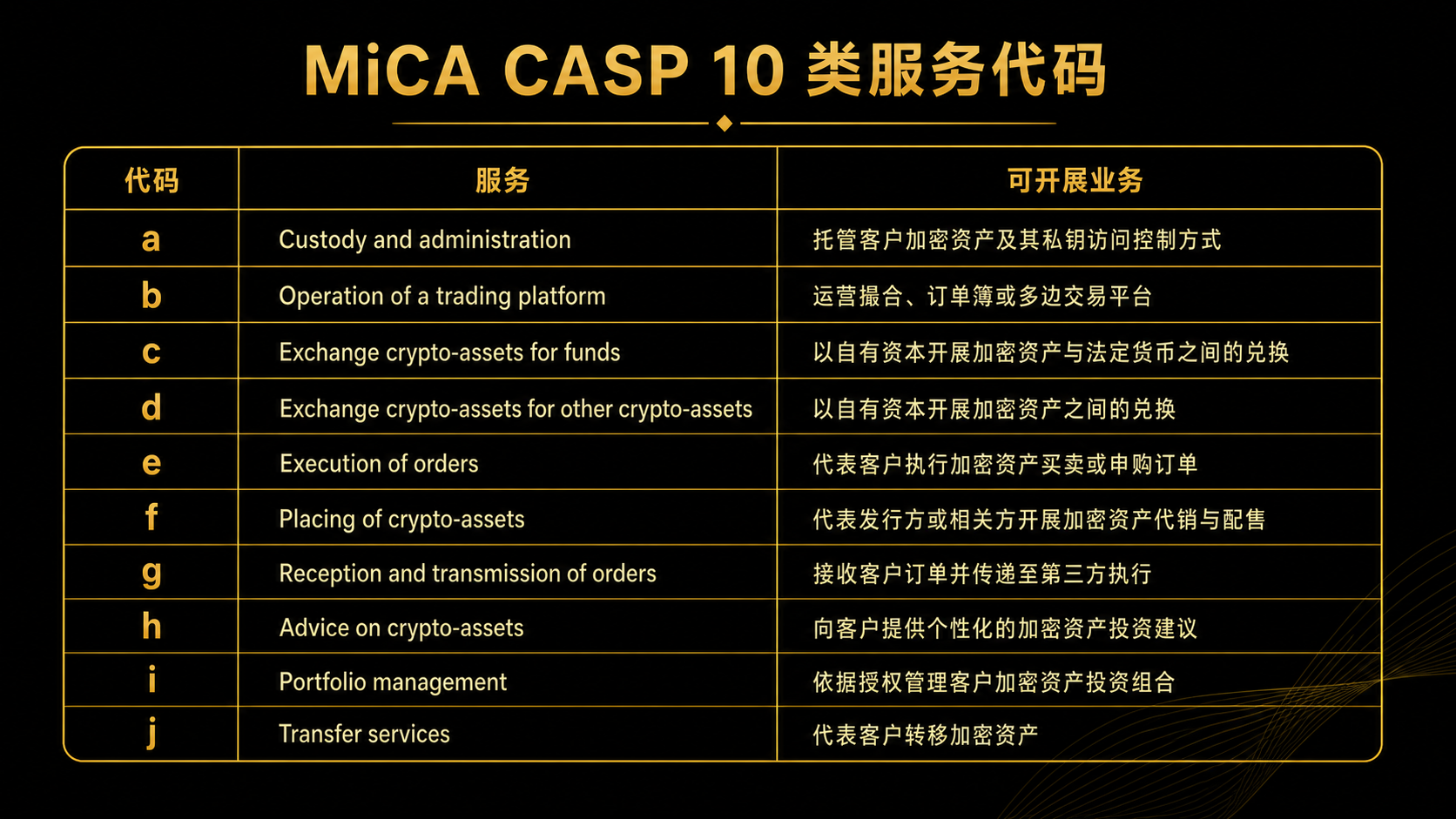
The 10 MiCA CASP service codes
MiCA divides CASP activities into 10 service codes, from a to j.
- a: custody and administration of crypto-assets on behalf of clients
- b: operation of a trading platform for crypto-assets
- c: exchange of crypto-assets for funds
- d: exchange of crypto-assets for other crypto-assets
- e: execution of orders on behalf of clients
- f: placing of crypto-assets
- g: reception and transmission of orders for crypto-assets on behalf of clients
- h: advice on crypto-assets
- i: portfolio management on crypto-assets
- j: transfer services for crypto-assets on behalf of clients
The article notes that the b category is the one most closely aligned with what the market typically thinks of as exchange business, because it covers operation of an order book, matching engine, or multilateral trading system where multiple buyers and sellers trade under platform rules.
Class 1, Class 2, and Class 3 refer to capital thresholds
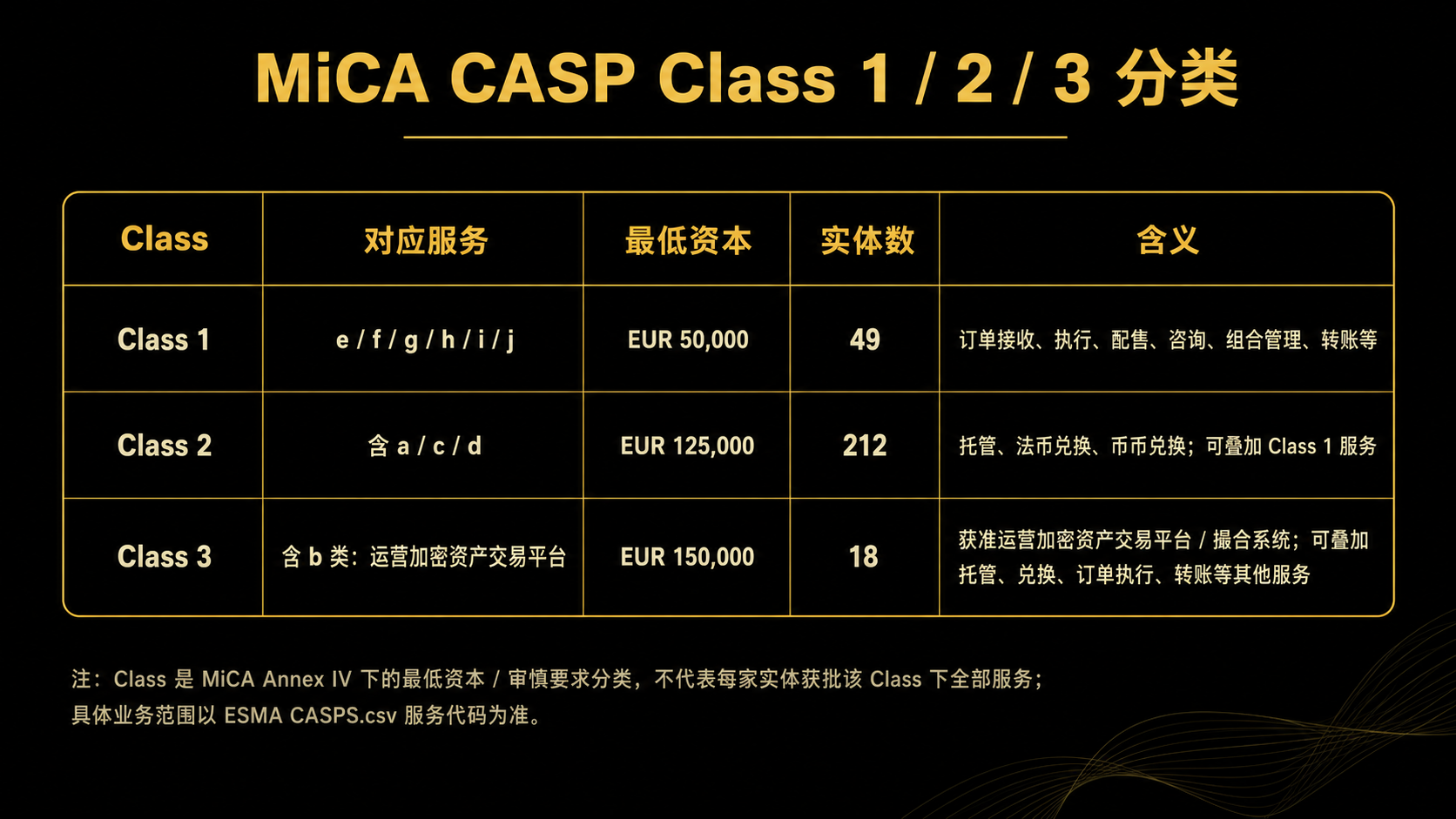
Separate from the service codes, MiCA Annex IV groups firms into Class 1, Class 2, and Class 3 based on minimum capital requirements.
Class 1 covers services e, f, g, h, i, and j, with a minimum capital requirement of €50,000. Class 2 adds a, c, and d, bringing custody plus fiat and crypto exchange activities into scope, with a minimum requirement of €125,000. Class 3 includes the b trading platform authorization, either on its own or layered onto some or all of the Class 2 services, and carries a minimum capital requirement of €150,000.
In the article’s framing, service codes show what a firm is allowed to do. The class level shows the minimum capital tied to the risk and complexity of those activities.
ESMA register: 18 entities with b-type trading platform authorization
Based on ESMA’s update dated July 3, 2026, the article lists 18 entities that have Class 3 authorization including the b service code for operating a trading platform.
- OKX, through Malta entity OKX Europe Limited, authorized on Jan. 27, 2025, with codes a, b, c, d, e, f, g, i, j.
- Gate.io EU, through Malta entity Gate Technology Limited, authorized on Sept. 29, 2025, with codes a, b, c, d, e, j.
- Kraken, through Irish entity Payward Global Solutions Limited, authorized on June 25, 2025, with code b.
- BSDex, through German entity Baden-Württembergische Wertpapierbörse GmbH, authorized on July 3, 2025, with code b.
- flatexDEGIRO / 360T, through German entity 360 Treasury Systems AG, authorized on April 2, 2025, with code b.
- PAYMIUM, through French entity PAYMIUM SAS, authorized on June 22, 2026, with codes a, b, c, d, e, j.
- Coinmate, through Czech entity COINMATE a.s., authorized on Feb. 27, 2026, with codes a, b, c, d, j.
- Webot, through Irish entity Pionew Ireland Limited, authorized on Dec. 18, 2025, with codes a, b, c, j.
- RULEMATCH, through Liechtenstein entity RULEMATCH Europe AG, authorized on June 1, 2026, with codes a, b, j.
- Bitstamp, through Luxembourg entity Bitstamp Europe S.A., authorized on May 15, 2025, with codes a, b, c, d, e, g, j.
- Kanga Exchange EU, through Latvian entity SIA AlphaRoute, authorized on June 18, 2026, with codes a, b, c, d, f, j.
- Anycoin, through Czech entity MP Developers s.r.o., authorized on Feb. 11, 2026, with codes a, b, c, d, e.
- Revolut Crypto, through Cyprus entity Revolut Digital Assets (Europe) Ltd, authorized on Oct. 20, 2025, with codes a, b, c, d, f, j.
- ZBX, through Malta entity Zillion Bits Limited, authorized on Feb. 6, 2025, with codes a, b, c, d, e, f, g, j.
- Bitvavo, through Dutch entity Bitvavo B.V., authorized on June 26, 2025, with codes a, b, j.
- One Trading, through Dutch entity One Trading Exchange B.V., authorized on May 15, 2025, with codes a, b.
- zerohash Europe, through Dutch entity zerohash europe B.V., authorized on Oct. 29, 2025, with codes a, b, c, d, j.
- FIRI AS, through Norwegian entity FIRI AS, authorized on May 22, 2026, with codes a, b, c, d, e, j.
Most major platforms in the article appear under Class 2
The article says that, outside Class 1, most authorized entities fall into Class 2, while only a smaller group are in Class 3. Class 2 can include custody, fiat exchange, crypto-to-crypto exchange, order execution, placement, order transmission, investment advice, portfolio management, and transfers, but it does not include the b trading platform authorization.
The article lists a number of major platforms under Class 2:
- Coinbase, through Coinbase Luxembourg S.A., authorized on June 20, 2025, with codes a, c, d, e, f, g, j.
- Kraken, through Payward Europe Solutions Limited in Ireland, authorized on June 25, 2025, with codes a, c, d, e, f, g, i, j.
- Bybit EU, through Bybit EU GmbH in Austria, authorized on May 28, 2025, with codes a, c, d, f, j.
- Crypto.com, through Foris DAX MT Limited in Malta, authorized on Jan. 27, 2025, with codes a, c, d, e, g, j.
- Gemini, through Gemini Intergalactic EU Ltd in Malta, authorized on Aug. 21, 2025, with codes a, c, d, e, f, g, j.
- Bitpanda has two entities: Bitpanda GmbH in Austria, authorized on April 9, 2025, with codes a, c, d, e, f, g, j; and BP23 CA Limited in Malta, authorized on Jan. 27, 2025, with codes a, c, d, e, g, j.
- KuCoin EU, through KuCoin EU Exchange GmbH in Austria, authorized on Nov. 27, 2025, with codes a, c, d, f, j.
- Blockchain.com, through Blue Cube (Malta) Limited, authorized on Oct. 22, 2025, with codes a, c, d, e, j.
- eToro Crypto, through eToro (Europe) Ltd in Cyprus, authorized on Jan. 16, 2025, with codes a, c, e, g, h, i, j.
- Robinhood Europe, through Robinhood Europe UAB in Lithuania, authorized on May 29, 2025, with codes a, e, g, j.
- Bullish Europe, through Bullish Europe GmbH in Germany, authorized on Sept. 4, 2025, with codes a, c, d, e, j.
- Backpack EU, through Latvian entity “Trek Technologies” SIA, authorized on May 27, 2026, with codes a, c, d, e, j.
- Strike Europe, through Zap (Strike) Europe Limited in Malta, authorized on June 25, 2026, with codes a, c, e, j.
- FalconX, through FalconX Limited in Malta, authorized on June 26, 2026, with codes a, c, d, e, j.
- APLO, through APLO SAS in France, authorized on June 30, 2026, with codes a, c, d, e, j.
- MoonPay, through MoonPay Europe B.V. in the Netherlands, authorized on Dec. 30, 2024, with codes c, d, j.
The article specifically says that platforms such as Coinbase, Bybit, Crypto.com, Gemini, KuCoin, Robinhood Europe, and eToro Crypto are already inside the MiCA CASP authorization system, but they appear mainly as Class 2 rather than as Class 3 entities holding b-type trading platform permission.
Platforms the article says are not yet visible on the ESMA CASP authorization table
The article also names a group of major global crypto platforms for which it says no clear corresponding MiCA CASP authorization entity is currently visible on the ESMA table. That list includes Binance, Bitget, MEXC, HTX / Huobi, Upbit, Nexo, Deribit, Bitfinex, Poloniex, Phemex, BingX, BitMart, LBank, and CoinEx.
It adds that, as MiCA implementation advances and platforms continue adjusting their European compliance structures, more entities may later complete the authorization process and enter the register.